Donation Programme
Never Let Me GoThe Donation Programme organizes the students’ lives around the provision of organs for medical treatment, carrying them from caring for other donors to making donations themselves and, ultimately, Completion. Its decisive injustice is not only that the students are expected to give their bodies, but that society’s dependence on this system coexists with efforts to regard them as less than fully human. Hailsham offers a more humane upbringing and a public argument for their humanity, yet even its advocates cannot change the programme’s central demand or grant the students a reprieve.
Purpose and Historical Foundations
Miss Emily explains that the programme arose from the rapid scientific breakthroughs of the early 1950s, when medicine acquired ways to treat conditions that had previously been incurable. The wider public wanted these cures, while the origins of the organs were pushed out of view: people preferred to imagine that they appeared from nowhere or grew in a vacuum. By the time the conditions in which students were raised became a public concern, society had already become dependent on the medical benefits. In Miss Emily’s account, there was no going back, because people would not surrender treatments they believed could save their children, spouses, parents, and friends from cancer, motor neurone disease, and heart disease.
That dependence produced a moral and political barrier. As long as the world required students to donate, it had an interest in treating them as fundamentally unlike ordinary people. The students were kept in the shadows, and people who did think about them could persuade themselves that they were less than human, making their exploitation easier to accept. The programme thus rests on a contradiction: its medical purpose is widely valued, while the humanity of the people who supply its means is obscured.
Hailsham and the Reform Movement
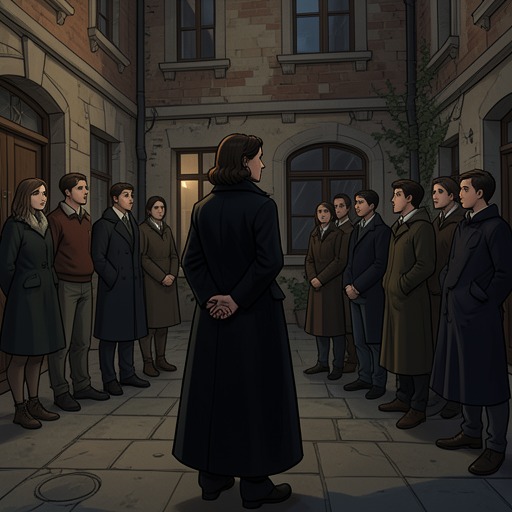
Hailsham belonged to a small movement that challenged how the Donation Programme was run. Along with Glenmorgan House and, later, the Saunders Trust, it argued that students raised in humane and cultivated surroundings could become as sensitive and intelligent as ordinary human beings. Hailsham’s collection of student art served as public evidence for that claim. The best work was selected for special exhibitions, where visitors could be asked to see the students’ creativity as proof of their humanity rather than to treat them as anonymous sources of medical material.
At the movement’s height in the late 1970s, its organizers held large events around the country, attracting cabinet ministers, bishops, and other prominent guests; speeches were made and substantial funds pledged. The effort won improvements for a select group of students, including the protected surroundings and education associated with Hailsham. It did not overturn the Donation Programme, however, or give students control over whether they would donate. Miss Emily is explicit that even when the movement was most influential, it could not have granted the deferrals that Kathy and Tommy hoped for.
The movement’s gains were also vulnerable to changes in public opinion. The Morningdale scandal, involving a scientist whose research pursued the possibility of children with enhanced characteristics and went far beyond legal boundaries, helped create a climate in which support for the movement receded. Hailsham, Glenmorgan House, and the Saunders Trust were swept away. The students’ lives were therefore shaped not only by the continuing medical system but by the rise and collapse of a limited campaign to make that system more humane.
The Students’ Course Through the Programme
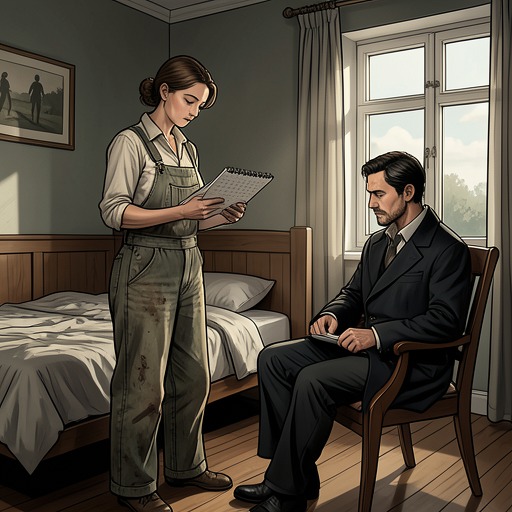
The programme’s stages become visible through the roles the students occupy. Carers look after donors, while donors undergo successive operations. Kathy H. describes more than eleven years as a carer, with another eight months expected before she would reach almost exactly twelve years. For the last six years of that work, she had been allowed to choose whom she cared for. She says that the work wears carers down and that continued closeness to donors requires emotional patience as well as practical attention. Her account gives the system a daily texture: a carer must judge when to stay and comfort a donor, when to leave them alone, and how to respond to distress.
That care can create intensely personal ties, but it does not alter the donor’s assigned course. Kathy becomes Ruth’s carer after Ruth has already entered the programme as a donor; their shared memories of Hailsham make their renewed connection possible without changing what lies ahead. Ruth says that five years as a carer felt like enough and that she was ready to become a donor, describing donation as what they were supposed to do. Her acceptance reflects the language through which the students learn to understand their expected role, not evidence that the system offers them an alternative.
The successive donations carry uncertainty as well as expectation. Ruth tells Kathy and Tommy that she has heard Chrissie completed during her second donation, and suspects that such outcomes happen more often than donors are told. Tommy, approaching his fourth donation, worries that nobody can say for certain whether a donor will Complete. He has heard frightening speculation that a person might remain conscious after the fourth donation and then face further donations without recovery centres, carers, or friends. The novel presents this as rumor and fear, not as a confirmed account of what happens after Completion; its force lies in how little certainty the students can obtain about the process governing their lives.
No Deferral and the Limits of Choice
The possibility that a loving couple might defer donations has offered Kathy and Tommy a reason to hope that the programme might contain an exception. When Tommy asks Miss Emily directly whether there is a deferral, she answers that there is nothing of the kind and that his life must run the course set for it. The answer closes off the hoped-for reprieve: intimacy and shared history do not exempt students from donation.
Miss Emily tries to place this refusal beside the movement’s achievements. She tells them that they were fortunate compared with many students who came before them, and that those who came after might face worse conditions. Kathy’s response identifies the scale mismatch in that defense: what may look like a passing trend to those observing history is the students’ actual life. The programme’s rules are not abstract to those subject to them; a political movement can make their treatment gentler without giving them the power to decide whether to undergo it.
Meaning and Consequences
The Donation Programme connects private care and public medicine without making them equivalent forms of exchange. Carers may offer attention, comfort, and companionship, and students may form relationships that restore a sense of shared identity. Yet the system does not return comparable freedom to donors: the medical benefits accrue to the wider world, while the students remain on the course laid down for them. Kathy’s long career as a carer shows both the value and the limit of tenderness within that arrangement. Care can make the experience of donation less isolating, but it cannot undo the structure that requires donation.
Hailsham’s Exchanges offer a revealing contrast. Students use tokens to acquire one another’s artwork and build collections of personal possessions; the practice encourages them to value what others create and makes creativity part of their social standing. Hailsham’s public exhibitions extend that valuation into a campaign to demonstrate students’ humanity. Neither recognition nor artistic achievement, however, becomes a route out of the Donation Programme. The system’s central injustice survives the very evidence intended to challenge the assumptions that sustain it: students can be shown to possess sensitivity and intelligence, yet still be denied a deferral and required to give their organs.