Exchanges
Never Let Me GoThe Exchanges are Hailsham’s quarterly exhibitions and trading events, where students’ paintings, drawings, pottery, and other creations became both purchasable possessions and measures of social regard. Their tokens made art part of an everyday economy: students depended on one another to produce things worth acquiring, while the system taught them to assess creative work by value, desirability, and the place it could hold in a personal collection.
How the Exchanges Worked
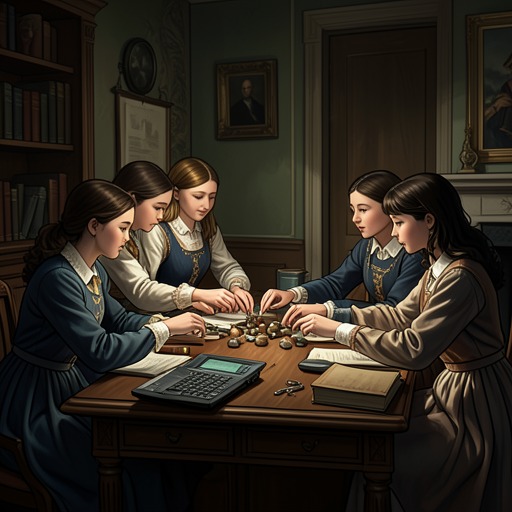
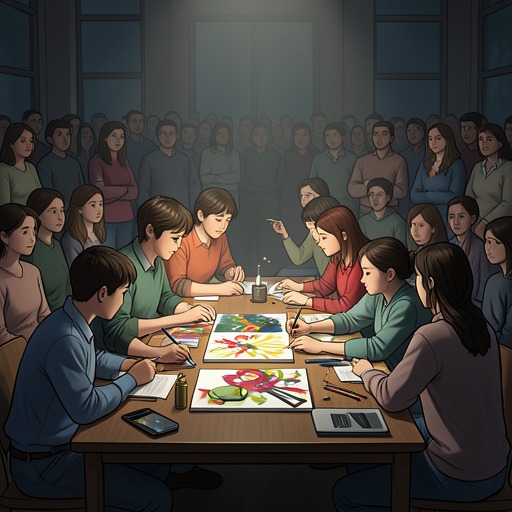
Four times a year, in spring, summer, autumn, and winter, Hailsham held an exhibition-cum-sale of work produced since the previous Exchange. The range extended from paintings, drawings, and pottery to improvised sculptures made from the materials that happened to be fashionable, such as battered cans or bottle tops attached to cardboard. The guardians assigned a token value to each submitted piece. Students then used their tokens to buy work they liked, with the restriction that they could purchase only work made by students in their own year. The three-month cycle gave many students time to produce a substantial selection of things to choose among.
The system connected making, appraisal, and acquisition in a single routine. A student’s work was not simply displayed: it was assigned a value by the guardians and could become another student’s possession. The resulting collection might include an object to decorate the space around a bed or something small to carry in a bag and move from desk to desk. The Exchanges were one of the students’ principal ways of building collections; the Sales were another, distinct source of possessions.
Collections and Social Standing
The Exchanges mattered not only because they supplied objects but because they made students reliant on one another’s creativity. What one student made might become someone else’s private treasure, so artistic production shaped relationships as well as furnishing rooms. At Hailsham, how well a student was regarded—how much others liked and respected them—could depend on how good they were at creating. The token system made that connection especially visible: creative work could acquire a price, attract buyers, and contribute to the maker’s standing.
By the time students were ten, the Exchanges had also helped foster a more acquisitive outlook. They had become attentive to the price of what they produced and to possessions that could make their surroundings feel personal: T-shirts, decorations around their beds, and arrangements for their desks. Each student kept possessions in a wooden chest bearing their name under the bed. Many took care over what went into the chest, bringing objects out to display and putting others away again. The collection was both a store of acquired things and a carefully tended record of personal attachment.
The Value of Art and the Tokens Controversy
The Exchanges could make the act of acquiring an artwork feel more important than its practical use. Kathy later recalled that students were permitted to submit poems as well as drawings and paintings. Even at nine, they were willing to spend scarce tokens on exercise books containing short, misspelled poems rather than on objects that might decorate their beds. They could have borrowed a poem and copied it, yet at an Exchange they found themselves choosing between Susie K.’s poems and the giraffes Jackie made. The remembered choice captures the system’s peculiar force: a student’s work became desirable not only as something to read or look at, but as an object to possess.
As students became more conscious of the value attached to their own work, the honour of having a piece selected by Madame began to conflict with the sense that they were losing something marketable. This tension fed the tokens controversy. Some students, mainly boys, argued that they should receive tokens as compensation when Madame took a piece; others were outraged by the proposal. The disagreement continued for some time. Roy J., a student a year above them whose work had been taken several times, eventually went to speak to Miss Emily about it. The available account establishes the dispute’s competing claims, but not a resolution: being selected could still signify an honour even as students increasingly regarded their work as something with a price and an owner.
Memory, Giving, and the Gallery
Years later, Kathy and Ruth remembered the Exchanges while Kathy was caring for Ruth at the Dover recovery centre. Ruth associated them with Hailsham’s encouragement to value one another’s work. Kathy shared that memory but also found the students’ devotion to their purchases strange in retrospect, especially their willingness to spend tokens on children’s poems. The difference between their recollections preserves both sides of the institution: the Exchange could make attention to another student’s work feel communal, while its currency encouraged calculation and ownership.
The story also distinguishes the Exchanges from other ways objects changed hands. After Kathy lost her Judy Bridgewater tape, Ruth gave her a replacement she had found at the last Sale. It was not the music Kathy had lost, but Ruth’s thoughtfulness transformed it into a treasured object; Kathy still kept it after Ruth was gone. That private gift differs from the token-mediated choice of an Exchange, even though both connect an object to a relationship. The Exchanges likewise differed from Madame’s taking students’ work for the Gallery: the controversy arose precisely because an act treated as recognition could also feel like the removal of something valuable.
Much later, Miss Emily explained that the collected art had served a public purpose. Hailsham and other institutions selected students’ work for exhibitions intended to persuade influential audiences that students were sensitive and intelligent human beings. The Exchange system and the Gallery were therefore related but not identical: one organized students’ purchases and collections; the other turned selected work into evidence in an external campaign for humane treatment. Together, they reveal how art at Hailsham carried several kinds of value at once—personal, social, institutional, and, in the students’ arguments over tokens, financial.