Hailsham Gallery
Never Let Me GoHailsham Gallery was the collection of paintings, poems, and other student work gathered by Madame at Hailsham, but its importance exceeded its role as a repository. Kathy and Tommy interpret it as a means of judging whether couples are truly in love and eligible for a deferral; Miss Emily reveals that its actual purpose was to use the students’ art to prove that they had souls and deserved recognition as human beings. The gap between those explanations makes the Gallery a record not only of student creativity but also of the adults’ effort to defend the students within a society that treated them as medical resources.
Collection and Meaning
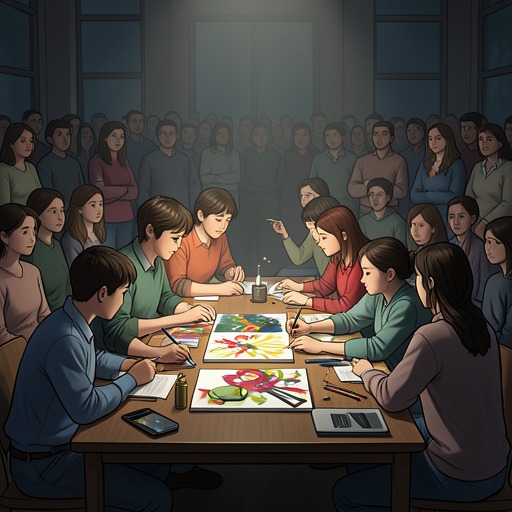
Madame had collected students’ paintings, poems, and other work over a period of years. The students themselves called it her gallery; she initially laughed when she heard the name, but eventually adopted it too. The collection was therefore both an adult-curated body of work and a feature of student life whose familiar name arose among the students. Miss Emily later says that some of it remains at her house, where the collection has had to be pruned because there was not room for everything.
The Gallery’s meaning is tested in the conversation at Madame’s house. Tommy tells Madame that he and Kathy believe she gathered the work so she could tell what students were like, and so she would have something to assess if a couple came to ask for a deferral. In their account, the art would supply evidence about the lovers themselves. Madame recognizes the reasoning behind this theory and articulates its central premise: that art might reveal students’ inner selves and souls. Her response connects Tommy’s mistaken explanation to the truth, but does not make the Gallery a deferral test. Its real function was larger and more public than the couple’s hoped-for exception.
The Deferral Theory and Tommy’s Work
Kathy and Tommy arrive believing that their love, combined with the Gallery’s evidence of their inner selves, might persuade Madame to grant a deferral. The collection thus acquires a private, urgent meaning for them: it seems to offer a procedure through which their relationship could be recognized and their future changed. Miss Emily later makes clear that the possibility of deferral was never theirs to grant, even when Hailsham’s influence was at its height. The lovers’ theory mistakes the purpose of an institution’s political argument for a route to individual exemption.
Tommy’s own history sharpens the misunderstanding. He tells Madame that he had been confused during his years at Hailsham and had not made art, so the Gallery contained none of his work. He acknowledges that this was his fault, though he fears it is too late to change matters, and brings a bag of drawings: some recent, others made much earlier. He points out that Kathy already has plenty of work in the collection. His gesture is at once an attempt to add himself to the evidence the Gallery holds and a belated offering to a system whose purpose he has misunderstood. The scene does not establish that his new drawings enter the collection; it shows him presenting them as the work he had failed to produce before.
The Gallery’s Public Purpose
Miss Emily explains that the work was collected because the guardians believed it could demonstrate that the students had souls. Hailsham did not gather art to identify which couples were genuinely in love; it selected the best work and displayed it as evidence that the students were sensitive and intelligent human beings. The distinction is stark: what Tommy imagined as a private measure of a couple’s feelings had been part of a public campaign against the denial of the students’ humanity.
Hailsham’s project belonged to a broader movement. Miss Emily names Glenmorgan House as another of the first places of its kind, followed a few years later by the Saunders Trust. Together, they challenged the way the donations programme was run by arguing that students raised in humane, cultivated surroundings could develop as sensitively and intelligently as ordinary human beings. Before such places existed, she says, clones had been treated largely as supplies for medical science, reduced in the public imagination to shadowy objects in test tubes. In that context, the Gallery’s selected works were not simply keepsakes: they were exhibits in an argument over how the students should be regarded.
At the height of Hailsham’s influence in the late 1970s, its supporters organized large events around the country. Cabinet ministers, bishops, and other well-known people attended; speeches were made and substantial funds pledged. The students’ art gave the movement visible evidence with which to challenge claims that the children were less than fully human. The Gallery consequently linked the intimate labor of making paintings and poems to a national effort to change public attitudes and the conduct of the donations programme.
Limits and Afterlife
Miss Emily presents that campaign as both consequential and limited. Hailsham and its allies secured humane surroundings for the students in their care and sought to protect them from the worst conditions after they left. But, she insists, even at the movement’s strongest, they could not grant the deferral Kathy and Tommy seek. The Gallery’s ability to make a public case for students’ humanity did not give its advocates control over the wider system or the students’ ultimate fate.
The collection also survives in a diminished form. Miss Emily says that the Gallery still exists at her house, although she had to reduce it for lack of space. This afterlife preserves the work while underscoring the contraction of the institution and the campaign it served. Miss Emily recalls that the Morningdale scandal and other developments undid much of the movement’s work. The Gallery therefore carries two histories at once: student-made art gathered as evidence of inner life, and an advocacy effort whose achievements could not secure the deferral its former students hoped the art might win.