Hailsham students' inability to have children
Never Let Me GoHailsham students’ inability to have children is both a fact about their lives and a limit that the adults around them teach them to understand only gradually. It distinguishes them from people outside Hailsham, but its significance reaches beyond reproduction: it affects the way students are taught about sex, what they can imagine for their futures, and how they recognize their separation from the wider world. The book gives no biological explanation for their infertility; it emphasizes instead the students’ partial knowledge and the consequences of living with it.
Knowledge Given Gradually
As children, the students have a vague awareness that they are different from their guardians and from ordinary people outside Hailsham, and that donations await them at some distant point. They do not yet understand what those facts mean. Kathy recalls that the subject embarrassed the children partly because the guardians became awkward when conversations approached it. Their reluctance to ask questions, and their harsh treatment of a student who raised the subject, show how the adults’ discomfort becomes a peer-enforced silence.
The students’ understanding develops through information that is present but not fully absorbed. Miss Lucy tells them that their futures are already set: they will grow up, donate their vital organs, and cannot choose ordinary careers. Yet the students respond with surprisingly little discussion. Kathy later describes the condition as having been told without truly understanding. Tommy proposes that the guardians timed information so students would hear it while still too young to grasp it; Kathy doubts that this was a deliberate scheme, but recognizes that facts could settle in their minds before they had examined them. Her recollection also suggests that early knowledge of donations existed alongside an incomplete grasp of what lay ahead.
Lessons About Sex and Reproduction
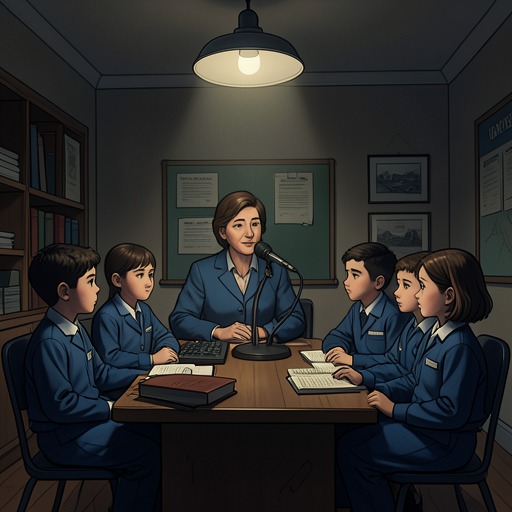
Around the age of thirteen, lessons about sex often bring the students’ inability to have children into the same conversation as their future donations. Miss Emily teaches them about sex and warns that it can affect emotions and relationships. She explains that people outside Hailsham can have children through sex, which helps account for the importance they attach to sexual relationships. The students, by contrast, cannot have children, although they are still expected to treat sex as significant and to observe rules about it.
That juxtaposition gives the lessons a double function. They describe an area of ordinary adolescent curiosity while also marking a difference the students cannot overcome. The guardians do not simply leave the children uninformed: they introduce facts through lectures and discussions, but the connection between sex, fertility, and the students’ predetermined futures remains difficult to confront directly. As the students grow older, they begin to make jokes about donations and related subjects, even while the underlying reluctance to discuss them openly persists.
Personal and Social Consequences
Kathy’s later memories show that knowledge of infertility does not remove the students’ interest in sex or the social pressure surrounding it. She feels increasingly like an outsider when other students claim experience, and she recalls that Ruth and another close friend had already had sex. Kathy has held back, remembering Miss Emily’s advice not to proceed without someone with whom she genuinely wants to share the experience. When she considers beginning, she thinks about gaining familiarity before a relationship becomes especially important. Her recollection places sexual experience within a social world shaped by comparison and instruction, not by the possibility of having children.
The distinction between students and outsiders also makes reproduction an emotional boundary. As a child, Kathy dances while holding a pillow as if it were a baby. Madame sees her and leaves in tears, an episode Kathy does not understand at the time. Years later, Tommy suggests that Madame may have recognized the sorrow of Kathy’s imagined baby because students cannot have children. Kathy questions how Madame could have known what the pillow meant or connected it to the song playing. The exchange preserves the uncertainty of the scene: Tommy offers an interpretation, but the memory does not establish exactly what Madame understood.
Meaning Within the Students’ Lives
The impossibility of having children is not presented as an isolated medical fact or as a subject the students comprehend all at once. It belongs to a larger pattern in which they acquire knowledge of their difference and future in fragments. The children’s early silence, the guardians’ carefully managed lessons, and the later recollections of Kathy and Tommy show how information can be known in outline while remaining emotionally unreal.
For the students, infertility marks a future from which ordinary family life is absent, while their lessons still ask them to understand intimacy in relation to the feelings and responsibilities familiar to people outside Hailsham. That contrast helps explain why the fact matters even when the students do not discuss it constantly. It is one of the limits built into their lives, and one of the clearest measures of the distance between their experience and the lives they have been taught to observe.