Hailsham’s Smoking Ban
Never Let Me GoHailsham’s Smoking Ban governed both conduct and knowledge: guardians strictly discouraged smoking, interrupted lessons to warn about it, and presented its physical harms, while leaving students unsure why the danger applied to them with particular force. When Miss Lucy admitted that she had once smoked and said it was much worse for the students, the rule briefly opened a path toward the truth of their situation. The students did not ask the next question, and the warning remained suspended between ordinary health instruction and an unspoken explanation of their future.
The rule and its enforcement
At Hailsham, the guardians were “really strict about smoking.” Their approach reached beyond telling students not to smoke. They tried to prevent smoking from appearing as an ordinary feature of culture: when a picture showed a famous writer or world leader holding a cigarette, a lesson could stop for a lecture. Students heard that some classic books might be missing from the library because their protagonists smoked, and they understood that pages had been torn from illustrated books or magazines when they contained smoking images. These were remembered as rumors, not confirmed explanations, but they show how the prohibition extended into what students were permitted to see and read.
The guardians also used explicit health instruction. They showed students disturbing pictures of the damage smoking did inside the body, and references to cigarettes could turn an otherwise ordinary lesson into a warning. The rule therefore combined restriction with explanation: smoking was represented as harmful, while its presence in books, pictures, and conversation prompted adult intervention. Kathy’s recollection that the guardians would have preferred the students never to learn that smoking existed captures the tension between suppressing an example and teaching about its danger. The ban did not make smoking an unmentionable subject; instead, it made the subject conspicuous and carefully managed.
Miss Lucy’s admission
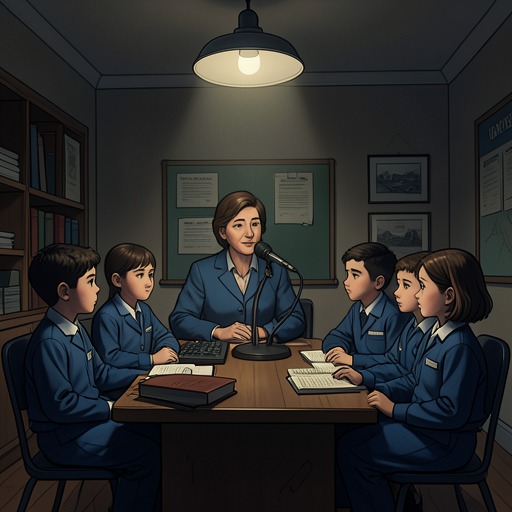
The limits of that managed instruction became visible after a rounders match. Miss Lucy had been giving a typical talk about smoking when Marge K. asked whether she herself had ever smoked. The students were furious at what they considered a rude question, but Miss Lucy paused and admitted that she had smoked for about two years when she was younger. The admission unsettled them: they had treated smoking as a danger from which a guardian would naturally be exempt, and now one of the adults who warned them acknowledged having done it.
Miss Lucy distinguished her own risk from theirs. She said that smoking had not been good for her and that she had stopped, but insisted that for the students it was “much, much worse.” She then reminded them that they had been told they were special and that keeping themselves healthy inside mattered more for them than it did for her. In that exchange, the same health rule acquired a sharper meaning. It was not simply a universal warning delivered by an adult who knew better; the students’ bodies were subject to a particular vulnerability that Miss Lucy nearly named but did not explain.
The question left unasked
Kathy later recalled that some students thought Miss Lucy wanted someone to ask why smoking was so much worse for them. No one did. The students were nine or ten, and, as Kathy understood it in retrospect, they already knew fragments of a truth they did not fully comprehend: they were different from their guardians and from ordinary people outside, and donations awaited them somewhere in the future. That partial knowledge made the subject embarrassing and unsettling. They had learned to notice that guardians became awkward near such topics, and their silence reflected that discomfort as much as a failure to follow Miss Lucy’s hint.
Their response to Marge made the silence more consequential. Before Miss Lucy answered, the students had been angry with Marge for asking. Afterward, their confusion displaced that anger only briefly; in the days that followed, they made Marge’s life miserable. Kathy connects the later bullying—including the incident when students held Marge’s face to a dormitory window to make her look at the woods—to the aftermath of the smoking conversation. The rule’s lesson thus became entangled with peer punishment: a question that might have drawn out an explanation instead brought embarrassment, cruelty, and a stronger reluctance to approach the subject.
Health, concealment, and hindsight
The smoking episode belongs to Hailsham’s broader practice of protecting students from knowledge even while giving them fragments of it. Miss Lucy’s emphasis on keeping their bodies healthy takes on a different weight in light of the students’ future as donors. Much later, Miss Emily explains that medical breakthroughs after the war made society dependent on students’ organs, while many people preferred not to think of the students as fully human. Hailsham’s guardians could warn students that smoking was especially dangerous without making plain the larger system that made their health so consequential.
That imbalance gives the rule its narrative significance. The students receive enough information to sense that the warning is not ordinary, but not enough to understand its cause or implications. Kathy later believes that one more question might have led Miss Lucy to tell them many things. Her memory does not establish exactly what Miss Lucy would have disclosed; it records instead the lost possibility of disclosure, created by the students’ fear and by adults’ evasions. The smoking ban is therefore both a practical restriction and a small, vivid instance of Hailsham’s pattern of being told and not truly knowing: a lesson about cigarettes almost becomes a lesson about the students’ lives, then stops just short of saying so.