Hailsham’s policy of shielding students
Never Let Me GoHailsham’s policy of shielding students was the guardians’ deliberate practice of keeping them from fully understanding who they were, what the Donation Programme required of them, and what awaited them after school. Miss Emily presents concealment as the price of giving students a real childhood: it allowed them to become absorbed in lessons, art, and writing, but left them to confront their predetermined future without the possibility of choosing a different one.
Policy and Rationale
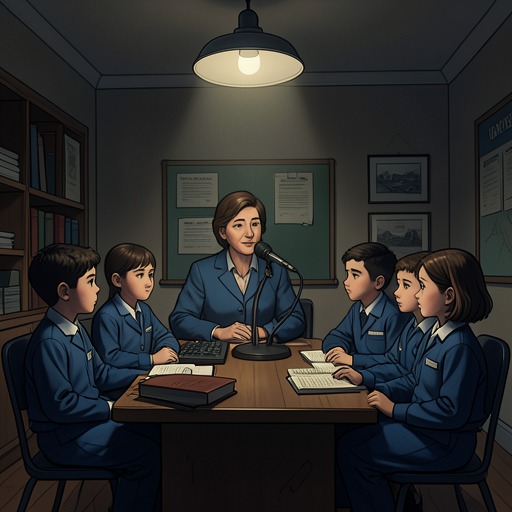
The policy was not simply an absence of information. Miss Emily acknowledges that the guardians sometimes kept things from students, lied, and fooled them, while insisting that this shelter gave them something lasting: their childhoods and the lives they built on what Hailsham had provided. In her account, fuller knowledge would have changed how the students experienced their education. Knowing the future awaiting them, she argues, they might have regarded lessons and creative work as pointless; their happiness at Hailsham would have been shattered.
Miss Lucy challenged this approach. She believed students should be made more aware of what lay ahead, who they were, and what they were for. The guardians considered her position and judged it mistaken, describing it as idealistic and insufficiently attentive to practical consequences. Miss Emily says Lucy meant well and had the makings of an excellent guardian, but that her approach would have deprived students of the protected childhood the school was meant to give them. The disagreement became an internal conflict over whether care meant telling students the truth or protecting them from knowledge that could destroy their happiness.
Hailsham in the Wider System
Miss Emily’s defense places the policy within a society that depended on students’ donations while resisting recognition of their humanity. After the war, rapid scientific breakthroughs made new medical possibilities available, and the public focused on cures for illnesses such as cancer, motor neurone disease, and heart disease. People preferred to imagine that the organs came from nowhere or grew in a vacuum. When concern turned to how students were raised and whether they should have been created, the system was already too established to reverse. Many people avoided thinking about students or persuaded themselves that they were less than human.
Hailsham’s effort to improve students’ lives therefore worked within a severe limit. Alongside Glenmorgan House, it was among the first institutions to offer students humane, cultivated surroundings; the Saunders Trust joined the movement later. The campaign used students’ art to argue publicly for their sensitivity and intelligence. Miss Emily recalls exhibitions and large events attended by prominent people, with speeches and funds pledged. Yet the movement could win better conditions only for a select few, not an end to the system that required students to donate. Its influence declined after the Morningdale scandal and other setbacks, leaving Hailsham unable to secure more than relative protection.
What Shelter Could Not Provide
The guardians’ policy did not include a promise that students could escape their assigned futures. When Tommy asks whether a deferral exists, Miss Emily confirms that there is none and that his life must follow its set course. She also rejects the idea that Hailsham’s lessons and collection of student art concealed a route to postponement: the art had been used to demonstrate students’ humanity to the outside world, not to grant couples a deferral. Kathy answers Miss Emily’s description of the students as lucky pawns by observing that a passing social climate may be a trend to others, but it is their life.
That exchange makes the distinction at the heart of the policy plain. Hailsham could protect students from the worst conditions elsewhere and give them an education, but it could not secure full knowledge, consent, or release from donation. Miss Emily acknowledges that the students grew up better off than many before them and may have fared better than those who came after Hailsham closed. Her defense is therefore comparative: the school improved life within an unjust system without changing the system’s destination.
The Policy’s Afterlife
The gap between childhood shelter and adult knowledge is visible in Kathy H.’s later work as a carer. At thirty-one, she has cared for donors for more than eleven years and expects to continue for eight more months, bringing her service to almost twelve years. She takes pride in donors recovering better than expected and remaining calm, and describes learning when to comfort them, when to leave them alone, and when to listen. The care she gives is attentive and individual; the world that assigns donors their futures is not.
Kathy’s decision to choose donors from her past brings the protected childhood into contact with the lives that followed it. Ruth was only the third or fourth donor Kathy chose, and already had another carer when Kathy arranged to look after her at the recovery centre in Dover. Their differences did not disappear, but their shared memories of Hailsham mattered more. Later, after Ruth’s second donation, Kathy sits beside her hospital bed, holding her hand through waves of pain. During a brief moment of recognition, Kathy promises to become Tommy’s carer as soon as she can. Hailsham’s shelter could preserve childhood memories and the attachments formed there; it could not protect those attachments from the bodily and emotional costs of the future the students had been given.