Kathy and Ruth
Never Let Me GoKathy and Ruth’s relationship is a long friendship in which closeness and injury continually coexist. Their shared past at Hailsham gives them a private language and a reason to seek one another out, but it does not erase the ways they compete, keep secrets, or hurt each other. As adults, Kathy’s decision to care for Ruth reopens their bond; Ruth’s final request that Kathy care for Tommy gives that bond a consequence beyond their own reconciliation.
A Shared Past and Uneasy Closeness
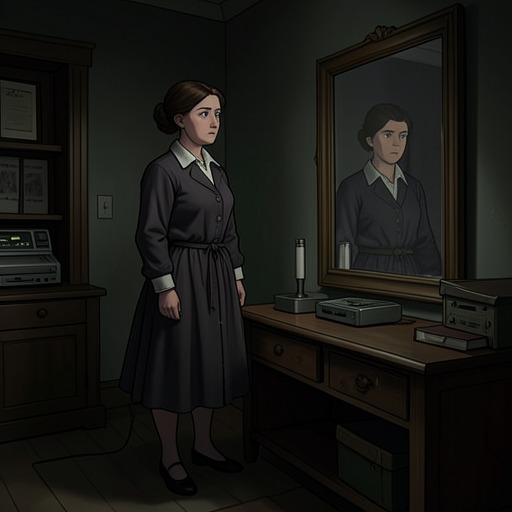
At the Cottages, Ruth and Kathy are simultaneously quarrelling over small matters and confiding in one another more deeply than before. Their late-night conversations take place in Kathy’s room in the Black Barn, where they sit together on her mattress with hot drinks and talk about their new life. They have an unspoken agreement that confidences shared in these conversations will be treated with care and not used as ammunition during their daytime arguments. For Kathy, this tacit protection is not incidental: it is what allows the friendship to survive their conflicts.
Their public behavior at the Cottages reveals a different strain. The students who arrived from Hailsham understand their collections as something they have carried from childhood, but Ruth notices that the veterans have no collections and concludes that keeping one is not normal there. She had packed her possessions in a holdall, intending to find a suitable wooden box, but left them in the bag for months before throwing them away. Her account gives Kathy access to a private loss Ruth had not previously explained, while also showing how strongly Ruth responds to the social expectations around her.
Ruth also performs the part of an established couple with Tommy. The veterans treat them as a long-standing pair, and Ruth seems pleased by that assumption, putting her arm around Tommy and kissing him in public. Kathy notices that the veterans’ gestures and manners often imitate television couples, and sees Ruth’s public elbow-slapping goodbye to Tommy as part of this borrowed performance. When Kathy asks Ruth about the gesture, Ruth says she had not realized she was doing it. The question, however, touches a sensitive boundary: Ruth believes, or at least may believe, that Kathy has challenged the way she presents herself to the veterans.
Confidences, Rivalry, and Rupture
Kathy understands the friendship through a division between two versions of Ruth. There is the Ruth who tries to impress the veterans, sometimes ignoring Kathy, Tommy, and the other Hailsham students if she thinks they might hinder her; and there is the Ruth who sits with Kathy at the end of the day, sharing private feelings in her attic room. Kathy trusts the latter and initially assumes that the two modes of behavior will remain separate. That confidence is broken when Ruth uses something Kathy had told her in private—about sex and making friends with some of the veterans—as a pointed remark during a quarrel.
The wound is sharpened by its timing. Just before Ruth makes the remark, Kathy has challenged her about the arm-slapping gesture. Kathy therefore comes to recognize that Ruth might have felt she had been exposed first, and that her own taunt was retaliation. This later understanding does not undo the hurt, but it complicates Kathy’s first judgment: the friendship is not a simple contest between a loyal confidante and a disloyal friend. Each can feel that the other has broken an unspoken compact.
The strain also plays out through Tommy. Kathy once tries to help Ruth and Tommy resume their relationship, telling Tommy that Ruth is prepared to call it quits and offering the reconciliation as a chance he should not waste. Tommy responds cautiously, saying that they are leaving Hailsham soon and must think carefully about what comes next. Kathy leaves their conversation feeling that she has failed Ruth. Later, Ruth tells Kathy that Tommy likes her but does not regard her as a proper girlfriend, while acknowledging the possibility that Ruth and Tommy might not remain a couple forever. Her disclosure brings Kathy’s feelings into the open without resolving the triangle: Ruth is both Tommy’s partner and the friend who names the limit of his feelings for Kathy.
Adult Reconnection Through Care
After Hailsham closes, Kathy becomes a carer for more than eleven years, with her service expected to reach almost twelve. She has cared for donors from different backgrounds, but during the final six years she has been allowed to choose whom she looks after. Kathy considers that choice a human necessity rather than a privilege without cost: caring requires sustained patience and emotional energy, and she says she could not have continued for so long without feeling for her donors. Choosing people from Hailsham allows her to become close again to Ruth and Tommy after years apart.
Ruth is only the third or fourth donor Kathy chooses. Ruth already has an assigned carer, so Kathy has to summon some nerve to take her on. When they meet again at the recovery centre in Dover, memories of Hailsham immediately matter more than the differences between them. Their first visit is warm: Ruth is pleased to see Kathy, they compliment one another, and they talk about Hailsham, the Cottages, and what has happened since. They do not, however, discuss how they parted. Their shared ease depends at first on leaving that history untouched.
As Kathy becomes Ruth’s carer, the avoided past presses back into the relationship. Kathy visits three or four times a week, bringing mineral water and Ruth’s favorite biscuits, but their conversations become stilted and guarded. One day Kathy waits in Ruth’s room while Ruth is in the shower. When Ruth comes in wearing a towel, her alarmed, wary look makes Kathy realize that Ruth does not trust her. The moment unsettles both of them, and the visits grow more difficult; Kathy even considers reporting that the arrangement has failed and asking to stop being Ruth’s carer. Their professional closeness has not automatically repaired their private bond. Instead, the work of care makes its concealed distrust visible.
Reconciliation and a Final Promise
The stranded boat gives the women a subject they can approach together. Rumors about it travel from recovery centre to recovery centre, and Ruth tells Kathy that a boy’s carer has seen it sitting in marshland within reach of the road. Kathy is relieved to have something to discuss with her and encourages Ruth to continue. The shared interest helps shift their visits away from silence and toward the possibility of a more candid encounter.
Kathy later remembers sitting with Ruth in an old bus shelter after a rainy, stormy day. She raises the argument from the churchyard and tries to sort out what happened rather than simply bury it. Ruth’s response includes a frank recognition that she and Tommy may not always be a couple, and that Kathy might naturally have wondered what would happen if they separated. Ruth then tells Kathy that Tommy likes her but does not see her as a proper girlfriend. The conversation exposes feelings that had been obscured by their roles as friends and by Ruth’s relationship with Tommy; its significance lies not in an easy resolution, but in Ruth’s willingness to speak directly to Kathy about the possibility of change.
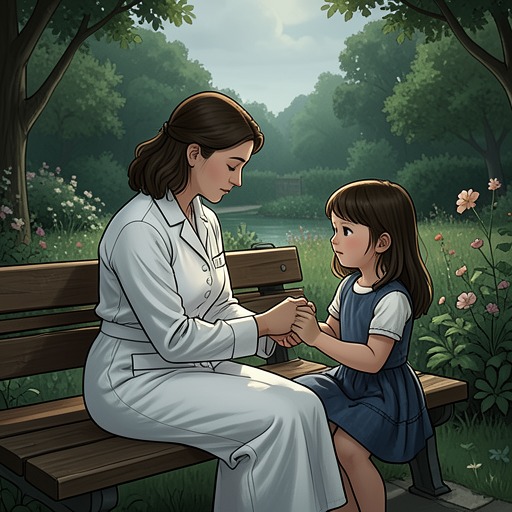
After Ruth’s second donation, Kathy is allowed to see her in the small hours, three days later. The medical staff’s behavior makes Kathy fear Ruth will not recover. Ruth is conscious but withdrawn into pain, and Kathy sits beside her metal bed for hours, holding her hand and squeezing it when pain makes her twist away. During a brief moment of recognition, Kathy understands that Ruth wants her to become Tommy’s carer. Kathy promises that she will do so as soon as she can. The promise carries their friendship forward into Kathy’s relationship with Tommy: Ruth’s care for Kathy and Kathy’s care for Ruth converge in a request that Kathy accepts, even when Ruth can no longer speak it aloud.
The Relationship’s Meaning
Kathy and Ruth’s friendship is sustained neither by perfect trust nor by the disappearance of old grievances. It survives because shared memories repeatedly draw them back toward one another, and because practical acts of attention can create contact where direct conversation has failed. Kathy’s long career as a carer makes that pattern especially clear: she values the ability to choose familiar donors because emotional connection helps her continue the work, yet caregiving cannot guarantee reconciliation. With Ruth, routine visits and small gifts coexist with guarded silence until the women begin to speak more honestly.
Their bond also develops through unequal and changing roles. At Hailsham they are confidantes and rivals; at the Cottages they negotiate friendship alongside Ruth’s public performance and relationship with Tommy; at Dover, Kathy is Ruth’s carer as well as her old friend. Near the end, Ruth’s request about Tommy makes Kathy’s future care an extension of their shared history. The relationship’s defining gesture is therefore not a declaration that the past has been repaired, but Kathy’s decision to remain present—to hold Ruth’s hand, understand what she wants, and carry out the promise.