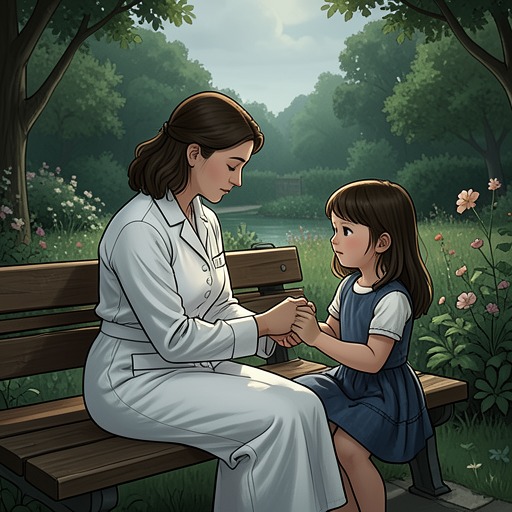
Kathy and Tommy begin a romantic relationship
Never Let Me GoKathy H. and Tommy begin a romantic relationship at Kingsfield, during his recovery from his third donation. Their reunion turns years of familiarity into a new form of intimacy, but it is shadowed from the outset by the late point in their lives at which they come together and by the demands of the donation system around them.
Background and Reunion
Kathy’s professional life as a carer had already become unusually long: at thirty-one, she had worked for more than eleven years and expected to reach almost twelve by the end of the year. For the final six years, she had been allowed to choose some of the donors she cared for. She preferred people from Hailsham and other places she knew, explaining that the deeper connection helped her sustain the work. Choosing donors from her past also gave her a way to become close again to Ruth and Tommy after years apart.
Ruth’s request helped bring Kathy and Tommy back together. After Ruth’s second donation, Kathy sat beside her in the hospital and held her hand. In a brief moment when Ruth recognized her, Kathy said she would become Tommy’s carer as soon as she could. Kathy later understood that promise as part of what Ruth had been hoping for: that Kathy and Tommy would try to build a life together. Almost a year after their trip to see the stranded boat, Kathy became Tommy’s carer, shortly after his third donation.
Life Together at Kingsfield
Tommy was recovering well but still needed rest, and the two settled into a quiet routine at Kingsfield. He had a large single room with a high, frosted window and a small school desk; Kathy visited after lunch, read to him from books including The Odyssey and One Thousand and One Nights, and completed her reports while he rested. Their conversations moved between their shared past and other subjects. The ease between them sometimes made the years seem to fall away, providing a gentle beginning to their relationship within the routines of recovery.
That closeness was not simply a return to how things had been before. Kathy and Tommy had known each other for years without becoming a couple, and now their relationship entered a new, more intimate phase. Kathy approached that change carefully, mindful that Tommy was still recovering and not wanting to pressure him. Their first step was tentative; in the days that followed, their relationship became more fully physical, and both were happy about it.
Intimacy and the Sense of Lost Time
Even as their physical relationship developed, Kathy sensed sadness alongside their happiness. She understood it as regret that they had waited so long to become intimate. The feeling persisted rather than disappearing as they grew more comfortable together. Kathy tried to keep it at bay by concentrating on their closeness, but it remained present after moments of happiness, and they held each other tightly as though that might quiet it.
The setting sharpened the contrast between intimacy and loss. Light through the room’s high frosted window could make it feel as though autumn had arrived even in early summer, while sounds from donors moving around the grounds replaced the remembered world of students talking in a field. Tommy’s remarks about how his body had changed since his donations could bring their awareness of time and recovery back into the room. Their relationship offered a new closeness, but it could not restore the younger years in which that closeness had not existed.
Care, Difference, and an Uncertain Future
Kathy’s role as Tommy’s carer made care both their daily setting and a source of strain. Later, when Tommy received notice of his fourth donation, they talked about how donors responded to that stage and about the uncertainty surrounding whether a donor would complete. Tommy raised the frightening possibility that donors might remain conscious after what was understood as completion, with further donations ahead and no carers or friends beside them. Kathy dismissed the possibility, but recognized that neither she nor the doctors could offer certainty; she regretted that they had retreated from the subject instead of talking it through.
Tommy also asked whether Kathy ever wished to receive her own notice and stop being a carer. His question exposed a difference between them that their closeness had not erased: the other people around them had become donors, while Kathy had continued in the caregiving role. His concern that she stood apart from donors, including him and Ruth, hurt her. Their relationship therefore begins not as an escape from their assigned lives, but within them: sustained by Kathy’s attentiveness and their shared past, yet pressed by bodily change, uncertain futures, and the unequal positions of carer and donor.