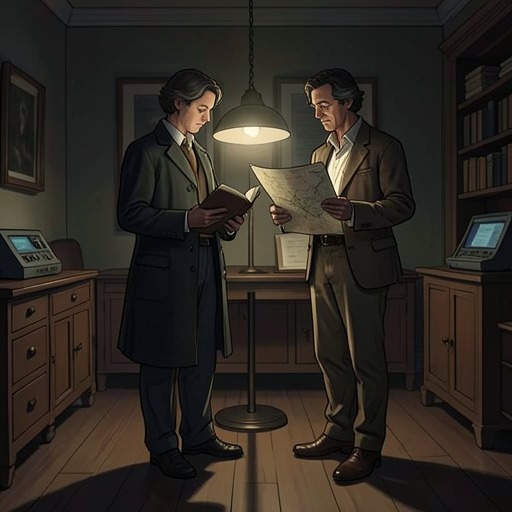
Kathy and Tommy visit Madame and Miss Emily
Never Let Me GoKathy and Tommy visit Madame and Miss Emily in Littlehampton hoping to learn whether couples in love can defer their donations. The visit dismantles that hope: the deferral rumor was never true. But the conversation also exposes the purpose of Hailsham’s gallery and the political campaign behind the students’ cultivated education. A private appeal for more time becomes an account of what Hailsham tried to prove about the people it sheltered—and what even its advocates could not change.
The Journey and the Encounter
Kathy remembers that she and Tommy had imagined the visit as a test of nerve: standing before Madame’s door, waiting with their hearts thumping, and trying to summon the courage to ring. The actual journey was difficult in less dramatic ways. Their car played up, making them an hour late for Tommy’s tests; a clinic mix-up then required him to repeat three of them. He felt woozy, became carsick on the way to Littlehampton, and needed several stops to walk it off. By the time they arrived, shortly before six, he was feeling better but had missed lunch. They parked behind the bingo hall and took from the boot a sports bag containing his notebooks.
As they walked towards the town centre, the closing shops and people gathering outside pubs made the visit feel less like the isolated confrontation they had anticipated. While they were looking for a takeaway sandwich, Tommy recognized Madame and grabbed Kathy’s arm. Kathy’s polite attempt to address her made Madame spin around. Her expression recalled the cold revulsion Kathy had felt years earlier when the students had waylaid her outside Hailsham’s main house. Madame seemed to identify what they were before she knew who they were; then, studying them in the setting sun, she put that visible revulsion aside.
Kathy introduced herself as Kathy H. and identified Tommy as Tommy D., reminding Madame that they had been students at Hailsham and had not come to cause trouble. Madame’s initial surprise turned into a small smile and a question about their purpose. Tommy raised the bag of notebooks and said they had brought things she might want for her gallery. His directness gave the encounter its central direction: they had not come merely to revisit a childhood institution, but to put their work and their hopes before the people associated with it.
Asking About Deferrals
Kathy had spent weeks rehearsing what to say, mentally arranging key lines and transitions during long car journeys and quiet stops at service-station cafés. Once she faced Madame, the prepared argument seemed mostly wrong or unnecessary. Although Madame had once seemed like a hostile stranger from outside Hailsham, Kathy now felt an unexpected intimacy with her, as if she were closer to them than people they had met in recent years. That shift allowed Kathy to speak simply about the rumors: they had heard that Hailsham students in love might receive deferrals, but had come to suspect the stories might not be accurate and were not relying on them.
Kathy explained that they would not have come unless they were sure of their love. Madame challenged the certainty behind that claim, asking how they could know love was so simple. When Miss Emily joined the discussion, Kathy asked directly whether the rumor was true. Miss Emily said that she had repeatedly stamped it out at Hailsham, but that it reappeared among former students. She had come to think that it was generated afresh wherever students carried the hope with them. Madame, she said, had long treated the rumor as something foolish students could be allowed to believe; Miss Emily had eventually become less concerned, reasoning that most would never test it.
For Kathy and Tommy, Miss Emily made clear, that comforting interpretation no longer applied. They were serious, had thought carefully, and had hoped carefully. She then gave them an unambiguous answer: there was no truth in the rumor and nothing she could do. Tommy asked whether deferrals might once have existed, before Hailsham closed. Miss Emily denied that too, specifying that the rumor had never been true, even before the Morningdale scandal and during the period when Hailsham was regarded as a shining example of a more humane system. The possibility that had brought the couple to Littlehampton was not a lost privilege or a rule that had since changed; it had never been available.
The Gallery and the Purpose of Hailsham
The denial did not end their questions. Tommy asked why the guardians had taken the students’ artwork if the gallery did not exist. Miss Emily clarified that it had existed, and in a reduced form still did: she had kept part of the collection in the house, though there had not been room for everything. Kathy pressed beyond the existence of the collection to its purpose. If the students were destined to donate and die, why had they been given lessons, books, discussions, and sustained encouragement to make art?
Miss Emily answered by recalling Tommy’s own earlier suggestion to Madame: that the artwork revealed what students were like inside. He had not been far wrong. The gallery’s purpose had been to show their souls—to establish that they had souls at all. The notebooks Tommy carried therefore mattered in two ways. They were works he hoped Madame might want, but they also represented the kind of evidence Hailsham had once put before the outside world in an effort to make its students’ humanity visible.
Miss Emily placed that effort in its historical context. When she and Madame began, Hailsham and Glenmorgan House were among the first places of their kind; the Saunders Trust followed some years later. Together these institutions formed a small but vocal movement that challenged the way the donation programme was run. They argued that students raised in humane, cultivated surroundings could become as sensitive and intelligent as ordinary people. Before that campaign, she said, clones were regarded by much of society as shadowy objects in test tubes, existing to serve medical science.
At the height of Hailsham’s influence in the late 1970s, the movement organized large events around the country. Cabinet ministers, bishops, and other prominent people attended exhibitions; speeches were made and substantial funds pledged. The students’ artwork served as public evidence against the claim that they were less than fully human. Miss Emily recalled those years with a gentle smile, though Kathy and Tommy could not follow the names and histories of the people she mentioned. The visit thus connects the personal history of their education to a public campaign whose achievements were real but limited: it could support humane treatment and recognition, but it could not secure the deferral the couple sought.
Consequences and Significance
The decisive change in the visit is not simply that Kathy and Tommy receive a refusal. They learn that the hope shaping their appeal was never a rule hidden in Hailsham’s past. Miss Emily’s explanation also alters the meaning of the artwork they had been encouraged to produce. It was not just a school exercise or a private measure of talent: the adults selected and exhibited it in an effort to make the students’ inner lives legible to a society that questioned their humanity.
The meeting brings those two truths into the same room. Hailsham’s advocates could argue for the students, create cultivated surroundings, and gather public support; they could not grant the couple more time. Kathy and Tommy come with art in a bag and a carefully considered appeal, but leave the conversation facing the limits of what that art and that campaign could achieve. The gallery’s history gives their education a political purpose, while the false rumor marks the boundary of its power.