Kathy loses her cassette and Ruth gives her a replacement
Never Let Me GoKathy H.’s lost cassette and Ruth’s replacement turn a small incident at Hailsham into a revealing account of private attachment, quiet attentiveness, and the difference between an object’s exchange value and what it comes to mean between friends. Kathy never learns what happened to the original Judy Bridgewater’s Songs After Dark cassette. Ruth cannot recover it, but she notices the depth of Kathy’s distress and answers with a gift that outlasts its practical purpose: a different recording, kept as a precious reminder of Ruth after her death.
The cassette and the Hailsham economy of possessions
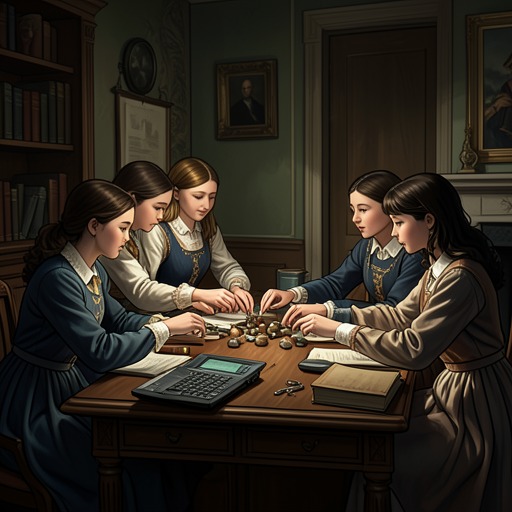
The loss occurs in the world of Hailsham’s collections, where possessions are acquired through Sales and the seasonal Hailsham student work exchanges. Four times a year, students display work made since the previous exchange, and the guardians award Exchange Tokens for their contributions. Students then spend those tokens on work made by others in their own year. Paintings, drawings, pottery, and improvised sculptures could all become something another student chose to keep. The exchanges thus provided more than a way to acquire decorations or things to carry between rooms: they made students’ private collections depend on one another’s creativity, and helped shape how students were regarded by their peers.
By the time they were ten, students had grown more acquisitive. A wooden chest under each bed held the things gathered from Sales and exchanges, and many students carefully displayed, stored, and revisited their possessions. That attachment existed alongside a growing sensitivity to the price and desirability of their own work. The tokens controversy arose when students objected to losing work taken by Madame without receiving tokens in compensation. This wider tension—between an object as something personally treasured and as something with a marketable value—helps frame the cassette’s disappearance. The recording is not simply missing property: it is an object whose significance Kathy keeps private, even from the friends sharing her dorm.
The disappearance and Ruth’s quiet attention
Kathy notices the cassette is gone while rummaging through her collection chest in the dorm just before lights-out. When she first understands it is missing, she tries not to reveal how panicked she feels. She hums as she searches, then asks the others casually whether they have seen it. She hopes she may have left it in the billiards room or that someone has borrowed it and will return it in the morning. Neither possibility proves true. The cassette does not turn up the next day, and Kathy never discovers what happened to it.
Looking back, Kathy connects the episode to a more general pattern of theft at Hailsham, which she believes students and guardians alike were reluctant to acknowledge. But the emotional importance of the loss is also bound to a recent moment between the two friends. Less than a month earlier, Midge had questioned Ruth about her pencil case in the Art Room, and Kathy had come to Ruth’s aid. Ruth had since been looking for something kind to do in return. Kathy later wonders whether the disappearance of the cassette gave Ruth a chance to act on that intention, and whether their friendship began to feel normal again after a period of strain.
Ruth’s response is first almost invisible. On the night Kathy asks about the missing tape, Ruth gives a distracted shrug and carries on with what she is doing. The following morning, however, Kathy hears Ruth casually asking Hannah whether she is sure she has not seen it. Ruth has understood both that the cassette matters to Kathy and that Kathy does not want a fuss made about it. Her first effort respects that wish: instead of turning the loss into a public display of sympathy, she searches in the background.
The replacement at the north hill
About a fortnight later, when Kathy has accepted that the original is truly gone, Ruth finds her during the lunch break. Kathy has been sitting on the grass talking with older girls when Ruth asks her to take a walk. They leave the group, go to the edge of the North Playing Field, and climb the north hill to a wooden fence overlooking the grounds and the scattered groups of students. Kathy remembers the strong breeze at the top, which she had not noticed below. The setting gives Ruth a little privacy for the particular thing she has brought to show her friend.
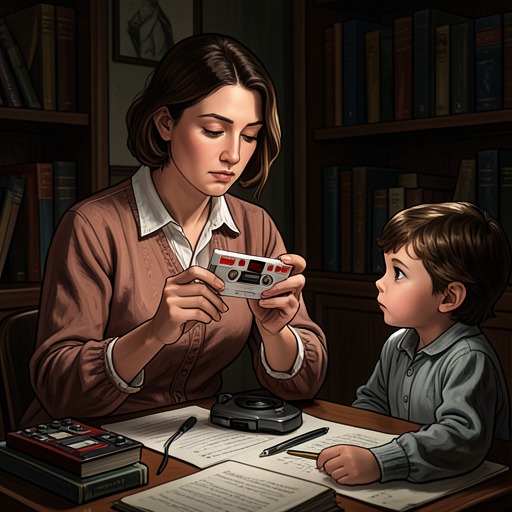
Ruth holds out a small bag. Kathy can tell that it contains a cassette, and her heart leaps, but Ruth immediately explains that it is not the lost one. She tried to find the original, she says, but it is really gone. Kathy answers with a joke about it having gone to Norfolk, and they laugh together. The exchange briefly softens the disappointment without pretending the missing tape has been recovered.
The replacement is called Twenty Classic Dance Tunes. When Kathy later plays it, she discovers that it contains orchestral music for ballroom dancing, nothing like the Judy Bridgewater recording she had lost. At first, the difference is apparent even before she knows what the music sounds like: she recognizes that Ruth could not have known what kind of recording she would actually want, because Ruth knows very little about music. As that recognition settles in, Kathy’s disappointment ebbs and gives way to happiness. Ruth has not reproduced the lost object or its particular meaning; she has tried to offer something she thought might please Kathy.
Kathy thanks Ruth by squeezing one of her hands between both of hers. She remembers that the students did not often hug one another at Hailsham, so this small gesture registers as an unusual expression of affection. Ruth tells her that she found the tape at the last Sale and thought it was the sort of thing Kathy would like. Kathy agrees, even though the recording is not the music she loved. The gift’s meaning lies in Ruth’s effort and in the care she took to act without making Kathy’s distress into a spectacle.
What the gift preserves
Kathy still has the replacement cassette, although she rarely plays it because its music has little connection to anything for her. She now understands it less as a recording to be used than as an object, like a brooch or a ring. After Ruth is gone, it becomes one of her most precious possessions. Its continuing importance reverses the usual measure of a collection item: the tape is not valuable because of its music, rarity, or success as a substitute, but because Ruth selected it and placed it in Kathy’s hands.
The episode also gives the friendship a material form. At Hailsham, students acquire possessions through systems that attach tokens and judgments to creative work; here, Ruth’s gift belongs to a different kind of exchange, shaped by attention rather than an assigned price. It cannot undo the loss or recover the original cassette, and Kathy does not claim that it does. Instead, the failed replacement becomes enduringly meaningful precisely through its difference from what was lost. The object preserves the circumstances of Ruth’s care, while Kathy’s later recollection preserves the quiet sequence by which that care became visible.