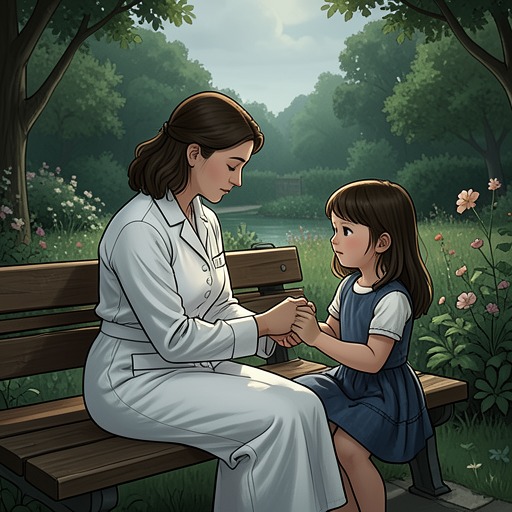
Kathy’s twelve-year caregiving tenure
Never Let Me GoKathy H.’s twelve-year caregiving tenure is both a long record of skilled, emotionally attentive work and the interval in which she regains closeness with Ruth and Tommy. At thirty-one, she has been a carer for more than eleven years and expects to continue for another eight months, bringing her service to almost exactly twelve years by the end of the year. The approaching finish feels right to her, even though she expects to miss the work: care has become not just a role but the means by which she has remained connected to people and memories from Hailsham.
Duration and institutional position
Kathy H. is careful not to present the length of her tenure as proof that she is exceptional. Some carers are asked to stop after only two or three years, while one she remembers continued for fourteen despite being, in her judgment, ineffective. She nevertheless knows that her own work has pleased those responsible for it, and that most of her donors have recovered better than expected. Their recovery times have been impressive, and few have been classified as agitated, even before a fourth donation.
For the last six of her twelve years, Kathy H. has been allowed to choose her donors. The permission is not unique to her, and it does not mean she has only cared for people from Hailsham or other privileged backgrounds: she has also looked after donors raised in many different places. Still, other carers associate her good record with the privilege of choosing and with her tendency to choose people like herself. Kathy H. understands why this can breed resentment, but regards choosing as a human limit rather than an unfair advantage. Carers do not have boundless patience or energy, and the work would have become impossible for her if she had stopped feeling for the people in her care.
The practice and cost of care
Her effectiveness rests on judgment as much as on time served. Kathy H. has developed an instinct for when to stay and comfort a donor, when to leave them alone, when to listen, and when to offer a brisk effort to lift their spirits. Keeping donors calm matters to her as a measure of how well she has cared for them, not merely as a favorable statistic. She is upset when a donor fares badly, but tries to retain the perspective that she has done what she could.
That composure is hard-won. Carers spend long hours driving between recovery centres and hospitals, sleeping away from home and often having no one with whom to discuss their worries or share a laugh. Chance meetings with people they knew from earlier years are usually brief, interrupted by exhaustion or the next obligation. The accumulated travel, broken sleep, and loneliness eventually become visible in a carer’s posture, gaze, movement, and speech. Kathy H. has learned to live with these pressures; she also recognizes that some carers, including Laura, never manage to recover from the distress of a donor’s unexpected completion. A reassuring letter or a nurse’s praise cannot immediately undo the demoralization of such a loss.
Kathy H. also distinguishes her own way of working from carers who seem merely to be waiting for their turn to become donors. In hospitals, she has seen carers shrink in the presence of medical staff, unable to speak up for the person they accompany. She tries not to become a nuisance, but has learned to make herself heard when necessary. Her account therefore presents caregiving as advocacy as well as consolation: attentiveness includes knowing when to give a donor space, and when to use one’s voice on their behalf.
Choosing donors and recovering old ties
The option to choose changes the emotional geography of Kathy H.’s work. Ruth was only the third or fourth donor she selected, and already had another carer when Kathy H. arranged to look after her. Their reunion at the Dover recovery centre did not erase their differences, but it made those differences seem less important beside their shared childhood at Hailsham and their common memories. From then on, Kathy H. increasingly sought donors from her past, especially people from Hailsham. As the years pass, however, fewer donors remain whom she remembers, and she has less opportunity to choose. Without a deeper connection, she finds the work harder.
Her choice to care for Ruth reconnects her to a friendship that remains complicated. A later sighting of mistrust between them makes Kathy H. recognize that the bond has not simply been restored: the unspoken divisions between them become more acute, and before visits she sometimes sits in her car preparing herself for the strain. A widely circulating story about a boat stranded in marshes gives them something to discuss and encourages Ruth to keep talking. Their conversation about it offers a temporary way back into contact, not an erasure of what has come between them.
The connection to Tommy gives the tenure a further purpose. Ruth repeatedly raises the possibility that Kathy H. might become his carer, and the proposal comes to stand in for other things they cannot easily discuss. Three days after Ruth’s second donation, Kathy H. visits her in hospital. Ruth is conscious but mostly unreachable amid severe pain; Kathy H. holds her hand for hours and understands a brief lucid look as a request. She promises to become Tommy’s carer as soon as she can. In this instance, professional care is also an answer to a personal obligation formed through shared history.
The fourth donation and the approaching end
Kathy H.’s work with Tommy brings her close to questions about the limits of care. About a week after notice of his fourth donation arrives, she and Tommy discuss how donors respond to the prospect: some talk repeatedly, some joke, and some refuse to discuss it. A donor on a fourth is often treated with a special respect, including by medical staff, who may greet them with smiles and handshakes. Tommy suggests that the anxiety comes partly from uncertainty about whether donors will actually complete. Kathy H. dismisses the fear as baseless, but recognizes that she has no evidence to settle the question. Rumors imagine that a donor might remain conscious after what is called completion, face further donations without carers or recovery centres, and eventually be switched off. The two retreat from the subject, although Kathy H. understands that it remains on Tommy’s mind.
In their later conflict, Tommy asks whether she is tired of being a carer and whether she ever wishes to receive her own notice. The question exposes a difference between their positions: he is a donor facing another procedure, while she has continued in the role for years. Kathy H. answers that good carers matter and that she is good at her work. Her conviction is grounded in the care she has practiced, but the exchange also makes the approaching end of her tenure newly visible: she has remained alongside donors long enough for them to ask why she has not yet joined them.
Significance of the tenure
Kathy H.’s long service is neither uncomplicated privilege nor mere endurance. The right to choose has helped her continue, but its most important consequence is relational: it lets her find Ruth and Tommy again after years apart. At the same time, the dwindling number of donors she remembers makes that strategy less available, while the daily demands of travel, isolation, and repeated loss remain. Her tenure reaches its expected close with both relief and attachment. She will miss caregiving, yet its nearly twelve years have already carried her from professional competence back into the fragile intimacy of shared history.