Keffers
Never Let Me GoKeffers is the gruff man who visits The Cottages to inspect the converted farm and oversee its upkeep. He is neither a replacement for the Hailsham guardians nor a source of comfort to the young people newly arrived from Hailsham. Instead, his visits make their independence tangible and conditional: the students must look after one another, but their daily life remains subject to his inspections, limited supplies, and expectations. Remembered through Kathy’s account, Keffers is defined less by a history or inner life than by his recurring presence in the students’ rooms and routines.
Role at The Cottages
The Cottages occupy the remains of a farm that had closed years earlier. The old farmhouse and its surrounding barns, stables, and outhouses had been adapted as accommodation, while some outlying buildings were close to collapse. Keffers arrived two or three times a week in a muddy van to look the property over. He spoke little to the students; his sighs and disapproving shakes of the head suggested that he thought they were not doing enough to maintain the place, though he never made clear what more they could reasonably do.
When the new arrivals first came, students already living there had organized a rota of chores, and the newcomers followed it conscientiously. Beyond that routine, their options were limited: they could report leaking gutters and clean up after floods, but they could not repair the broader dilapidation. Keffers’s inspections therefore carried an unresolved tension. He conveyed that the students were responsible for the property without giving them either the means or clear instructions to put it right.
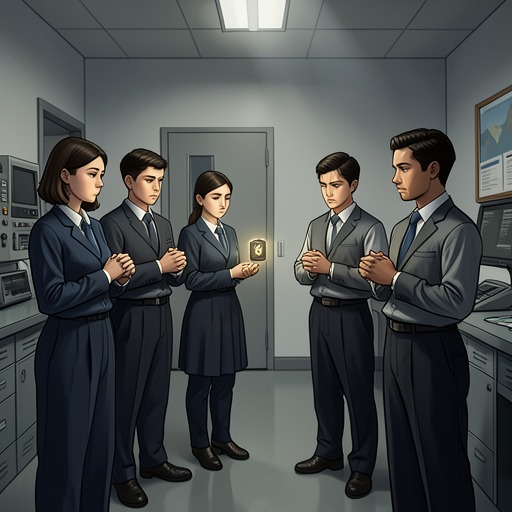
His authority was practical rather than pastoral. The students had repeatedly been told that there would be no more Hailsham guardians after they left Hailsham and that they would have to care for one another. Some initially tried to regard Keffers as a kind of guardian, but he did not accept that role: when they went to greet him, he stared at them as though their approach were strange. His presence could supervise their surroundings, but it did not reproduce the relationships they had left behind.
Supplies and Everyday Conditions
The old farmhouse had fireplaces, and the students could burn split logs kept in the outer barns. For other heating they relied on large, box-shaped heaters that used gas canisters. Unless the weather was particularly cold, Keffers did not bring many canisters, despite the students’ requests for a larger supply. He seemed to suspect they would waste them or cause an explosion. The practical result was that the students were often cold outside the summer months, wearing several jumpers and keeping their wellington boots on indoors when the floors were muddy or damp.
Keffers disapproved of the muddy trails they left through the rooms, but when the students asked what else they could do given the condition of the floors, he did not answer. The exchange captures the limits of his supervision: he noticed the disorder and judged it, yet offered no workable alternative. The students, for their part, accepted the discomfort as part of the excitement of life at The Cottages. His shortages and rebukes shaped their days, but they did not make the new setting feel like a punishment to them.
The students also lived under a modest system of accountability. Keffers kept a ledgerbook recording when they entered and were expected to return. They understood that no one would stop them from walking away, provided they came back at the recorded time. Even so, the recent arrivals initially stayed close to the buildings and watched the more experienced students leave for trips with bags and rucksacks. Keffers’s ledger was one visible feature of a wider transition: the students had more freedom than at Hailsham, but had not yet learned how to use it.
Ruth’s Collection and Keffers’s Van
Keffers appears in Ruth’s later recollection of disposing of her collection. Ruth had placed the items in a bin bag but could not bring herself to put them out with the rubbish. When Keffers was about to drive away, she asked him to take the bag to a charity shop. He rummaged through it, initially doubted that a shop would want the contents, and then changed his response when he saw that Ruth was becoming upset. He said he would take the items to Oxfam and made an effort to reassure her that they were good things.
The outcome remains uncertain. Ruth suspected that he may simply have put the bag in a bin somewhere, but took some comfort in not having to know for sure. Her account shows Keffers as someone capable of a small, responsive kindness, though not one that guarantees the result she hoped for. It also places him between the students and the outside world: Ruth relies on his van to carry something she cannot bear to discard herself, while having no way to verify what happens after it leaves The Cottages.
The Magazine Purges
Keffers’s most alarming episodes at The Cottages concerned pornographic magazines that appeared among the old newspapers or behind furniture. The students circulated a rumor that he was religious and strongly opposed to pornography and sex. That rumor is not established as fact, but his behavior gave it force: when he found magazines, he could become furious, enter rooms without knocking, and search for them. His usual grumbling would stop during these outbursts, a silence that made him seem more frightening to the students.
On one occasion, he gathered six or seven magazines and carried them toward his van. While rearranging things there, he set them down on bricks outside the boiler hut, then drove away without them. Kathy later found the magazines untouched. Rather than take them to her room, where she expected teasing and misunderstanding, she carried them into the hut and placed them on Keffers’s workbench. The sequence shows the limits of his control as well as its reach: his purges could make the students anxious, but an ordinary lapse left the magazines briefly beyond his attention.
The boiler hut itself was another converted barn, containing old farm equipment and Keffers’s workbench. Its function was utilitarian, and its clutter made it one of the spaces associated with the property’s neglected past. In Kathy’s recollection, it becomes the setting for a private search among the magazines, while Keffers remains outside the scene he has inadvertently made possible. The episode is not evidence that he deliberately permitted the magazines to remain; Kathy understood his departure as forgetfulness.
Characterization and Narrative Significance
Keffers is a recurring figure of everyday authority, not a fully explained character. Kathy remembers his muddy van, his inspections, his silence, and the gestures by which he expressed disapproval. His actions range from withholding extra gas canisters and pursuing magazines to changing his tone when Ruth became emotional. The account allows those actions to coexist without turning him into either a benevolent guardian or a simple villain.
His significance lies in the contrast between the independence promised to the students and the material conditions in which they attempt to practice it. They are told to look after one another, yet their rooms are cold, the buildings are deteriorating, and their movements are recorded. Keffers enforces parts of this arrangement without explaining its larger purpose. Because Kathy recounts him through particular chores, supplies, and incidents rather than through a personal history, he remains a figure at the edge of the students’ lives: close enough to affect their routines, but never a substitute for the guardians or a guide to the world beyond The Cottages.