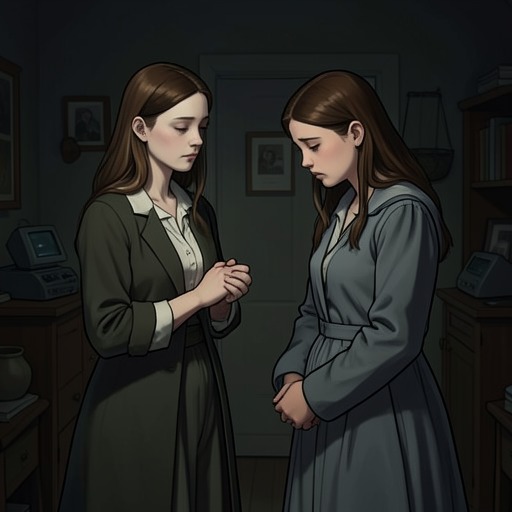
Laura
Never Let Me GoLaura is a close friend of Kathy H. from Hailsham whose appearances span the novel’s school years, life at The Cottages, and the later work of caring for donors. At school she is known for comic performance and easy teasing; years later, Kathy finds her worn down by the pressures of caregiving. Their reunion makes visible both the cost of that work and the persistence of a shared past: even after distance and estrangement, the memory of Hailsham can briefly bring them close again.
Identity and Early Characterization
At Hailsham, Laura is part of Kathy’s close circle and is remembered as the group’s big clown. Her humor is physical and observant: when Tommy is left unchosen during a football team selection, she imitates the changing expressions on his face as his confidence gives way to confusion, hurt, and panic. The other students laugh and encourage her performance. Kathy, by contrast, watches Tommy rather than Laura, registering the spectacle’s cruelty even as she remains within the group gathered to observe it. Laura’s comic role is thus introduced within a scene of collective exclusion, where entertainment and humiliation are difficult to separate.
Laura’s attention to small mishaps can also make her teasing seem ordinary and friendly. When she notices mud on the back of Tommy’s rugby shirt, she calls it out as a joke. The remark is not intended as an attack, and Kathy recalls that it belongs to the casual joking students routinely direct at one another. Tommy’s unexpectedly furious reaction unsettles the group: he turns on Laura with a thunderous expression, then abruptly stalks away. The episode presents Laura as playful rather than deliberately hostile, while showing how little the others understand the volatility beneath Tommy’s behavior.
Her humor sits alongside a harsher social atmosphere among the students. After Miss Lucy admits that she smoked when she was younger, the students are shocked and then make Marge’s life miserable for having asked the question. Kathy recalls that an incident in which the group held Marge’s face to a dormitory window to make her look at the woods was part of what followed. Laura belongs to the group Kathy remembers in this period, but the account does not single her out as the person who proposed or carried out that particular act. The distinction matters: the scene locates Laura within a community capable of turning curiosity and group feeling into cruelty without assigning her an individual action the narrative does not establish.
The Cottages and Changing Affiliations
At The Cottages, Laura and Kathy remain close enough to share private moments and observe the people around them together. On one occasion, they watch Keffers from Kathy’s room as he carries away pornographic magazines he has collected. When he leaves the magazines beside the boiler hut, Laura jokes that they will not remain there for long and that Keffers will have to collect them again during another purge. Kathy later picks them up herself. Laura’s comment reflects the pair’s amused observation of the adults’ habits, while the episode also shows that their shared presence does not mean they respond to a situation in the same way.
As the Cottages period passes, Laura’s ties to the Hailsham group appear to loosen. When new students arrive who are not from Hailsham, Kathy senses that their old group is becoming less bound together. Laura has found a boyfriend who is not from Hailsham, and Kathy feels that it is becoming possible to forget Laura was once so closely connected to them. The narrator does not describe this as a formal break or explain Laura’s feelings about it; the detail instead marks a gradual dispersal, as relationships and attachments beyond the old school community take on greater weight.
Laura and Ruth also have a history of tension. Years later, Laura tells Kathy that she encountered Ruth at a clinic while Ruth was still a carer. Kathy asks how Ruth had been, but Laura is reluctant to say much. She explains that they were both in a hurry and had not parted from one another on good terms at The Cottages. Her reserve gives a concrete measure of the unresolved relationships Kathy’s reunion with Laura brings back into view: shared origins do not erase past conflict, and Laura does not immediately turn their meeting into an account of everything that happened before.
Reunion as Carers
Kathy encounters Laura again at a service-station car park, seven years after they last met at The Cottages. At first, Kathy considers walking past without acknowledging her. The hesitation reflects not simply the surprise of meeting an old friend, but Kathy’s recognition that Laura seems to embody the depleted kind of carer she has just been describing: someone whose work has become exhausting and whose encounters with donors and hospital staff have left her worn down. Kathy approaches anyway.
Laura is sitting behind the wheel of a parked car, looking vacantly toward the motorway. She wears a shapeless blue anorak, and her hair is much shorter than Kathy remembers. When Kathy taps on the window, Laura does not appear startled. Her response seems to Kathy almost like relief: Laura opens the door, as if glad that someone from the old days has arrived. The meeting begins less like a buoyant reunion than an interruption of isolation, with Laura apparently ready to talk and Kathy deciding to stay.
They speak for about twenty minutes, much of it about Laura’s work. Laura describes being exhausted, having a difficult donor, and loathing particular nurses and doctors. Kathy waits for the old Laura’s mischievous grin and inevitable wisecrack, but neither returns in the way she expects. Laura speaks faster than she once did. Although she seems pleased to see Kathy, Kathy sometimes feels that what matters most is having someone there to listen, whoever that person might be. The encounter offers no simple recovery of their younger friendship: the familiar friend is present, but the pressures of carer life have changed the terms of their contact.
Hailsham, Memory, and Renewed Closeness
For a long time, Kathy and Laura avoid talking about the old days, perhaps because both sense the difficulty of reopening them. Their conversation eventually turns to Ruth, bringing the strained history among the former friends into their meeting. Laura’s account of her rushed encounter with Ruth and their poor parting does not resolve that history, but it allows Kathy to understand why Laura had been so unwilling to speak about it.
Laura asks whether Kathy is now allowed to choose donors. Kathy explains that she can sometimes have a say because she has done well with some donors. Laura’s question is not accusatory; she follows it by asking why Kathy does not become Ruth’s carer. The suggestion links Kathy’s professional choice to the possibility of repairing a personal relationship. It also shows that Laura remains attentive to the connections among their old group, even while speaking from the experience of a carer whose own work has become difficult.
When they finally discuss the closing of Hailsham, Laura says that it feels strange: although she supposes it should make no difference to her now, somehow it does. That exchange brings the two women close again, and they hug spontaneously. Kathy understands the gesture not chiefly as an attempt to comfort one another, but as an affirmation that Hailsham still exists in both their memories. The school is no longer a place they can return to, and their lives have carried them into separate, demanding circumstances; nevertheless, remembering it gives their reunion a shared ground that neither has to explain to an outsider.
Laura’s role is defined by this contrast between comic familiarity and the fatigue of later life. At Hailsham, her mimicry makes her a lively presence in the group, though it can participate in the students’ treatment of someone who is already isolated. At the service station, the expected performer is difficult for Kathy to find beneath the exhausted carer. Their conversation and embrace do not undo the intervening years or settle the fractures among their friends. They show instead how friendship may return in a changed form, carried by attention, candid talk about caregiving, and the memories the two women still hold in common.