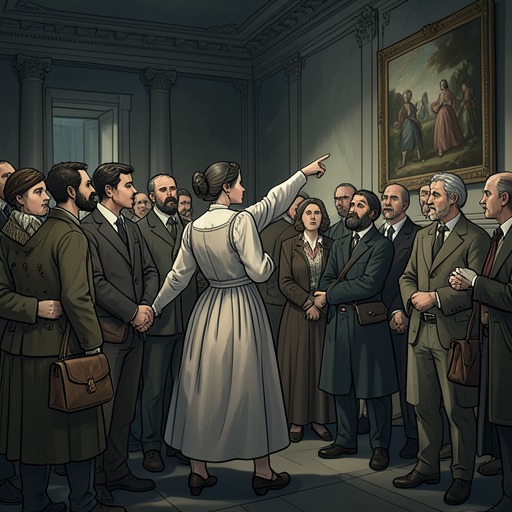
Look in the gutter
Never Let Me Go“Look in the gutter” is Ruth’s blunt formulation of her belief that the students’ possible models will not be respectable people. During the argument, she rejects the idea that the woman they have been discussing could be a model and directs the search instead toward society’s discarded and despised. The phrase turns a search for origins into an exposure of the students’ imposed social degradation.
Context and Meaning
At the center of Ruth’s argument is her certainty that the woman could never have been a model. When Tommy tries to dismiss the search as “Just a bit of fun,” Ruth cuts him off, irritated by his effort to make their hopes seem playful. She says that the woman and her friend had mistaken them for art students, and argues that they would have been thrown out had they revealed what they really were. Her conclusion is that the students should look for possibles among people whom society rejects, rather than among someone who appears respectable.
Ruth makes that conclusion explicit by describing the students as modelled from “trash,” then naming junkies, prostitutes, winos, tramps, and convicts as possible sources. “Look in the gutter” condenses this list into a sharp direction. She extends it with the parallel commands “You look in rubbish bins” and “Look down the toilet,” carrying the image from the gutter to places associated with waste. The escalation gives her claim a deliberately degrading force: she is not simply proposing another place to search, but insisting that the students’ origins belong to the social and literal margins.
The Phrase in the Scene
The expression also marks a clash over how the search should be understood. Tommy calls it fun, but Ruth refuses that framing: she insists that the group face what she sees as the truth. Kathy tries to stop her, and Rodney warns her to drop the subject and go see Martin; Chrissie puts an arm around Ruth and urges her to leave with him. Ruth nevertheless completes the thought, making the phrase the scene’s most uncompromising statement of the stigma she believes surrounds their origins.
The search for a possible has offered the students a chance to imagine a connection between themselves and an ordinary adult. Ruth’s phrase closes that possibility down rather than comforting them with a hopeful alternative. Its repeated movement from gutter to bins to toilet makes the rejection increasingly difficult to soften, while the disagreement around it shows how differently the group responds to the same hope: Tommy tries to treat it lightly, Kathy tries to interrupt Ruth, and Ruth insists on naming the conclusion she considers unavoidable.