Lost Corner
Never Let Me GoLost Corner begins as a phrase Miss Emily uses to describe Norfolk and becomes a shared Hailsham belief that lost things might still be found. For Kathy H., Ruth, and their classmates, the imagined destination offers comfort when something precious disappears; years later, finding a replacement cassette in Norfolk briefly makes that childhood hope feel real. The expression’s lasting force comes from the contrast between objects that might be recovered and people and places that cannot be brought back, even when memory keeps them present.
Origin in Miss Emily’s lesson
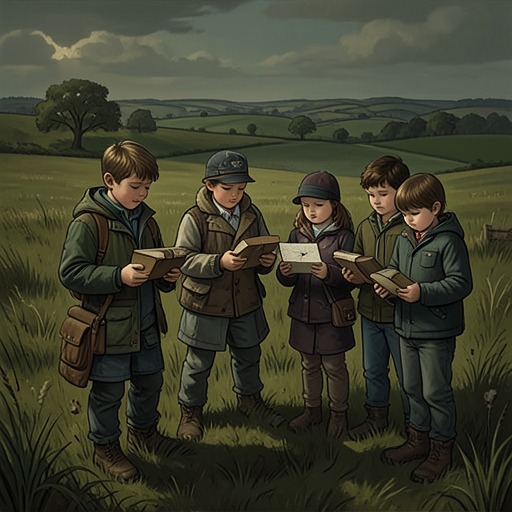
During lessons about the counties of England, Miss Emily used a large map and picture calendars to give the students an image of places beyond Hailsham. Her collection had no calendar showing Norfolk. When she reached it on the map, she would remark, “And over here, we’ve got Norfolk. Very nice there.” On one occasion, rather than move straight on, she explained that Norfolk projected into the sea and was bypassed by people travelling north and south. That made it a peaceful place, but also, in her words, “something of a lost corner.”
The phrase connected the geography lesson to a familiar place inside Hailsham. On the third floor, the students had their own “Lost Corner,” where lost property was kept and where someone could go either to report a loss or to look for something found. After the lesson, a student claimed that Miss Emily had meant Norfolk was England’s lost-property storehouse. The mistake turned a place the children had never seen into a destination with a practical, almost logistical purpose: the country’s lost belongings would somehow be gathered there.
From misunderstanding to shared comfort
Kathy H. remembers that the idea did not begin as a joke. By the time the students were twelve or thirteen, the Norfolk story had become a running joke, but she and Ruth both recalled believing it literally at first. Tommy later remembered it differently, thinking the notion had always been playful. Kathy H.’s account preserves that disagreement rather than settling it: even among former classmates, the beginning of a shared memory could be remembered in different ways.
The children imagined a larger version of the deliveries they already knew at Hailsham. Just as lorries brought food and goods for Sales, they supposed vehicles might travel around England collecting things left behind in fields and trains and taking them to Norfolk. They had no picture of the county, and that absence strengthened its mystique. The world outside Hailsham was still hazy to them; they had little basis for judging what could or could not happen there, and never tested the theory in detail.
Norfolk mattered less as a convincing explanation than as a promise of consolation. Ruth later put the comfort into words: “when we lost something precious, and we’d looked and looked and still couldn’t find it, then we didn’t have to be completely heartbroken. We still had that last bit of comfort, thinking one day, when we were grown up, and we were free to travel around the country, we could always go and find it again in Norfolk.” The imagined place did not reverse a loss; it gave the students a way to keep the possibility of recovery alive. Its value lay in what they could continue to hope, not in any evidence that the lost property really accumulated there.
The cassette and the wish renewed
The idea acquired a personal object in Kathy H.’s lost copy of Judy Bridgewater’s Songs After Dark cassette. She treasured the tape, whose cover showed Judy Bridgewater in a purple satin dress, seated at a bar with a cigarette in her hand. Kathy H. became secretive about it partly because of that cigarette, against the background of Hailsham’s rules. The later copy was not the cassette she had lost as a child: it was one that she and Tommy found years afterward in a town on the Norfolk coast.
That discovery gave the old story an uncanny, intimate echo. Kathy H. and Tommy could laugh at finding the cassette in the place their childhood theory had assigned to lost things, but the coincidence also stirred an old wish to believe in Norfolk again. The replacement did not restore the original object or the childhood moment attached to it. Rather, finding it made the distance between the children’s fanciful belief and the adults’ actual experience briefly collapse. Norfolk’s significance thus rests on both sides of the coincidence: the tape is recovered, while the earlier selves who imagined its recovery remain unreachable.
A place for what cannot be recovered
Kathy H.’s later memories place the expression within a wider pattern of loss. When she and Laura speak about Hailsham, Laura says, “It’s weird. Thinking it’s all gone now.” The school’s closure unsettles the assumption that its people and routines will continue to exist in the background. Kathy H. remembers the news through the image of a man gripping balloon strings: the closure seems like someone cutting the strings, leaving the balloons no longer bound together. The image gives physical form to a separation that cannot be repaired by locating an old object.
After Tommy completes, Kathy H. drives to Norfolk without a particular errand and does not go as far as the coast. She crosses flat fields beneath a huge grey sky, eventually stopping by trees and a fence where rubbish has caught on two lines of barbed wire and torn plastic and carrier bags flap in the branches. The scene returns Norfolk to the landscape of things carried, lost, and caught, but it does not promise that what has disappeared can be restored. In the closing movement of her account, Kathy H. says that she has lost Ruth and Tommy, yet will not lose her memories of them. She does not search for the former site of Hailsham; she expects to carry it in her mind instead. Lost Corner therefore holds together a childhood fantasy of recovery and an adult recognition of its limits: a cassette may turn up, but memory, rather than a journey to Norfolk, is what remains of the people and place she has lost.