Madame’s house
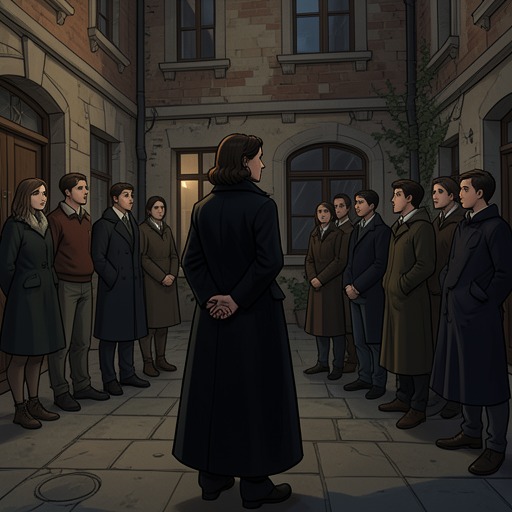
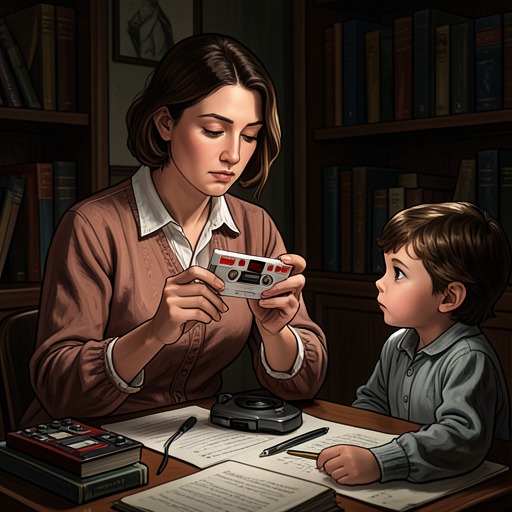
Never Let Me GoMadame’s house becomes the setting for Kathy H. and Tommy’s attempt to learn why Hailsham encouraged students to make art and then took their work away. Its narrow, dim interior turns their visit into a gradual discovery: Madame first directs them into a darkened room, while someone they cannot see listens from deeper in the house. The Gallery they had imagined as a source of answers is present there in reduced form, but the house offers no simple resolution to their questions.
Arrival and the House’s Layout
Tommy arrives carrying a bag of things he believes Madame might want for her gallery. He insists that they need to talk with her, and Madame eventually invites them inside. The threshold changes the scene’s atmosphere. Coloured glass panels in the front door dim the light, and the hallway beyond is so narrow that stretching out their elbows would bring their hands close to both walls. From it, a staircase rises to the left; an even narrower passage continues to the right, farther into the house.
Madame pauses with her back to the visitors, apparently listening. Kathy H. listens too, but at first hears only silence. A faint thump, perhaps from upstairs, seems to prompt Madame to point them onward before she climbs the stairs herself. When the two hesitate, she leans over the banister and indicates the dark passage again, then disappears upstairs. The instructions bring them into the front room without explaining what Madame has heard or whom she may be listening for.
The Front Room and Its Uncertainty
The front room seems prepared for night: its curtains are closed and dim table lamps are switched on. Kathy H. notices the smell of old furniture, which she thinks is probably Victorian. A board seals the fireplace, and in place of a fire there is a woven picture of a strange, owl-like bird staring outward. These furnishings make the room feel less like an open reception space than an interior arranged around what is absent or obscured.
Tommy points to a framed picture hanging in a corner above a small round table and thinks it depicts Hailsham. Kathy H. is less certain. The watercolour seems attractive, but a lamp with a crooked shade and traces of cobwebs casts a shine over the murky glass instead of illuminating the image. The visitors can identify the possibility of Hailsham without being able to see the picture clearly. The obscured image anticipates the limits of what the house will disclose: it contains traces of the place and its history, but those traces do not initially make the past legible.
The Hidden Listener and the Meeting
The room’s darkness proves to conceal more than its pictures. Madame asks whether the conversation should continue and whether she is going too far. Kathy H. realizes that these questions are not addressed to her or Tommy, but to someone listening in the darkened part of the room. She turns and hears a mechanical sound from farther away than she expected the house to extend. A shape moves toward them, and a woman answers Madame from the darkness.
Madame then emerges pushing a wheelchair and steers its occupant around to face the visitors. Tommy recognizes Miss Emily. The room’s hidden depth has held not a vague threat but the person to whom, as Madame makes clear, the students should be speaking. Miss Emily identifies herself as the proper person to answer and acknowledges Madame’s work on their project, while noting that its outcome has left Madame disillusioned. She recognizes Tommy as the boy with a bad temper and a big heart, and Kathy H. as a carer about whom she has heard a great deal. In this exchange, the house becomes the place where the students’ remembered institutional world and its former guardians meet face to face.
The Gallery and the Questions It Holds
The meeting is explicitly against regulations. Miss Emily says that Madame should not have invited the visitors in and that she herself should have turned them away; nevertheless, both women are willing to let the conversation continue. A doorbell interrupts them, and Miss Emily identifies the caller as a man from the decorating company. Madame goes to deal with him, leaving the visitors a few more minutes to speak with Miss Emily.
Tommy asks whether the Gallery existed if the rumour about deferrals was never true. Miss Emily confirms that there was a Gallery and says that, in a fashion, it still exists in Madame’s house. It has been reduced because there was not room to keep all of the work. This gives the house a direct institutional significance: it holds a remnant of the collection that had once been removed from the students, though the evidence does not show that all their work remains there.
Kathy H. presses beyond the Gallery’s existence to ask why the students were made to work, taught, and encouraged if they were ultimately destined to make donations and die. The question turns the house from a repository of art into the setting for a demand about the purpose of Hailsham’s education. At this point in the conversation, that demand is still open. Madame’s house gathers the objects and people connected to the students’ past, but the room’s dimness, the partly obscured picture, and the interrupted visit all mark how incomplete their access to that past remains.