Marginalization of Clones
Never Let Me GoThe social marginalization of the clones is not expressed only through overt hostility; it is built into a society that depends on their donations while refusing to recognize them fully as people. Kathy H.’s recollections show how that exclusion is learned in childhood, registered in small acts of recoil, and reinforced by a political order that prefers not to consider how the students were created or what their futures require. Hailsham offers a more humane upbringing, but its eventual closure reveals the limits of reform within a system that continues to need the students’ organs.
A difference learned before it is understood
At Hailsham, the students know early that they differ from their guardians and from people outside, but that knowledge does not yet amount to an understanding of what their difference means. When Kathy H. looks back on the episode with Madame, she recalls children who have received talks, videos, discussions, and warnings without being able to grasp their full significance. The ordinary friendliness of gardeners and delivery men, who joke with the children and call them “sweetheart,” sits beside the unspoken knowledge that they are not regarded as ordinary members of the wider community. The contrast helps explain why exclusion can remain obscure until a gesture suddenly gives it force.
A similar incompleteness shapes the students’ response to Miss Lucy’s warning about smoking. At nine or ten, they have some vague sense that donations await them, but not a deep understanding of what that entails. They also recognize that their guardians become awkward when conversations approach this territory. Rather than ask the next question, the children avoid the subject; they even punish Marge K. cruelly after she brings it up following a rounders match. The students’ silence is therefore not evidence that they have been told nothing. It reflects a childhood in which partial disclosure, embarrassment, and adults’ discomfort prevent knowledge from becoming comprehension.
Miss Lucy names this condition directly when she tells the students they have been “told and not told.” She makes explicit what their more hopeful fantasies exclude: they will not go to America, become film stars, or work in supermarkets. Their lives have been arranged around becoming adults and then donating vital organs, a purpose for which they were created. Her candour exposes the difference between receiving information and being equipped to understand one’s place in society. It also makes plain that the students’ exclusion is not an accidental misunderstanding: their futures have been decided by others.
The encounter with Madame
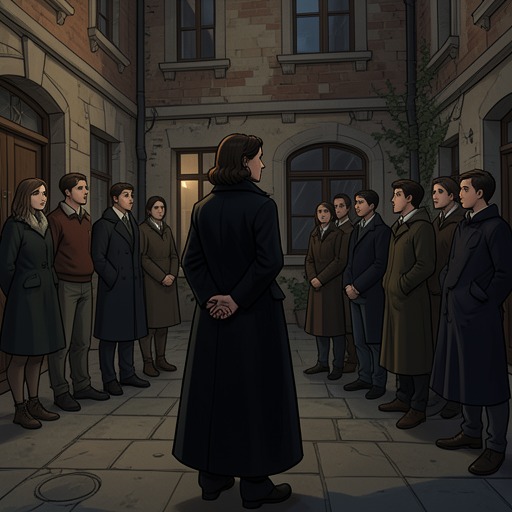
The students’ attempt to test Ruth’s theory about Madame turns an uncertain suspicion into a bodily experience. Six of them wait for Madame in Hailsham’s courtyard and move toward her together, intending to remain civil and then continue on their way. Madame does just what they anticipate: she freezes and lets them pass. But close attention to her face reveals a shudder and an unmistakable dread that one of them might brush against her. The children had treated the plan as a private dare; the encounter makes them confront what it means to be seen as a source of revulsion.
Kathy H. remembers the change as a movement from sunlight into chilly shade. Madame does not need to shout or threaten the students. Her recoil is enough to make them feel that they are being regarded as one might regard spiders. Hannah seems ready to cry, and even Ruth is shaken. A student asks why Madame wants their work if she dislikes them, but no one answers. The question links the students’ valued creativity to the same people’s fear of their bodies: Hailsham seeks their work while the adult world keeps them at a distance.
Years later, when Kathy H. and Tommy approach Madame’s house, the earlier encounter returns almost exactly. Kathy calls out politely at the gate, but Madame spins around, stiffens, and looks at them with the same coldness Kathy remembers from Hailsham. Her expression changes as she studies them, yet the old response has already made visible how readily their identity is recognized and feared. During the visit, Kathy tells Miss Emily that Madame has always been afraid of them, comparing that fear to fear of spiders. Miss Emily confirms that she too felt revulsion when she looked down at the students from her study window, though she says she fought those feelings to do what she believed was right. The admission complicates the distinction between sympathetic reformers and a hostile outside world: even those who advocate for the students are not untouched by the stigma surrounding them.
Dependence, denial, and the limits of reform
Miss Emily’s account places the students’ treatment in a history of scientific and political dependence. After the war, rapid scientific breakthroughs made previously incurable conditions seem treatable, and the public valued the new possibilities more than it questioned the origin of the organs. People preferred to imagine that the organs appeared from nowhere, or grew in a vacuum. Once the donation system became indispensable, concern about how the students were reared came too late to reverse it. The social order could benefit from the students while avoiding sustained recognition of them as human beings.
Miss Emily explains that this denial was reinforced by the belief that the students were somehow less than human. Hailsham and its associated movement tried to challenge that belief by improving the students’ circumstances and demonstrating their humanity. Hailsham students received an education and upbringing that Miss Emily describes as better than the conditions found in the government homes. Yet the improvement was selective, not universal, and it did not remove the underlying demand for donations. The movement could make some lives better without securing the students’ freedom from the system on which society relied.
The Morningdale scandal and other changes in public opinion expose how precarious those gains were. Miss Emily describes the movement as dependent on the support of corporations and politicians; after the climate shifted, sponsors withdrew one after another in just over a year. Hailsham continued for two years longer than Glenmorgan House before it too was forced to close. The world, she says, wanted the students returned to the shadows: out of sight and out of mind. The decline of Hailsham thus does not signal that the need for donations has ended. It marks the loss of a campaign that had made the students’ lives and conditions harder to ignore.
The stigma carried into donation and care
Marginalization also persists within the intimate routines of donation. Donors respond to the anticipated fourth donation in different ways: some talk about it continually, some joke, and some refuse to discuss it. Yet reaching a fourth donation can bring a donor a peculiar respect, with doctors and nurses greeting them with smiles and handshakes. The ritual recognizes endurance while leaving the destination of that endurance uncertain. Tommy observes that people worry about the fourth because they cannot be sure they will truly complete, and nobody tells them with certainty what happens afterward.
Kathy H. recalls the frightening speculation that a donor might remain conscious after technically completing, face further donations without carers or friends, and eventually be switched off. She dismisses Tommy’s concern as baseless talk, although she knows she cannot support that reassurance. Their retreat from the subject shows how institutional uncertainty and social avoidance enter even a close relationship: the prospect is too disturbing to discuss, and the people directly affected have no reliable answers. The repeated need to manage fear privately is part of the broader exclusion that denies them control over the conditions of their lives.
The same imbalance appears in care. After Ruth’s second donation, Kathy H. sits beside her in a hospital room for three hours or more, holding her hand and squeezing it when pain makes Ruth twist away. Ruth is conscious but largely inaccessible; in a brief moment of lucidity, Kathy understands that Ruth wants her to become Tommy’s carer and promises that she will. Care offers genuine closeness, but it takes place within an institutional sequence of donations and decline that neither woman can undo. Taken together, these memories show marginalization as both a public system and a private burden: the students are needed, watched, sometimes protected, and sometimes cared for, yet their dependence on others does not translate into social equality or secure knowledge of their own fate.