Miss Emily and Madame
Never Let Me GoMiss Emily and Madame form the partnership behind Hailsham and the campaign to improve students’ lives: they create a humane, cultivated environment and present students’ artwork as evidence of their humanity. Their collaboration has real achievements but strict limits. They can challenge how the Donation Programme treats students and shield them from some of its worst conditions, yet they cannot secure the deferrals Kathy and Tommy seek, and their school ultimately closes when public support disappears.
A Partnership Built Around Hailsham
Miss Emily describes herself and Madame as having started out together, with Hailsham among the first places of its kind, alongside Glenmorgan House. The Saunders Trust followed a few years later. These institutions became a small but vocal movement challenging the way the Donation Programme was run. Their shared project was not simply to provide a better school: it was to demonstrate that students raised in humane surroundings could become as sensitive and intelligent as ordinary people.
Within that partnership, however, Miss Emily presents herself as the one who carried the earliest doubts. She says that she questioned the purpose of Hailsham from the beginning, while Madame did not ask that question before the Morningdale scandal. Miss Emily’s account makes their work look both collaborative and unevenly burdened: her questioning allowed the other guardians and the students to continue without confronting the same doubts. Madame’s later agreement that Hailsham’s purpose had become difficult to defend does not erase this difference in how each woman remembers their earlier commitment.
The Gallery and the Case for Students’ Humanity
The Gallery gives their educational and political aims a public form. Hailsham collected students’ work, selected the strongest pieces, and displayed them at special exhibitions. Miss Emily explains that they wanted the art to show what students were like within—to demonstrate that they had souls. She connects that effort to a time when clones were treated as shadowy objects for medical science rather than as children whose lives and capacities mattered.
At the height of the movement’s influence in the late 1970s, Miss Emily says, the women organized large events around the country. Cabinet ministers, bishops, and other prominent people attended; speeches were made and substantial funds pledged. The artwork was evidence in an argument addressed to people with influence: students’ sensitivity and intelligence made it harder to deny their humanity. The Gallery thus joined education to advocacy. The students made the work, while Miss Emily and Madame selected and exhibited it as part of a campaign on their behalf.
Their success was meaningful but limited. Miss Emily credits them with giving students better lives than they would otherwise have had and keeping them away from some of the worst conditions after they left Hailsham. Yet she also makes clear that even when their influence was greatest, they could not grant the couple’s hoped-for deferral. Their advocacy could expose the students’ humanity to the public; it could not overturn the system that required them to donate.
The Deferral Rumor and Their Different Responses
The rumor that couples might defer donations reveals both women’s protective instincts and the boundaries of their agreement. Miss Emily says she stamped out talk of deferrals within Hailsham. After students left, she had no comparable control over what they heard or believed. She came to think that the rumor repeatedly arose on its own, reappearing even when its supposed source was challenged. She also says Madame shared that assessment.
Their attitudes toward the rumor’s consoling power are not identical. Miss Emily describes Madame’s view as allowing students to believe the story if they were foolish enough to do so. Miss Emily herself says that, after years of worrying, she began to think it might be harmless for students to keep the idea as a fantasy, since most would never test it. She nevertheless recognizes that Kathy and Tommy have taken the possibility seriously and hoped carefully, and she regrets having to disappoint them. This is not evidence that either woman could make the rumor true: Miss Emily says deferral was always beyond their power, even at the peak of their influence. Their disagreement concerns how to regard the hope, not whether they can fulfill it.
The Movement’s Decline and Their Retreat
The Morningdale scandal marks a turning point in Miss Emily’s account of their work. She believes that she and Madame may have been culpable for failing to respond more alertly when news of it broke, although she acknowledges Madame’s view that the collapse might have happened regardless. Miss Emily also points to other causes, including a television series, and identifies the deeper weakness of their movement: it depended too heavily on the changing preferences of sponsors, corporations, and politicians.
Once the climate shifted, supporters withdrew in quick succession. Miss Emily says the sponsors were gone one after another in a little over a year. Hailsham continued for two years longer than Glenmorgan House, but it too had to close. She describes a return to government homes and to the obscurity from which the movement had tried to bring students into view. She and Madame retreat to their house, where a mountain of students’ work remains, alongside debt and memories of those they had tried to help. Their collection preserves the evidence of their labor, but the absence of other schools like Hailsham shows how little of their institutional achievement survived.
Protection, Care, and the Limits of Their Achievement
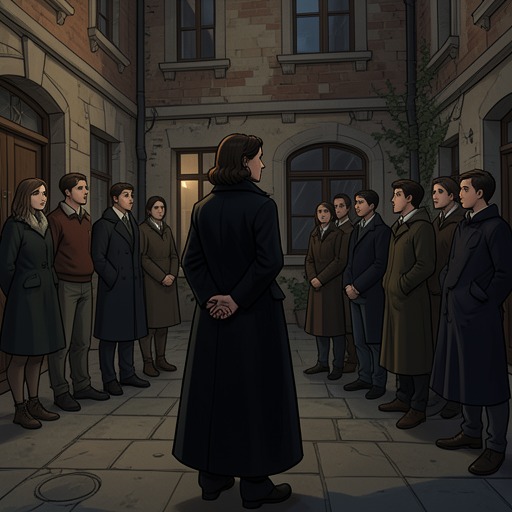
When Kathy and Tommy visit, the women’s partnership is still present, but its history cannot answer the visitors’ immediate hope. Miss Emily explains and regrets the limits of what she and Madame could achieve. Madame, speaking from behind them, rejects the expectation that the students should feel grateful: they came wanting more, and the better lives the women fought to secure did not satisfy them. Her response reveals the emotional strain in their relationship to the students they had sought to protect. The women measure their work against the worse treatment they believe they prevented; the students measure their lives against the freedom they never received.
Kathy’s later experience as a carer gives that unresolved difference a concrete human scale. At thirty-one, she has worked for more than eleven years and expects to continue until she has served almost twelve; for the last six years she has been allowed to choose donors, often seeking people from Hailsham or from her past. When Ruth is gravely ill after her second donation, Kathy sits beside her, holding her hand, and promises to become Tommy’s carer. That intimate act of attention is far removed from exhibitions and political influence, yet it belongs to the same history of trying to meet students’ needs within a system that remains intact. Tommy later questions whether good care matters when donors will donate and complete anyway. The contrast clarifies both the value and the limit of Miss Emily and Madame’s partnership: they improve how students are treated and remembered, but their protection cannot release them from the fate around which their lives have been organized.