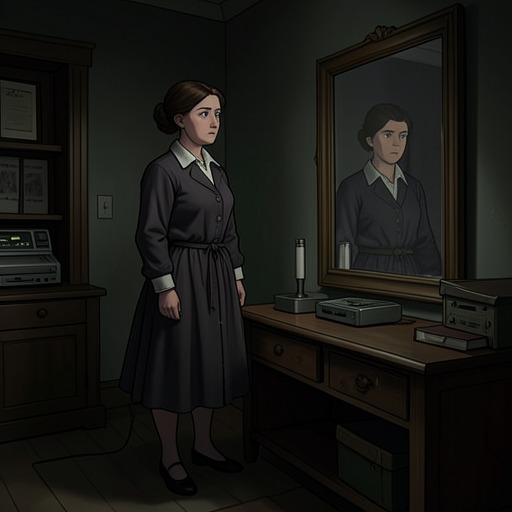
Miss Geraldine
Never Let Me GoMiss Geraldine is a soft-spoken Hailsham guardian remembered for comforting students and for becoming the focus of their protective games and imagined private favor. Her kindness is most consequential in a classroom incident involving Tommy: an attempt to spare him ridicule instead helps set resentment in motion. In the children’s recollections, she is both a real source of care and the center of stories whose claims about her favor they cannot verify.
Identity and Character
When Kathy recalls Miss Geraldine from the students’ younger years, she describes her as everyone’s favorite guardian at that age: gentle, soft-spoken, and ready to comfort a child who needed it, even after the child had misbehaved or been reprimanded by another guardian. If Miss Geraldine herself had to tell a student off, she would give that student extra attention for days afterward, as though she owed them something. Her care thus extended beyond the moment of correction; the children understood it as a continuing effort to restore closeness.
The Art-Class Incident
Miss Geraldine’s kindness had an unintended effect during an art lesson in which Tommy drew an elephant. The picture was deliberately childish, took about twenty minutes, and earned a laugh, though not the response Tommy had hoped for. Miss Geraldine was teaching that day. Kathy later reflects that a different guardian might have simply told Tommy off and left the drawing to be read as a weak joke. Miss Geraldine instead tried to look at it with kindness and understanding, apparently anticipating that the other students might mock him. She went further, pointing out things in the picture to praise before the class. Tommy later recalled hearing the students talk about him after they left the room. Kathy identifies Miss Geraldine’s well-intentioned praise as the point at which their resentment began: her attempt to protect Tommy made him more conspicuous among his classmates.
The Secret Guard and Ruth’s Claims
Around the time the children were seven or eight, Ruth led a secret guard whose members believed Miss Geraldine was the best guardian at Hailsham. Its membership fluctuated between six and ten as Ruth admitted or expelled children; Kathy is unsure whether Ruth invented the group, but remembers that she was unquestionably its leader. The children made gifts for Miss Geraldine, including a large sheet covered with pressed flowers. Their central purpose, however, was to protect her from a supposed plot to kidnap her. They did not know who was behind the imagined plan, and only suspected various older boys or a guardian they disliked; they were convinced that the woods behind Hailsham House would be involved. The abduction remained a children’s fear and conjecture, not an event shown to occur.
Ruth also encouraged the impression that Miss Geraldine showed her particular favor. When Ruth displayed a pencil case and proposed that everyone agree she had obtained it in the Sale, Kathy understood the carefully phrased claim and Ruth’s knowing smile as an implication that it had been a gift from Miss Geraldine. Ruth had previously hinted at other supposed privileges, such as being allowed to play a music tape in the billiards room before four o’clock or receiving Miss Geraldine’s attention during a walk when the rest of the group had been asked to keep quiet. The claims were never made outright, and Kathy could not establish whether they were true. Although guardians were not officially meant to show favoritism, the children observed small displays of affection within permitted limits; Ruth’s suggestive hints left Kathy unable to challenge her without turning an implication into an explicit accusation.
Narrative Significance
Miss Geraldine’s remembered importance lies less in a separate plot of her own than in how the children organize their feelings around her. Her observable tenderness gives the secret guard a credible object of devotion, while the group’s uncertain kidnapping fears reveal how children turn partial knowledge and anxiety into shared play. Ruth’s hints about special treatment further show how a guardian’s ordinary kindness could acquire social meaning among students, whether or not the claimed favors had actually occurred. The art lesson provides the sharpest contrast: Miss Geraldine intends to protect Tommy, but her public praise intensifies his exposure to the group. Through these recollections, her kindness is genuine, yet it cannot control how students interpret, repeat, or use it.