Miss Lucy
Never Let Me GoMiss Lucy is a Hailsham guardian remembered for athletic strength, briskness, and an unusually direct willingness to challenge what the students have been allowed to believe. Her interventions with Tommy reveal a tension in her character: she first tries to release him from the pressure to be creative, then returns to admit that this reassurance was mistaken and that his art matters. In a separate address to the students, she insists that they understand the future set before them. She does not remain at Hailsham long after speaking so plainly, leaving her candour as both an act of care and a rupture in the school’s pattern of partial disclosure.
Identity and Presence at Hailsham
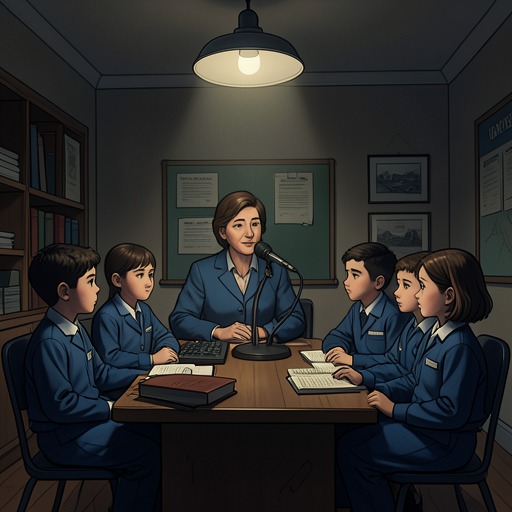
Kathy remembers Miss Lucy as the most sporting of the guardians, a distinction that her appearance would not have led the students to expect. She had a compact, strongly built figure, and her black hair grew upward rather than falling over her ears and neck. Her strength was not merely a matter of impression: even older students, including boys, struggled to keep up with her on runs across the fields. She excelled at hockey and could hold her own against Senior boys on the football pitch. When James B. tried to trip her as she ran past with the ball, he was the one sent flying.
Her athletic authority did not mean that she had always been an emotionally approachable adult. When the students were younger, Miss Lucy spoke little to them and was not the guardian they would instinctively seek out when upset; Kathy contrasts her with Miss Geraldine, who had that more comforting role. It was only as the students reached the Senior years that they began to appreciate Miss Lucy’s brisk manner. The contrast matters: she is not presented as a uniformly gentle confidante, but as someone whose directness becomes valuable when the students are old enough to grasp more of what she says.
Reassurance and Reversal in Her Relationship with Tommy
Miss Lucy first intervenes in Tommy’s distress over his lack of creativity by telling him not to worry about what others say. When Kathy later asks about it, Tommy recalls that Miss Lucy had told him it was all right if he could not be creative, and that others should not blame or pressure him for it. She tells him that he is a very good student regardless of his artistic ability. Her support challenges the judgment he has faced from fellow students and guardians, and gives him a reason, for a time, to believe that his failure to produce art need not define his worth.
That reassurance is not the last word. At the beginning of the summer, Tommy helps Miss Lucy carry flipcharts and box files toward her study. Near the Orangery, she stops him, asks for a serious conversation, and brings him into the study. She says she made a mistake years earlier and should have corrected it sooner. In Tommy’s account to Kathy, Miss Lucy now says that the other guardians had been right about his art and that her earlier encouragement had done him a disservice. Tommy does not recall her exact judgment consistently, but understands her to mean that his work was negligible or incompetent. What matters to him is not simply the insult: he tells her that he is all right now, that no one laughs at him, and that he can manage the future by being physically fit for donations.
Miss Lucy rejects that practical answer. She insists that his art matters not only as evidence but for Tommy himself, because making it can give him something personally. When he asks whether this has something to do with Madame’s gallery, she acknowledges that the gallery matters more than she once thought. She also tells him that there are things he does not understand about Hailsham and his place in the wider world, while conceding that the students who leave usually discover little. Her explanation remains incomplete, but its emphasis has shifted: creativity is no longer merely a source of school approval or protection from ridicule; it has significance within a system whose purposes she cannot fully explain to him.
The encounter carries a physical awkwardness alongside its grave subject. Miss Lucy hugs Tommy in the manner of someone comforting a much younger child, and he stands still, embarrassed by the gesture now that they are older. She asks him to begin making art again for her sake. His promise to try is less an expression of conviction than a response to the discomfort of the moment. The scene thus leaves her care sincere but compromised: she wants to repair the harm of her earlier reassurance, yet cannot give Tommy a complete account of why his art matters.
Telling the Students What Awaits Them
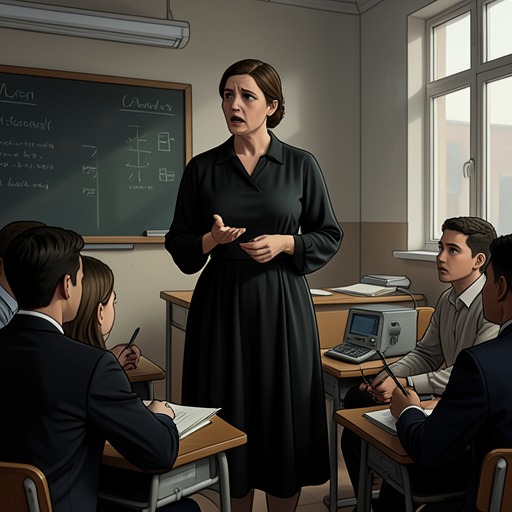
Miss Lucy’s most public challenge to Hailsham’s reticence comes when she addresses the students about their imagined adult lives. She has heard them talk about going to America, becoming film stars, or working in supermarkets, and tells them that these futures are not available to them. They will grow up and begin donating vital organs before they are old, or even middle-aged; she says that this is what they were created to do and that their futures have already been decided.
She identifies the central problem as being told and not told: the students have received some information, but do not properly understand it, and some people are content to leave them in that condition. Miss Lucy says that this is not enough if they are to have decent lives. They must know who they are and what lies ahead. Her speech does not offer a route out of their assigned future, but it breaks through the comforting possibilities the students have been entertaining. Its force comes from the plainness of the facts and from her decision to address the whole group rather than leave the knowledge dispersed in hints and fragments.
Departure and Narrative Significance
The news that Miss Lucy has left Hailsham arrives the next day, during a Culture Briefing. Another class had expected a lesson with her, but Miss Emily appeared instead and announced that Miss Lucy would not return. Kathy recalls that the students first wondered whether this was only a rumour; the report soon became unmistakable. Mr. Chris, who had been teaching Kathy’s class and apparently already knew, leaves without giving them an explanation. The account establishes the abruptness of the departure, but does not provide its practical circumstances.
Kathy immediately looks for Tommy because she wants him to hear the news from her. She finds him already among a circle of boys, listening with an empty expression while the others seem animated. That evening, Tommy and Ruth get back together. Kathy later reflects that she had not been able to assess whether her own conversation with Tommy had affected him before Miss Lucy’s departure intervened; Ruth thanks her for having helped bring about the reconciliation, though Kathy doubts that she did much. Miss Lucy’s exit therefore closes one strand of Tommy’s Hailsham life while the students’ relationships continue around the absence she leaves.
Miss Lucy’s importance lies in the contrast between her different forms of telling. With Tommy, she first offers protection from artistic judgment, then admits that this protection obscured something important. With the students as a group, she refuses the evasions that have allowed them to imagine ordinary futures. Yet even in her candour she cannot explain everything, and Tommy’s account preserves her own uncertainty about how much the students who leave will ever discover. Her actions make care more than reassurance: sometimes it requires correcting an earlier comfort or speaking a painful truth. The suddenness of her departure leaves that principle unsettled inside Hailsham, where the students have been told enough to glimpse their fate but not enough to understand the world that has chosen it.