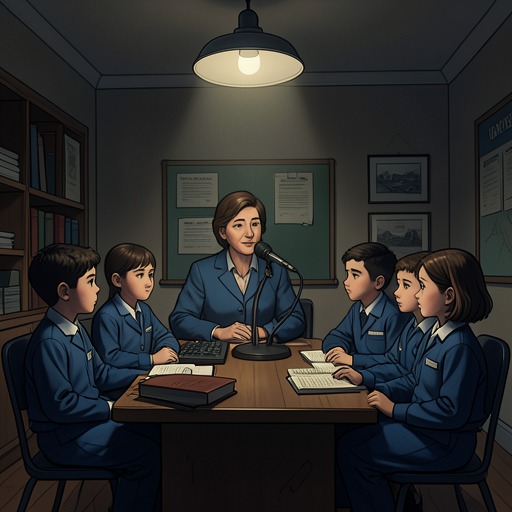
Miss Lucy reveals the students’ fate in the pavilion
Never Let Me GoMiss Lucy reveals the students’ fate in the pavilion is the moment when she states plainly that the students at Hailsham were created to donate their organs and that their futures have already been decided. The disclosure breaks through the protective vagueness surrounding their lives, but it does not immediately produce understanding: the students have encountered fragments of the truth before, and many respond as if Miss Lucy has told them nothing new.
Setting and Interruption
The scene takes place in the students’ last year at Hailsham, when they are fifteen. More than thirty of them have gathered on the pavilion veranda after a downpour begins while they are changing for rounders. The boys have recently taken to playing rounders as a way to flirt with the girls. As the rain continues, the crowded group mills about under the roof, waiting for it to stop. Laura demonstrates an especially disgusting way of blowing her nose to discourage a boy, and Kathy H. is laughing with her while keeping an occasional eye on Miss Lucy, the only guardian present.
Miss Lucy stands at the veranda rail, peering out across the playing field. Kathy notices her bent posture and the gutter’s dripping water nearly falling on her, but initially explains the posture away as impatience for the rain to end. Then the surrounding chatter falls quiet. Miss Lucy has turned from the field to face the students and speaks loudly enough for the whole group to hear. Kathy recalls having sensed even before the next words that this would be more than a reprimand or a new rule for rounders. The shift from noisy, flirtatious waiting to attentive silence gives the revelation its immediate force.
The Disclosure
Miss Lucy addresses two boys on the benches in front of her. She apologizes for overhearing their conversation, explaining that they were directly behind her, then asks Peter to tell the others what he had said to Gordon. Peter looks bewildered and seems ready to adopt an expression of injured innocence. When he does not readily explain himself, Miss Lucy gently prompts him again. She confirms that he had been saying he would have to go to America to have the best chance.
Turning her gaze across the group, Miss Lucy insists that the talk she has overheard has gone on too long. She recognizes that the students mean no harm, but says that if no one else will speak openly to them, she will. In her account, the central problem is that they have been told and not told: they have received information without properly understanding its meaning. She says some people may prefer to leave the students in that state, but she will not, because they need to know what lies ahead if they are to have decent lives.
She directly rejects the imagined futures the students have discussed. They will not go to America, become film stars, or work in supermarkets. Instead, she tells them, they will grow up and begin donating their vital organs before they are old, or even middle-aged. She says that this is what each of them was created to do, distinguishes them from the actors they watch and from herself, and stresses that their futures have already been decided. They will soon leave Hailsham, and their first donations are not distant. Her appeal is not merely to remember the information, but to understand who they are and what awaits every one of them.
A Revelation That Remains Incomplete
After speaking, Miss Lucy falls silent. Kathy remembers her gaze continuing to move from face to face, as though the speech were still going on inside her. The students seem relieved when she turns back towards the playing field. Although the rain is still steady, Miss Lucy says it is not so bad and suggests they go outside, adding that perhaps the sun will come out. The ordinary suggestion to return to the game follows a declaration about an inescapable future; the abrupt change of subject leaves the students with no shared response that could make the disclosure easier to absorb.
Kathy later questions how much Miss Lucy actually explained. When Kathy discusses the scene with Ruth at the recovery centre in Dover, Ruth claims Miss Lucy also described the usual sequence of donations, the period spent as Carers, and the recovery centres. Kathy is fairly sure those details were not given at the pavilion. She allows that Miss Lucy may have intended to explain more, but thinks the students’ puzzled and uncomfortable faces made it impossible to continue. The distinction matters: Miss Lucy names the students’ fate unmistakably, but the scene does not become a complete account of the system or its procedures.
Reception and Significance
News of the outburst travels quickly, yet attention settles more on Miss Lucy than on what she said. Some students think she briefly lost her mind; others suspect Miss Emily and the other Hailsham guardians instructed her to speak. A few who were present even interpret the episode as a reprimand for making too much noise on the veranda. When the content does come up, students tend to say that they already knew it. Their responses enact the very condition Miss Lucy has identified: exposure to facts has not made those facts fully intelligible or emotionally present.
Kathy’s retrospective account links this scene to earlier moments when Miss Lucy seemed unlike the other guardians, including her quiet remark about terrible accidents. At the time, Kathy says, she may have noticed such incidents without understanding what they signified; their coherence becomes apparent only in the light of what happened at the pavilion. Years later, she revisits the idea with Tommy. He suggests that the guardians may have carefully timed what they told the students, giving each piece of information when the students were too young to understand it fully, while leaving fragments in their minds. Kathy finds this too much like a conspiracy theory, though she concedes that something in it rings true: she remembers having a vague sense of donations from early childhood, and later talks from guardians did not feel entirely surprising. In that light, the pavilion speech does not introduce an entirely unknown future. It makes the concealed shape of a familiar but unexamined knowledge briefly explicit.