Norfolk
Never Let Me GoNorfolk is a real county on England’s east coast that acquires an imaginative life for the students of Hailsham: they first understand it as the country’s Lost Corner, a place where lost things might eventually be found. That childish belief becomes a shared comfort, later attaches itself to a recovered cassette and a search connected with Ruth, and finally gives Kathy a setting in which to imagine—briefly and painfully—that Tommy might return. Norfolk matters not because it can restore what has been lost, but because it gives loss a place in which to be remembered.
The County in the Classroom
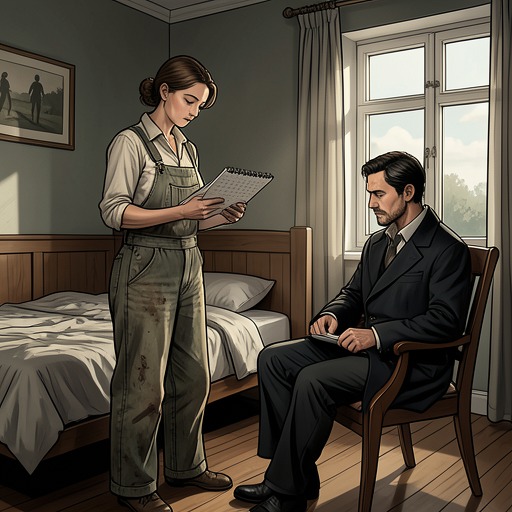
Miss Emily teaches the students about England’s counties with a map, a pointer, and picture calendars displayed on an easel. Her images of villages, churches, beaches, and cliffs help form Kathy’s enduring sense of the wider country: even years later, while travelling as a carer, she finds herself expecting to see the landscapes she first encountered in those lessons. Norfolk is the conspicuous exception. Miss Emily’s collection contains no picture of it, and her brief mention of the county does not supply the students with an image to replace the blank.
In explaining Norfolk’s position, Miss Emily describes it as jutting eastward into the sea, away from the routes taken by people travelling north and south. She presents it as peaceful and somewhat out of the way, and calls it a lost corner. The geographical description is simple, but the phrase catches the students’ attention because Hailsham has its own Lost Corner: a third-floor room where lost property is kept. A place on the map and a familiar schoolroom therefore become joined by a verbal association. The county’s absence from the picture calendars helps the association take hold; to the children, Norfolk is not only distant but unseen.
The Lost Corner as Shared Belief
After the lesson, a student misremembers or playfully extends Miss Emily’s description, claiming that Norfolk is where all the lost property in England ends up. The idea spreads through the year group and, in time, becomes an in-joke. Kathy nevertheless distinguishes the later joke from the original belief. By the students’ early teens, she recalls, they were making fun of the notion, but at first she and Ruth took it quite literally. Tommy remembers the story differently, thinking it had been a joke from the beginning; Kathy is confident that Ruth’s recollection supports her own.
The children imagine an operation on a national scale: just as lorries bring supplies to Hailsham, vehicles might carry things left behind in fields and trains to Norfolk. Their certainty is not based on evidence about the county. Rather, it grows from how little they know about the world beyond Hailsham, where places outside the school seem almost fantastical. The absence of a picture makes Norfolk more mysterious, while the story gives that mystery a practical purpose: somewhere, lost things might still be waiting.
Ruth later explains the emotional value of the belief. When the students have lost something precious and searched for it without success, Norfolk lets them imagine that the loss need not be final. They can picture travelling there when they are grown and free to move around the country, and finding what they had thought gone. The idea is a small, shared consolation rather than a carefully tested theory. Kathy recognises that Norfolk remains a source of comfort even after the students grow older and treat the story as a joke. Its persistence shows how a collective memory can survive as play while continuing to carry a more serious hope.
Searches and Returns
Norfolk becomes linked to more than the students’ invented lost-property depot. When Chrissie tells Ruth that she and Rodney believe they have seen Ruth’s possible working in an office in Cromer, a town on Norfolk’s north coast, the claim gives a real destination to the uncertain idea that each student might have a model somewhere in the outside world. Kathy is wary of the claim and does not want Ruth to go, but Ruth is determined. Kathy decides to accompany her, and the five of them—Chrissie, Rodney, Ruth, Tommy, and Kathy—set out together. Norfolk is thus both the site of a possible search for Ruth’s origins and the landscape onto which the students project questions they had been reluctant to discuss openly.
The county also returns through Kathy’s lost cassette of Songs After Dark by Judy Bridgewater. Tommy had wanted to find the original for Kathy and, when it seemed unlikely to turn up, imagined going to Norfolk to look for it. Years later, he and Kathy find another copy in a Norfolk coastal town. When they recall the old Lost Corner story, the coincidence is more than a joke: it revives their childhood wish that something precious might still be recoverable. The cassette’s rediscovery does not undo the original loss, but it briefly brings their shared past into contact with the imagined promise that had accompanied it.
Kathy’s Last Norfolk Visit
A few weeks after Tommy has completed his donations, Kathy drives to Norfolk without a particular errand and does not go as far as the coast. She passes flat, nearly featureless fields beneath a broad grey sky, sometimes seeing birds rise from the furrows as her car approaches. After driving for a time without knowing where she is, she notices a small cluster of trees beside the road and stops. A fence with two lines of barbed wire keeps her out of the ploughed field; rubbish is tangled along the wire, and pieces of plastic and old carrier bags flap in the trees. The wind has gathered these scraps against the only nearby barrier in an otherwise open landscape.
Standing there, Kathy imagines that the rubbish is everything she has lost since childhood, washed up in Norfolk at last. She pictures a tiny figure appearing on the horizon and growing into Tommy, who might wave or call to her. The fantasy stops there. Kathy does not allow it to develop further; she waits, cries without losing control, and then returns to her car. Norfolk’s childhood promise reaches its most intimate form in this scene, but it cannot bring Tommy back. The place can hold the shape of her longing, not fulfil it.
Kathy says she will not search for Hailsham as it exists after its closure, and that once her carer’s work ends she will carry her memories of Ruth, Tommy, and the school with her. Her final Norfolk visit gives that resolve a concrete landscape: open fields, caught debris, and a horizon across which an imagined reunion appears and disappears. The Lost Corner has endured not as a reliable storehouse of recovered objects, but as a shared language for remembering what cannot be retrieved.