Norfolk as the “Lost Corner”
Never Let Me GoNorfolk as the “Lost Corner” is a story the students at Hailsham make from a gap in their knowledge: the county becomes the imagined destination for everything lost elsewhere in England. What begins as a mistaken interpretation of a geography lesson develops into a shared joke, but it also gives the students a way to imagine that loss need not be final. Years later, when Kathy and Tommy find another copy of her missing cassette in Norfolk, the old idea returns with an emotional force that the joke alone cannot explain.
A county missing from the lesson
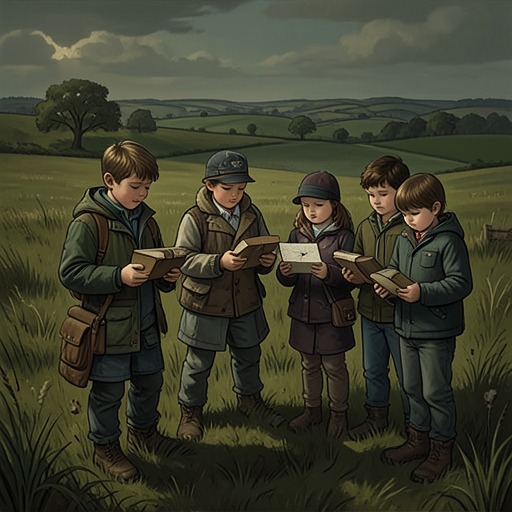
The idea begins in lessons taught by Miss Emily. She uses a large map, a pointer, and picture calendars to introduce the counties of England. As she moves between map and easel, the students see villages, streams, churches, fields, beaches, and cliffs. Kathy later recalls that these pictures continued to shape how she imagined places even after years of travelling as a carer. The lesson is not simply a list of county names: its photographs supply the students with a visual world beyond Hailsham, a world they have little direct experience of.
Norfolk is the conspicuous exception. Miss Emily’s calendar collection contains no picture of it, although the county recurs in the lessons. She points to it on the map and describes it as a peaceful, rather out-of-the-way place on England’s eastern edge, a “lost corner.” On one occasion she pauses, apparently having no picture to show next, before explaining that travellers going north or south tend to bypass it. The unillustrated county is therefore introduced through absence: the students hear where it is and what it is like, but cannot compare that description with an image.
From geography to lost property
The phrase acquires a second meaning because Hailsham has its own Lost Corner on the third floor, where students go when something has been lost or found. After Miss Emily’s lesson, someone interprets her description as meaning that Norfolk is England’s lost-property destination: anything misplaced in the country eventually turns up there. The claim spreads until it is accepted across the students’ year. Kathy cannot remember who first made the connection, but she remembers how thoroughly the idea took hold.
Tommy later recalls the belief as a joke from the outset. Kathy disagrees, and notes that Ruth remembered it as she did: at first, the students believed the story literally. By the time they were twelve or thirteen, the Norfolk idea had become a joke, but that later tone does not erase the earlier credulity. Kathy recalls imagining a large-scale version of the deliveries they knew at Hailsham: as vehicles brought food and goods for Sales to the school, other vehicles might travel around England collecting things left behind in fields and trains and taking them to Norfolk. Since they had never seen a picture of the county, its blankness helped sustain its mystery.
A consolation for what is lost
The students’ belief belongs to a time when places outside Hailsham seemed almost like fantasy lands. They had only hazy ideas about the wider world and what might be possible in it, so they did not test the Norfolk story closely. Its usefulness lay less in its accuracy than in the hope it offered. Ruth later describes that hope in a conversation with Kathy: after searching for something precious without finding it, they could still imagine that, once grown and free to travel, they might go to Norfolk and recover it. The imagined destination did not undo loss; it left open a comforting possibility after ordinary searching had failed.
Kathy agrees that Norfolk became a genuine source of comfort, probably more than the students admitted. That persistence explains why the idea remained in their conversation after it had become an in-joke. Its emotional meaning is clearest in contrast with its fanciful mechanics: the imagined lorries and national storehouse are childish, yet the need they answer is real. Norfolk lets the students give absence a location, and therefore imagine that what has disappeared might still exist somewhere, beyond their reach for now.
The lost cassette and the return of the idea
The belief resurfaces years later through Kathy’s lost copy of Judy Bridgewater’s Songs After Dark cassette. Kathy and Tommy find another copy in a town on the Norfolk coast. They recognize the coincidence as funny, but Kathy recalls that both of them also felt an old tug: the wish to believe again in something that had once mattered to them. Norfolk does not literally return the original cassette; the copy they find is another one. The distinction preserves the loss even as the discovery echoes the students’ childhood story.
Kathy’s brief response to Ruth’s later gift of a different cassette also shows how readily the Norfolk phrase can stand for what cannot be retrieved. When Ruth tells her that the original tape is really gone, Kathy says it has gone to Norfolk, and they laugh. The remark acknowledges the disappearance while borrowing the old fiction as a soft landing. Across these recollections, Norfolk changes from an unpictured county into a shared explanation, then a joke, and finally a compact expression of longing. Its imaginative power rests on the tension between knowing that the story is not true and wanting, for a moment, to believe that lost things still have a place where they can be found.