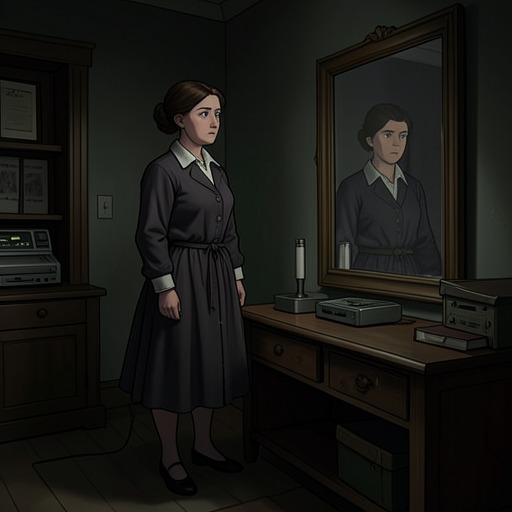
Ruth’s pencil case and Kathy’s confrontation
Never Let Me GoRuth’s pencil case and Kathy’s confrontation is a remembered Hailsham episode in which a small possession becomes the focus of rivalry, shame, and repair. Ruth presents the case in a way that invites others to believe it came from Miss Geraldine, while Kathy’s effort to test that claim turns their unspoken competition into a private injury. The object matters not only as a coveted possession, but as a token of the special attention Ruth hopes others will imagine she has received.
Background: possessions and status at Hailsham
The incident unfolds within the economy of the Exchanges, held four times a year at Hailsham. Students contributed paintings, drawings, pottery, and other creations; the guardians awarded Exchange Tokens for their work, which students then spent on pieces made by classmates in their own year. Alongside the Sales, the Exchanges were a principal way to acquire personal belongings. Students kept their purchases in named wooden chests under their beds, and many took care to arrange and display their collections.
These systems made possessions socially charged. As students grew older, they became more attentive to the value of their work and to personalizing their beds and desks. Having something selected by Madame had once seemed an unquestioned honor, but by about age ten that pride had become complicated by the thought that the most marketable work was being taken away. In this setting, a pencil case could signify more than practical use: it might suggest access to a desirable Sale item, or a guardian’s exceptional favor.
The pencil case and Kathy’s suspicion
The confrontation begins in crowded Room 5 on a winter morning. The small room is stuffy, its windows steamed by the radiators, and students are squeezed around a desk where Ruth is sitting. Kathy notices a polished-looking, deep tan pencil case patterned with red circles, its zip fitted with a furry pom-pom. Ruth moves it out of Kathy’s way, but not before Kathy has seen it and asked whether it came from a Sale. Several nearby girls turn to admire it.
Ruth pauses to check the faces around her before saying that they should agree she got it at the Sale, then gives them a knowing smile. Kathy understands the implication: Ruth is suggesting that Miss Geraldine gave it to her. It is not an explicit claim, which makes it difficult to challenge. For weeks, Ruth has used a particular smile, a lowered voice, or a stage-whisper gesture to hint at small favors: permission to play a music tape in the billiards room before four on a weekday, or a conversation with Miss Geraldine during a walk when the rest of the group had been told to keep quiet. Guardians were not supposed to show favoritism, though limited displays of affection did occur, leaving Kathy uncertain whether Ruth’s hints were true.
Kathy is especially stung because a gift from a guardian seems to her to exceed even the informal boundaries of favor she has observed. She glares at Ruth, who responds with a hurried warning and another smile; the arrival of the guardian ends the moment before Kathy can answer. Afterwards, Kathy becomes distracted for days, imagining how she might expose Ruth and make her admit she had invented the story.
The bluff and its cost
Kathy reasons that the pencil case probably came from a Sale. Ruth might have obtained it from another student, but Kathy considers that unlikely: such an attractive item would have been noticed if it had circulated at Hailsham. Ruth could also have reserved it with a monitor before a Sale opened, making it less likely that others had seen it. Sales registers recorded what was bought and who bought it, so Kathy considers checking one. She eventually decides that she need not carry out the whole plan; if her guess is right, she can bluff.
On a foggy, drizzly day, the two girls take shelter under the eaves of the main house. As students hurry in from the rain, Kathy tells Ruth she had been looking through the register at the previous Tuesday’s Sale. Ruth quickly asks why she was looking at it. Kathy says she had been talking with a monitor and turning the pages, then adds that the register shows what people have bought. Kathy is looking out at the rain when she sees Ruth turn away, upset and close to tears.
The sight changes the meaning of Kathy’s scheme for her. What had seemed like a carefully prepared way to catch Ruth out now feels like a deliberate effort to hurt her closest friend over a harmless fantasy. Kathy recognizes that Ruth had not actually named Miss Geraldine, and that students themselves often dreamed of a guardian bending a rule or giving them a special kindness. Kathy tries to soften what she has said, but the attempted reassurance does not repair the moment. After a further silence, Ruth walks away into the rain.
A chance to protect Ruth
Kathy struggles with remorse and frustration, unsure how to make amends. She later creates small opportunities for Ruth to be near Miss Geraldine, including slowing down at a classroom door so Ruth can pass beside the guardian. These gestures do not resolve what happened under the eaves, and Kathy fears that the friendship may simply fade.
The opening comes during an art lesson, when Midge innocently asks Ruth where the pencil case came from. Ruth tenses and looks around at the students present. Before Midge or the others can press her, Kathy intervenes, saying that there are good reasons the case’s origin cannot be told and making it sound like a mystery. The group nods along; Midge lets the matter drop. Kathy has not openly discussed the Sales-register confrontation with Ruth, and Ruth cannot openly thank Kathy for stepping in. Still, Ruth’s manner over the following days and weeks makes her gratitude clear, and Kathy notices her looking for an opportunity to do something kind in return.
About a month later, Kathy loses her favorite cassette. Ruth gives her a replacement she has found at the last Sale, Twenty Classic Dance Tunes, which turns out to contain ballroom orchestral music rather than anything like Kathy’s lost recording. Kathy initially recognizes the mismatch, but then realizes Ruth could not have known what kind of music she wanted. She accepts the gesture with happiness and squeezes one of Ruth’s hands in both of hers. The replacement is not valuable to Kathy for its music; it becomes a treasured object because Ruth chose it for her. Long afterward, especially after Ruth is gone, Kathy continues to keep it.
Significance
The episode sets the regulated exchange of possessions beside the less measurable exchange between friends. At Hailsham, work earns Exchange Tokens, and Sales and Exchanges give students ways to build personal collections. But the pencil case and the later cassette acquire their deepest meaning through implication, attention, and response rather than through their price or usefulness. Ruth’s case becomes a bid for recognition; the replacement tape becomes a keepsake because it records an act of care, despite being musically unsuitable.
The narration also makes the confrontation a story of belated understanding. Kathy recalls the initial scene through the anger and elaborate plan she felt at the time, then revises its meaning when Ruth turns away in tears. The later intervention with Midge does not erase the hurt, but it gives the girls a way to resume caring for one another without directly naming the injury. In that movement from suspicion to regret, and from regret to an unspoken kindness, the pencil case becomes the point around which their friendship is tested and renewed.