Search for Ruth’s Possible
Never Let Me GoThe search for Ruth’s Possible takes five young people from the Cottages to Norfolk to find a woman Rodney believes resembles Ruth and might be one of the possibles from whom students were modeled. The outing begins as an uncertain mix of hope, social performance, and curiosity, but ends with a failed identification and Ruth’s blunt account of the students’ origins. Its decisive turn comes not when the group first spots the woman, but when proximity makes the resemblance—and the comforting story built around it—harder to believe.
Background and decision to go
Chrissie and Rodney’s claim that they had seen Ruth’s possible carried particular weight because the veterans admired students from Hailsham. Ruth had encouraged the impression that Hailsham students might enjoy special privileges, largely by allowing assumptions to stand rather than openly lying. Kathy understood that this history made the proposed search more complicated: she was wary of Ruth going, though she could not fully explain her reluctance. When Ruth insisted, Kathy said she would come too. Ruth initially seemed less than pleased, and for a time it appeared she might exclude Tommy as well; eventually all five agreed to go.
The trip’s importance to Ruth was clearer than she let on. She presented the excursion as a joke and as an opportunity to make better use of their freedom since leaving Hailsham, including a chance to find their lost things in Norfolk. She repeatedly played down the prospect of finding her possible. The day before the journey, however, a message reached the farmhouse kitchen that the borrowed car might not be available. As Fiona relayed it while preparing stew with other veterans, Ruth’s posture abruptly stiffened; she pushed past Kathy and left without speaking. Kathy concealed the real source of Ruth’s distress by telling Fiona it was about something else. Rodney secured a replacement car, but Ruth’s reaction had already shown how much the search mattered to her.
The journey and the group’s divisions
Rodney had arranged to borrow a car from farm-workers at Metchley, a couple of miles away. After the original arrangement failed, he obtained a promise of another vehicle, and before dawn the five set off in a battered but usable Rover. Chrissie sat beside Rodney; Ruth, Tommy, and Kathy sat across the back seat, a formation that seemed natural to them as they got in.
Once they reached the main roads, Ruth leaned forward between the front seats and talked to Chrissie and Rodney. Her position left Tommy and Kathy on either side of her, unable to hear the conversation and unable to speak or even see one another across her. When Ruth occasionally leaned back, Kathy tried to draw the three of them into conversation, but Ruth did not respond for long before leaning forward again. After about an hour, as daylight began, they stopped beside a large empty field. Kathy noticed Ruth standing apart and looking toward the sunrise. She suggested Ruth change seats so she could continue talking with Chrissie while Kathy and Tommy could talk together. The scene makes the search a test of the group’s relationships as well as a pursuit of a possible: Ruth’s attention is fixed on the veterans and the hope they have brought her, while Kathy feels the distance that creates between her and Tommy.
The office and the apparent resemblance
The group followed Rodney into town, where his directions repeatedly led them down the wrong streets. At least four times he confidently turned off the High Street only for the shops and offices to peter out, forcing them to double back. He grew defensive and seemed close to giving up, until he stopped and pointed across the street.
The office was visible through a broad street-level glass front. Inside, roughly a dozen desks stood in irregular L-shaped arrangements among potted palms, polished machines, and curved desk lamps. Workers moved between desks, leaned on partitions to chat, or sat together with coffee and sandwiches. Tommy observed that they were having lunch without leaving the office. To the group, the room looked like a comfortable, self-contained world, and Kathy saw Ruth’s eyes moving anxiously across the people behind the glass.
Rodney identified a woman in a blue outfit, speaking with a larger woman in red. At first the identification was not obvious, but the woman’s age, her darker hair tied back in a ponytail, and particularly her face as she laughed and shook her head seemed to echo Ruth’s. The resemblance gathered force as the five watched. Then a couple of the office workers noticed them, and one gave an uncertain wave. The interruption broke their concentration, and they ran off in giggly panic. For a moment, the sight through the window had allowed them to treat resemblance as evidence and possibility as something nearly found.
The gallery and the failed identification
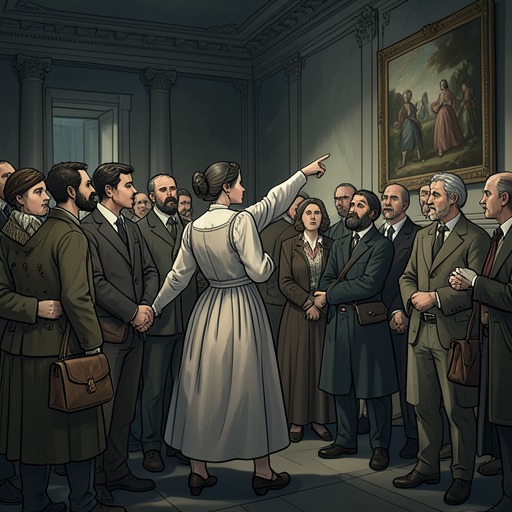
The group later entered a gallery where the woman they had followed was talking with a much older, silver-haired woman who seemed to be in charge. The room was empty apart from the two women. Kathy found herself absorbed by its quiet: peppermint-colored walls and ceilings, fishing net and a rotted boat fragment displayed near the cornice, and oil paintings in deep blues and greens, many with sea themes. The others wandered separately among the pictures, making only occasional hushed remarks, while the two women’s conversation carried across the space.
They heard the women discussing a man they both knew and his inability to manage his children. As they listened and stole glances, the apparent resemblance to Ruth weakened. The woman was now close enough to be seen and heard as an individual, not just through the office window, and the group increasingly felt that she was not Ruth’s possible. Ruth, absorbed in a painting on the other side of the room, seemed to share their realization. They lingered among the pictures, delaying the moment when they would have to acknowledge what they had seen. When the woman left, no one followed her; the group avoided one another’s eyes as their unspoken conclusion settled.
Outside, Chrissie said that they all knew the woman was not Ruth’s possible and apologized, while also insisting that Rodney’s attempt had not been unreasonable: through the windows, the resemblance had seemed persuasive. Rodney patted Ruth’s shoulder too, smiling as though he had tried to do her a favor. Ruth gave little response, shrugging away Chrissie’s touch and looking toward the sky. The failed search left her exposed to a disappointment the others could soften only by calling the attempt understandable.
Ruth’s explanation and the search’s significance
Ruth finally admitted that she had thought the search was foolish all along, but rejected Tommy’s effort to dismiss it as harmless fun. She explained that people did not use someone like the office worker as a model for students like them. When Kathy tried to stop her, Ruth continued: she said they were modeled from society’s discarded people—among them drug users, sex workers, alcoholics, tramps, and possibly criminals, though not people considered psychotic. She pointed to the women in the gallery as people who had taken the group for art students, and argued that they would have reacted differently had they known what the visitors were.
Ruth’s account turns a disappointing outing into a confrontation with the limits of the group’s hope. The search had assumed that a familiar face might disclose a more reassuring origin; Ruth instead insists that their models come from people whom society rejects. Her appeal to look in gutters and rubbish bins, rather than among respectable office workers, is deliberately brutal, and Kathy’s attempt to interrupt shows how painful the statement is within the group. The trip does not establish the identity of any model for Ruth. It does, however, expose the gap between the imagined possibility of finding oneself in an ordinary, admired adult and the stigma Ruth believes defines the students’ origins.