Students test and confirm that Madame fears them
Never Let Me GoThe students’ test of Madame turns a private childhood theory into a painful recognition of their place in the world. At Hailsham, six students deliberately approach the visiting collector to see whether she is afraid of them. Her restrained but unmistakable recoil confirms Ruth’s suspicion; more importantly, it makes the students feel the difference between themselves and the people beyond their sheltered school as something visible in another person’s eyes.
Background: Madame and The Gallery
Madame came to Hailsham usually twice a year, sometimes three or four times, to select work from the students. Her visits mattered because the children’s paintings, sketches, pottery, essays, and poems were gathered for her consideration, although The Gallery itself remained hazy to them. They did not discuss it with the Hailsham guardians. Looking back, Kathy H. understands that this silence was partly a rule the students had imposed on themselves, not merely an order from adults. The institution’s importance was thus felt before the children could clearly explain what it meant.
To the students, Madame was sharply distinct from the other adults who came to the school. Tall and narrow, with short hair and a sharp grey suit, she kept her distance and did not talk to them. The children had called her snooty, reading her reserve as a familiar kind of adult coldness. When Ruth, around the age of eight, proposed instead that Madame was scared of them, she supplied a more disturbing explanation for the same behavior. The others challenged her: they could not imagine what Madame had to fear from children. Ruth could not specify a danger either, but insisted that her impression was right.
The disagreement persisted over several days. Rather than settling it through argument, the group devised a practical test: the next time Madame visited, the six would suddenly emerge around her, remain polite, and watch her reaction. The plan was mischievous in form, a shared dare meant to verify Ruth’s hunch. Its simplicity concealed a question the children had not yet considered: what it would mean to discover that an adult regarded them with fear.
The Test in the Courtyard
Madame’s arrival was not announced, but the preparations made it possible to anticipate it. In the weeks before a visit, the Hailsham guardians sorted the students’ work, eventually placing four or five pieces from each junior and senior year in the billiards room. The room was closed, and students watched the display grow through its windows from the terrace wall. Once the work had been arranged on tables and easels like a miniature Exchanges, Madame was expected within a day or two. On this visit the six needed to know the precise moment, since she might remain at Hailsham for only an hour or two, so they took turns keeping watch.
The school’s position helped them. Hailsham lay in a hollow, with fields rising around it, and its windows offered a view of the narrow road descending to the main gate. Vehicles were uncommon enough that a car could unsettle a lesson. When Madame’s car appeared, the students were in Mr. Frank’s spelling class in a first-floor room at the front of the house. Their sudden restlessness confused him. As the class ended, they saw Madame park in the courtyard below and hurriedly agreed on what to do.
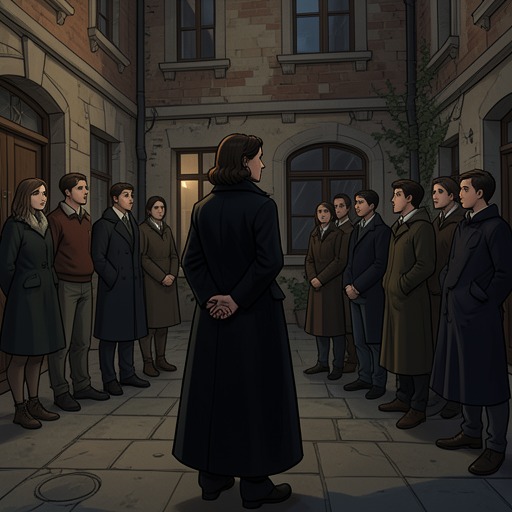
They followed the other students downstairs and waited just inside the main doorway. Madame remained in her car, searching through her briefcase, before emerging in her familiar grey suit with the case held tightly in both arms. At Ruth’s signal, the six sauntered out toward her as if in a dream. When she stopped stiffly, each student murmured an apology and moved away. They did not threaten or touch her; the test depended on their unexpected closeness and on the response it might provoke.
Confirmation and Immediate Aftermath
Madame did not cry out or gasp. She simply froze and waited for them to pass. But the children were watching her closely, and Kathy H. remembers seeing a shudder she seemed to suppress and dread that one of them might brush against her. The restraint of the reaction made it no less legible. Ruth had been right: Madame was afraid of them, and the students understood that her fear resembled the fear someone might feel toward spiders.
The discovery changed the mood before the group had even crossed the courtyard. Their anticipation had been light-hearted, private, and partly playful; now they felt as though they had walked out of sunshine into chilly shade. Hannah looked close to tears, and even Ruth was shaken. Laura asked why Madame wanted their work if she disliked them, and why she did not leave them alone. No one answered. The students continued toward the pavilion in silence, carrying a question their simple prank had opened but could not resolve.
The contradiction at the center of the scene is concrete: Madame comes to choose the students’ creative work, yet recoils from the children who made it. The Gallery offers them attention as makers while Madame’s bodily response marks them as objects of dread. Her visit therefore does not give them a clear explanation of their status; instead, the children encounter its social meaning through a gesture of avoidance. What they had treated as an abstract suspicion becomes something they can see and feel in another person’s reaction.
Retrospective Significance
Kathy H. recalls the episode as a moment when the students knew that they were different from the Hailsham guardians and from people outside the school, but did not yet understand what that difference entailed. The adults had given talks, shown videos, and held discussions, and the children had received warnings. Yet such preparation could not reproduce the force of seeing an outsider shudder at the thought of coming into contact with them. Their sheltered surroundings made the contrast especially sharp: gardeners and delivery men could joke with them and call them sweethearts, while Madame’s response disclosed another way they might be regarded.
The memory’s force comes from the delay between being told and truly understanding. Kathy H. reflects that some part of a child may already be waiting for the moment when an indistinct unease becomes knowledge, even before the child can name what is coming. In this courtyard, the students briefly see themselves through Madame’s eyes. Kathy compares the recognition to passing a familiar mirror that suddenly shows something troubling and strange. The image shifts the scene from a test of one woman’s behavior into a formative encounter with exclusion: the students discover not simply that Madame fears them, but that they can be seen as fundamentally other while still being sheltered, addressed kindly, and valued for what they create.