Students’ souls and humanity
Never Let Me GoStudents’ souls and humanity form the central moral and political question behind Hailsham’s collection of student artwork. What the students experienced as a gallery of their work was also an argument aimed at a wider society: their art could make visible the inner lives that many people preferred to deny. Miss Emily’s explanation gives that collection its full stakes. It was meant not merely to identify what students were like or whether they were in love, but to demonstrate that they had souls at all—and to challenge the conditions that made such proof necessary.
Art as Evidence of Inner Life
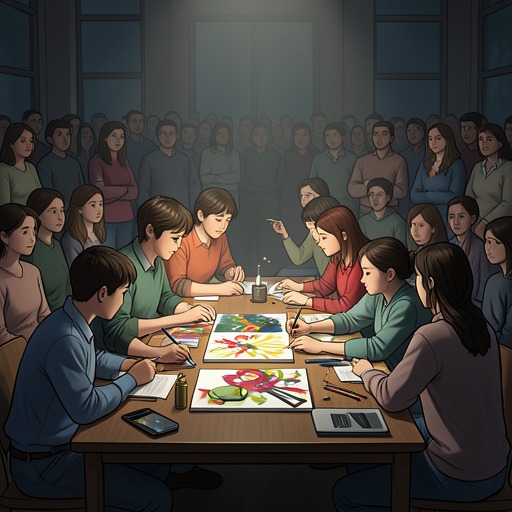
During the visit to Madame, Tommy explains that the gallery might help show what the students were like. Madame immediately supplies the more ambitious interpretation: their art displayed their souls. Her question about whether the gallery could reveal which students were truly in love points to the belief that creative work might disclose private feeling as well as character. The students’ art, in this account, is not an ornament added to their lives; it is a trace of an inner life that other people cannot or will not see directly.
Miss Emily confirms the connection but sharpens its purpose. Hailsham collected the students’ work because its guardians believed it would reveal their souls—or, more fundamentally, prove that they had souls at all. The distinction is consequential. Tommy understands the artwork as evidence of what the students are like inside; Miss Emily reveals that the audience for this evidence was a society that might doubt whether there was an inside to know. The gallery therefore turns creative expression into a public test of personhood, although the burden of proof falls on the students rather than on those who deny their humanity.
The collection had an institutional form as well as a symbolic one. Hailsham selected the best student work and used it in special exhibitions. Miss Emily recalls that the exhibitions became part of a campaign, with public events designed to place the students’ abilities before influential visitors. Art could be looked at, discussed, and presented as evidence in a way that an abstract assertion of shared humanity might not be. Yet the need to stage that evidence also exposes the unequal terms of recognition: the students’ humanity had to be argued for through the products of their creativity.
Why Humanity Had to Be Proved
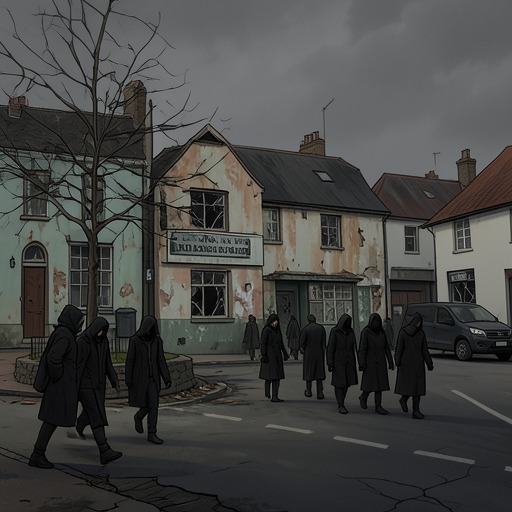
Miss Emily places the doubt about students’ humanity in the history of medical progress after the war. In the early 1950s, scientific breakthroughs rapidly created new ways to treat illnesses that had previously been incurable. The benefits of those treatments dominated public attention, while the circumstances of the students’ existence received less consideration. People could prefer to imagine that the organs used in treatment came from nowhere, or from a kind of vacuum, rather than confront how students were brought into the system.
By the time the public began asking how students were raised and whether they should have been brought into existence, Miss Emily says, the process could not be reversed. A society that had come to regard cancer and other grave illnesses as curable was not prepared to surrender those cures. Its concern for its own children, spouses, parents, and friends outweighed concern for the people required to donate. The resulting denial was both practical and psychological: students were kept in the shadows, and people who did think about them could persuade themselves that they were less than human and therefore did not merit equal concern.
That account explains why a claim about souls could have political force without removing the underlying conflict. The Donation Programme depended on students donating, while that dependence itself created a barrier to seeing them as fully human. Hailsham’s advocates were therefore trying to change public understanding inside a system whose benefits rested on the students’ continued use. Their argument could expose the contradiction, but it could not make the contradiction disappear.
Hailsham’s Campaign and Its Limits
Miss Emily describes Hailsham, Glenmorgan House, and later the Saunders Trust as the beginnings of a small but vocal movement. Its central demonstration was that students raised in humane, cultivated surroundings could become as sensitive and intelligent as ordinary human beings. This claim made the conditions of their upbringing part of the evidence: the students’ capacities were not presented as a mystery but as something that could flourish when they were treated with care and given an education and culture.
At the height of the movement’s influence in the late 1970s, its supporters organised large events across the country. Cabinet ministers, bishops, and other prominent people attended; speeches were given and substantial funds pledged. The exhibitions enabled the advocates to point to the students’ work before audiences with social and political influence. Miss Emily remembers that period as one in which support for the movement was widespread and the public tide seemed to be running in its favor.
The achievements were nevertheless selective and limited. Miss Emily acknowledges that students elsewhere were being raised in deplorable conditions that Hailsham students could scarcely imagine. Hailsham had provided its own students with unusually good surroundings and, after they left, some protection from the worst conditions; it had not secured comparable treatment for all students. Nor could its influence grant Tommy and Kathy the deferral they hoped for. Miss Emily says that such a concession would have been beyond the movement even at its strongest. Recognition of the students’ humanity and power to change the system were not the same thing.
Decline and Continuing Significance
The Morningdale scandal marks the turning point in Miss Emily’s account. After it, the public climate changed: people no longer wanted to be seen supporting the movement, and Hailsham, Glenmorgan House, and the Saunders Trust were swept away. Miss Emily’s recollection thus links the movement’s decline to the loss of public willingness to defend its cause. With Hailsham gone, she expects conditions for students more broadly to worsen, even though its former students may have been educated and protected from some of the worst experiences.
The gallery’s meaning consequently survives its institutional purpose. Its work was collected to answer a question that should not have needed answering, and its exhibitions sought to make the students’ sensitivity and intelligence undeniable to people invested in not seeing them. The collection records both an act of care and the limits of that care: Hailsham tried to secure humane lives and public recognition, but could not end the system’s dependence on donation or obtain every protection the students sought. Students’ souls and humanity are therefore presented not as qualities the art creates, but as realities the art makes legible to a world that has arranged not to acknowledge them.