The Gallery
Never Let Me GoThe Gallery is the presumed collection for which Madame takes selected work from Hailsham, an institution whose students grow up discussing the Gallery without knowing for certain that it exists. Its importance lies in the gap between what they observe and what they are allowed to understand: their art is singled out as valuable, while the reason for its collection remains obscure. When Kathy connects the Gallery to the students’ future donations, a familiar feature of school life becomes evidence that their creativity and their hidden fate may be linked.
Inherited Knowledge and Silence
The Gallery is not introduced to the students through a formal explanation from the Hailsham guardians. Instead, knowledge of it circulates among the children, passed on across generations at Hailsham. Kathy cannot remember when she first heard of it, which makes the idea feel less like a lesson than part of the school’s shared background. Its familiar name gives the children a common reference point even though none can say with confidence what the institution is or how it operates.
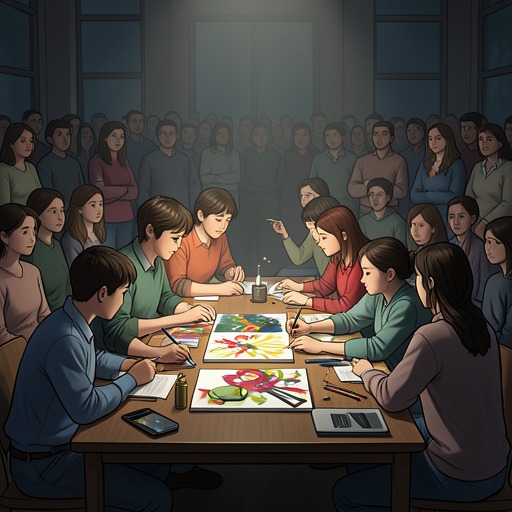
Kathy recalls an early example from when she was about five or six. While she was making something with modelling clay beside Amanda C., Amanda praised her work and said it might be chosen for the Gallery. Kathy remembers feeling pride at the possibility, followed almost immediately by the thought that none of them could yet be good enough. The memory shows the Gallery working first as an imagined standard: it gives a child’s artwork a possible destination and turns praise into a judgment about artistic merit.
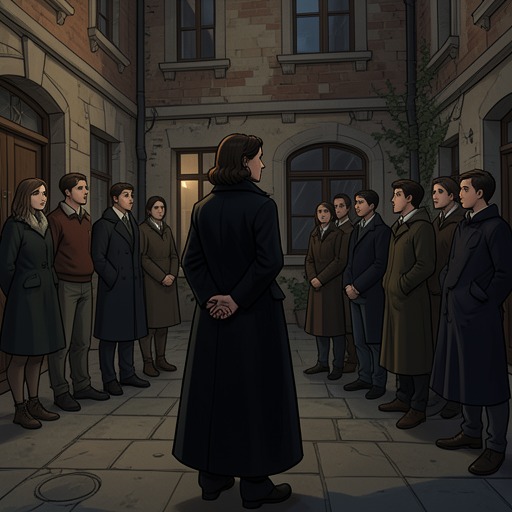
That expectation persists as the children grow older, but speaking about the Gallery in front of the Hailsham guardians is tacitly forbidden. When Carole H. mentions the possibility of work being selected during a joking conversation with Mr. Roger, she covers her mouth as soon as she realizes what she has said. The moment is treated as a breach of convention, not a catastrophe; Mr. Roger allows the conversation to move on. Kathy later understands the silence as something the students themselves helped enforce, rather than simply a rule imposed on them. Their caution preserves the Gallery’s mystery even while their everyday talk keeps its promise alive.
Madame’s Visits and the Value of Selection
The collection’s most tangible evidence is Madame’s repeated presence at Hailsham. She visits usually twice a year, and sometimes three or four times, to select work from among the students’ best pieces. Unlike gardeners, drivers bringing supplies, and nearly everyone else who arrives from outside, she does not converse with the students. Kathy remembers her as a tall, narrow woman in a sharp grey suit, holding them at a distance with a chilly look. The students call her Madame because that is what the guardians call her, although they dispute whether she is French or Belgian.
These visits give the Gallery a practical force despite the uncertainty surrounding it. Selected work is physically taken away; the rest remains with the students. In Hailsham’s token system, having work chosen by Madame is described as a most distinguished honour, though the promise of that distinction does not settle arguments about how many tokens the students should receive. The Gallery therefore exists in their lives both as a destination for art and as a measure of recognition. Selection can inspire pride, but it also sets the students’ work apart according to criteria whose purpose they do not know.
The contrast with the Sales sharpens the question of what happens to the collected work. The Sales bring in objects from outside for the students to obtain, including clothes, toys, and special things not made by another student. Tommy speculates that Madame might sell their pictures because, outside, everything is sold. Kathy rejects that explanation. To her, the Gallery is connected not simply to an exchange of goods but to the students’ future donations. The distinction matters: one possibility makes the collection part of the school’s material economy; the other suggests a relationship between the students’ art and their place in a larger system.
Questions Without an Answer
The uncertainty becomes explicit during a library lesson devoted to the tokens. After a joke about the tokens, Miss Lucy invites the students to put aside their play-reading and discuss the subject everyone has been talking about. Polly T. then asks why Madame takes their things. The question breaks an unwritten boundary. Kathy remembers feeling angry that Polly had raised it, yet eager to hear Miss Lucy’s answer; the other students likewise turn from their disapproval toward anticipation.
Miss Lucy offers only a limited assurance: she says Madame takes the work for an important, good reason, but that the students would not understand an explanation at that time and that she hopes it will be given to them one day. The answer confirms that the taking is deliberate and meaningful, while withholding the meaning itself. The embarrassed discussion quickly returns to the tokens, but Kathy continues thinking about Miss Lucy’s words. The scene links the Gallery’s mystery to a wider pattern in which the students receive fragments of information without a complete account of their circumstances.
Later, Tommy tells Kathy about a conversation with Miss Lucy concerning what the students have not been taught. That report revives Kathy’s memory of the library, and she begins to see the Gallery alongside other puzzling incidents. She asks Tommy whether the collection is connected to what Miss Lucy said about the students one day making donations. Kathy does not claim to have solved the mystery; she says only that the pieces seem linked, though she cannot yet work out how. She asks Tommy not to tell anyone about their conversation, extending the same private caution that has surrounded the subject at Hailsham.
Narrative Significance
The Gallery makes the conflict between Hailsham’s visible routines and the students’ incomplete understanding concrete. The children can see Madame arrive, watch her select their best work, and hear that this selection is an honour. They can also recognize the guardians’ silence and Miss Lucy’s promise that an explanation may come later. What they cannot establish for themselves is the collection’s true purpose. Its reality is therefore divided: the act of selection is certain, while the institution and the meaning behind it remain indistinct.
Kathy’s memories also show how that uncertainty is maintained across time. A child learns the Gallery’s name through another student’s praise; older students learn not to mention it before the guardians; a question in class briefly brings the hidden subject into the open, only for the conversation to retreat to tokens. Kathy’s later connection between art and donations does not provide an answer, but it changes how those earlier details appear. The Gallery becomes more than a promise that a student’s work might be admired: it is one of the first signs that Hailsham’s encouragement of creativity may be bound to a purpose its students have not been equipped to understand.