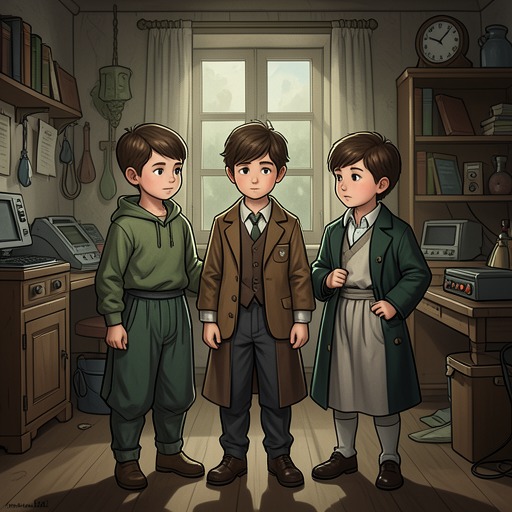
The argument over Tommy's animal drawings in the churchyard
Never Let Me GoThe argument over Tommy’s animal drawings in the churchyard is a small, quiet confrontation that Kathy H. later recognizes as a decisive break in the tightly interwoven lives of herself, Ruth, and Tommy. Its outward subject is Tommy’s belief in his drawings and his theory about showing them to Madame; its deeper force comes from Ruth turning Kathy H.’s earlier laughter into evidence against him, and from Kathy H.’s failure to contradict her. What seems at first like another tiff among friends becomes, in retrospect, the moment when their shared intimacy starts to come apart.
Setting and Immediate Context
Several days before the confrontation, Kathy H. and Ruth had laughed together over Tommy’s animal drawings during an evening in Kathy H.’s room. They joked about how one creature looked as if it were wearing underpants and how another seemed inspired by a squashed hedgehog. Kathy H. later admits that she should have told Tommy his animals were good, but she did not. Her laughter had been genuine, and she had also been pleased by the thought that Ruth did not take the drawings seriously. That private exchange gives Ruth’s later accusation its foothold: she can cite a real moment, though Kathy H. understands that the laughter meant something less simple than Ruth makes it sound.
The meeting takes place at an old church about half a mile from The Cottages. Its rambling grounds are overgrown, and gravestones lean in the grass; Ruth has made a habit of reading there on a bench beneath a large willow. Kathy H. had not initially welcomed Ruth’s new retreat, remembering the previous summer when the group had spent time together outside The Cottages. Nevertheless, when her walks brought her near the church and she thought Ruth might be there, she often passed through the low wooden gate and followed the path by the stones. On this warm, still afternoon, she arrives in a dreamy mood, reading the names on the gravestones, and finds Ruth and Tommy together beneath the willow.
Ruth sits on the bench while Tommy stands with one foot raised on its rusty armrest, stretching as they talk. Kathy H. sees no obvious sign of a serious dispute and approaches without hesitation, eager to share gossip about a newcomer. She talks for a while, while Ruth and Tommy listen and occasionally ask a question. Only after some time does she sense that something is wrong and ask, jokingly, whether she has interrupted them. The ordinary, almost casual start makes the shift that follows more jarring: a gathering of three old friends becomes a test of where each stands.
Tommy’s Theory and Ruth’s Accusation
Ruth explains that Tommy has been telling her his “big theory,” which he had already shared with Kathy H. long before. Her wording presents the disclosure as a favor Tommy has now allowed her to share in, while the phrase “big Gallery theory” gives the subject a teasing edge. Tommy sighs and seems about to answer, but Ruth continues to needle him. She says that people might accept the theory itself, but would laugh at the idea that he could persuade Madame by showing her his little animals. The drawings are therefore not just the object of a joke: they are tied to Tommy’s serious hope that they might matter to Madame.
Kathy H. wants to defend Tommy, but she is trying to find a response that will not make Ruth angrier. Before she can speak, Ruth tells him that Kathy H. also finds his animals ridiculous. The charge lands because Kathy H. knows there is a memory Ruth can use: the two women did laugh at the drawings together. Kathy H.’s first impulse is to deny the accusation and then to laugh it off, but she recognizes an authority in Ruth’s manner and cannot dismiss the claim as wholly fabricated. Ruth presses the distinction she wants Tommy to accept: private laughter between herself and Kathy H. may be harmless, but he must not let other people know he is serious about the drawings.
Tommy stops stretching and looks questioningly at Kathy H. In that instant, she sees him as childlike and without a defensive front, with something dark and troubling gathering behind his eyes. Ruth tries to contain the injury by distinguishing the two women’s private amusement from the judgment of everyone else, but the distinction does not undo the exposure. Tommy is left to decide what Kathy H.’s silence means, and she knows that the three of them understand one another well enough for Ruth’s claim to carry weight.
Kathy H.’s Silence and Departure
Kathy H. later dwells on the alternatives she failed to take. She might have denied Ruth’s account, challenged the way Ruth had twisted the meaning of the laughter, or gone to Tommy and hugged him. She recognizes that a full explanation would have been difficult: she really had laughed, but not necessarily in the dismissive way Ruth implied. Years later, physical reassurance seems to her as though it might have made her allegiance unmistakable; at the time, however, she doubts that such a gesture was genuinely available to her within the three friends’ established way of being together.
Instead, fatigue and bewilderment overwhelm her. She compares her state to being handed a difficult mathematics problem when too tired to work toward its solution. A resigned impulse tells her to let Tommy believe the worst, and she imagines her face confirming Ruth’s account. She recalls Tommy’s expression changing: for a moment his anger recedes and gives way to something like wonder. That look makes her failure to respond more consequential than a simple inability to find the right words. She understands that he is watching her for an answer, and she supplies none.
Kathy H. turns and walks back past the gravestones toward the low gate. She later calls leaving a mistake, but at the time she fears that one of the other two will storm off first, leaving her alone with the one who remains. She wants to make sure that she is the one who leaves. For several minutes she feels almost triumphant, imagining that Ruth and Tommy have been left together to suffer the company they deserve. The brief satisfaction is sharply at odds with the lasting damage she will later attach to the scene: she exits the immediate conflict, but cannot prevent her silence from becoming part of it.
Delayed Consequences and Significance
At first, Kathy H. does not understand the churchyard encounter as a turning point. In her later account, she says that she was upset but thought it no more exceptional than other quarrels the friends had experienced. Only long after leaving The Cottages does she grasp how significant it was. Her retrospective narration places the recognition after the event itself, so that the scene’s importance emerges through the difference between what she felt then and what she knows later. The churchyard quarrel is thus presented not as an openly declared rupture, but as a moment whose consequences take time to become legible.
That delayed understanding gives the argument its particular weight. The visible dispute concerns whether Tommy’s animals are laughable and whether they could persuade Madame; the underlying conflict concerns trust, loyalty, and the distance between private affection and public support. Kathy H. does not invent Ruth’s account, but neither does she believe it conveys the truth of her feelings. Her inability to make that distinction audible leaves Tommy exposed at precisely the moment he has stopped performing confidence and is looking to her for a response.
The episode also illuminates the later bonds among the three. Kathy H. says that choosing donors from her past helped her get close again to Ruth and Tommy after years apart, and that her reunion with Ruth at the Dover recovery centre made their shared Hailsham memories feel more important than their differences. Much later, when Ruth is gravely ill after her second donation, Kathy H. holds Ruth’s hand and promises that she will become Tommy’s carer as soon as she can. These later acts of care do not erase the churchyard failure; they show how the friendship continues through separation, regret, and renewed responsibility. The quarrel matters because it marks a point at which their closeness can no longer be taken for granted, and because Kathy H.’s memory keeps returning to the support she could not offer when Tommy needed it.