Tommy
Never Let Me GoTommy’s story is shaped by a tension between being judged by other people and trying to discover what he can make or understand for himself. At Hailsham, a watercolour of an elephant begins years of social exclusion; later, Miss Lucy’s reassurance about creativity first relieves him, then leaves him with a painful sense that she has withheld something important. As an adult, his theories about the Gallery and his painstaking miniature animals become ways of returning to questions that Hailsham left unresolved.
Identity and Early Exclusion
Tommy grows up at Hailsham, where the other students’ view of him is formed in part by his behaviour and his apparent lack of artistic ambition. Looking back, Kathy recognizes that his difficulties did not begin with a brief episode of teasing: the idea that he deliberately refused to try had circulated since the Juniors, and his exclusion had continued for years. Ruth’s explanation—that he had brought his problems on himself—echoes what many students seemed to believe, but Kathy’s later account makes clear how easily that belief could conceal a longer pattern of cruelty.
One early scene shows the detachment surrounding that pattern. As boys gather on the North Playing Field, Ruth tells her friends that Tommy does not suspect the latest plot against him. The girls watch from the pavilion windows, curious about what will happen, rather than actively intervening. Their distance matters: Tommy’s humiliation can become a spectacle even to people who know him, while the group’s casual observation helps make his isolation seem ordinary.
The Elephant Painting and Miss Lucy
Tommy traces the start of his troubles to an art lesson with Miss Geraldine. He had previously enjoyed painting, but in that class he made a watercolour of an elephant standing in tall grass. He later described it as a joke. Kathy suspects there was no clear explanation at the time: like many impulsive acts, it may have been done to get a laugh or provoke a reaction, only to seem inexplicable when someone demanded a reason. Whatever his intention, the picture became associated with a story about Tommy not trying, and that story outlasted the painting itself.
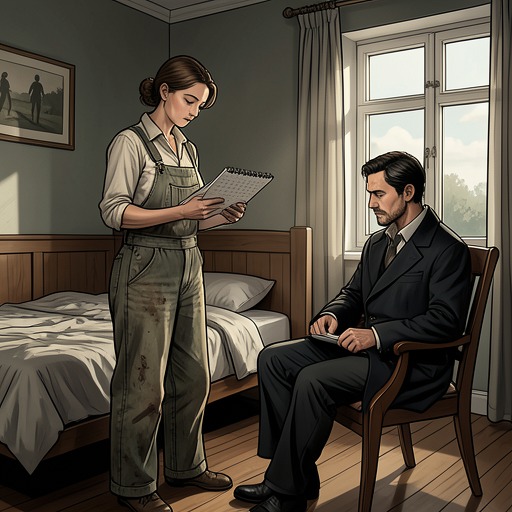
A private conversation with Miss Lucy briefly offers him a different account of his choices. Tommy tells Kathy that Miss Lucy had said it was all right if he did not want to be creative. He felt better afterward, as though her permission relieved him of pressure. But the reassurance did not settle the matter. Later, he confides that he keeps thinking about Miss Lucy, rather than about his break with Ruth. He recounts how she regretted having told him that he need not try: she now believed his art mattered, both as evidence and for his own sake, and urged him to make up for lost time.
Tommy answers her concern by thinking in practical terms about his future. He tells Miss Lucy he is fit and will manage when the time comes for donations. Her response—a hug like the one she might have given when he was younger, followed by another plea to begin drawing—makes their exchange intimate but also unsettling. She has changed what she tells him, yet cannot give him a full account of why the work matters. Tommy leaves feeling embarrassed and eager to get away, while the episode deepens his sense that adults know more than they have explained.
Searching for Meaning in Art
At the Cottages, Tommy begins to draw again, without telling Ruth. His project grows out of an old children’s book he found behind a sofa, with its back cover missing. He persuades Keffers to give him one of the small black notebooks in which Keffers scribbles figures, then fills it with at least a dozen imaginary creatures. Rather than making large pictures like the elephant watercolour, Tommy draws the animals tiny, working within the limited pages and adding details about how each creature might protect itself or reach things. He believes that making them small changes the whole process, as if the creatures come to life on the page.
The project is at once a response to his past and an experiment with a different kind of artistic attention. Kathy initially finds it hard to show enthusiasm and is reminded of the elephant painting that began his troubles. Tommy, however, is not simply repeating that earlier work: he is trying a new scale and attending to the imagined lives and capabilities of the creatures. His drawings do not resolve whether art can affect his future, but they show him acting on Miss Lucy’s appeal even while keeping the effort private.
He also turns to the mystery of the Gallery. Tommy reasons that the rumour of deferrals for couples in love might explain why Madame took away the best student work: perhaps the Gallery was meant to assess whether students were truly in love. The theory joins two puzzles that had occupied students at Hailsham, the purpose of the Gallery and the meaning of the collected artwork. Kathy warns him that Miss Emily might be furious if he presents the idea and she believes it. Tommy’s theory is not confirmed in these scenes, but it shows him revisiting fragments of Hailsham’s past and arranging them into a possible explanation.
Relationships and Later Encounters
Tommy’s relationship with Ruth and his connection with Kathy frame his later life. When Kathy urges him to reconcile with Ruth, she argues that Ruth wants a fresh start and that being together could help him after they leave Hailsham. Tommy hesitates, telling Kathy that other things are on his mind. His continuing distress about Miss Lucy shows that his emotional life cannot be reduced to his relationship with Ruth: the question of what she told him, and later took back, remains unresolved for him.
Years later, Kathy and Ruth arrive at the Kingsfield recovery centre and Tommy comes out from a group of donors beneath the recreation hall roof. He is wearing a faded green tracksuit top and looks heavier than Kathy remembers. Ruth stays in the car, momentarily unsure whether to get out; Kathy steps out, and Tommy looks to her and hugs her first. The faint medical smell Kathy notices and the setting among the donors mark the distance from their childhood, while the embrace makes their old connection immediate again.
Tommy also takes part in the search for Ruth’s possible. While the group waits near a car park, he is joking with Rodney, but suddenly stops when he sees a woman leaving the office and says that she is the same one. The others follow her along the busy High Street, keeping a distance and trying not to look like a gang. The scene makes Tommy an active participant in the group’s uncertain investigation: his recognition gives them a reason to pursue the woman, though it does not establish that she is Ruth’s possible.
Care, Vulnerability, and Significance
After Ruth’s second donation, Kathy is allowed to visit her in the early hours, three days later. Ruth is alone in a hospital room, in severe pain and largely inaccessible, though she has a brief moment of recognition. Kathy holds her hand and promises that she will become Tommy’s carer as soon as she can. This promise links Tommy’s future care to Ruth’s final request and to Kathy’s effort to renew bonds with people from Hailsham. At the Kingsfield reunion, Kathy’s instinctive step out of the car has already shown how readily that older closeness returns.
Tommy later asks Kathy whether she ever gets tired of being a carer and wishes that she would receive notice to stop. The question unsettles their roles: Kathy has taken pride in doing the work well, while Tommy asks her to consider its cost and the fact that donors will donate and complete regardless. Their exchange presents him not only as someone dependent on care, but also as someone able to notice the burden carried by the person caring for him.
Across these episodes, Tommy’s efforts to draw and to interpret the Gallery sit beside relationships that survive exclusion, uncertainty, and separation. He is repeatedly made to confront other people’s judgments—of his art, his conduct, and what his future permits—yet he continues to search for meanings that have not been plainly given to him. The miniature creatures, with their imagined ways of protecting themselves and reaching what they need, offer a particularly concrete expression of that search.