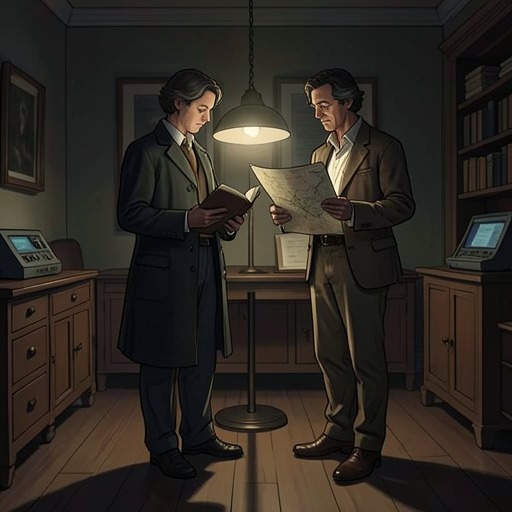
Tommy begins drawing miniature animals
Never Let Me GoTommy’s miniature-animal drawings mark a private return to making art after the ridicule he endured at Hailsham, and a tentative decision to let someone else see what he has made. The drawings begin as a secret project, but their painstaking detail and Tommy’s growing willingness to show them distinguish this effort from the childhood pictures associated with his earlier exclusion.
Background and private beginnings
The project emerges after Tommy and Kathy have discussed his theory about the significance of Hailsham students’ art. Kathy warns that explaining the theory to Madame could make her furious. Tommy says little at first; later, walking through narrow side streets, he sheepishly admits that he has already started doing something in preparation, and that he has told no one—not even Ruth. The drawings therefore begin under a cloud of uncertainty: Tommy is making them in connection with a theory he has not explained to others, but his activity is also personal and initially guarded.
His source is an old children’s book with its back cover missing, which he finds behind a sofa at the Cottages. He persuades Keffers to give him one of the small black notebooks Keffers uses for scribbled figures, then fills it with at least a dozen fantastic creatures. The modest materials matter to the undertaking: Tommy takes an available book and a pocket-sized notebook and turns them into a space for sustained, independent work. He says the small pages have changed how he draws. Because the animals must be tiny, he thinks through how each might protect itself and reach things, filling out their imagined lives through details rather than simply reproducing the kind of pictures he made at Hailsham.
Kathy initially struggles to respond. Hearing Tommy’s excitement, she remembers the elephant-in-the-grass picture that began his troubles at Hailsham and fears that imaginary creatures will expose him to laughter again. She does not voice that fear; instead, she looks at him cautiously and offers encouragement she does not yet fully feel. Her reserve makes clear how the earlier social punishment still shapes both her expectations and Tommy’s decision to keep the work hidden.
The first viewing in the Goosehouse
A little over two months after the Norfolk trip, Kathy encounters Tommy near the Goosehouse, barefoot on a patch of dry ground amid puddles. He has been drawing and holds up a small black notebook. He invites her to look, then leads her inside. The leaking, disused barn—with sunlight coming through its skylights and broken furniture pushed against the walls—has become a private workroom. Tommy’s Wellingtons lie beside the settee where he has been sitting; he has taken off his clothes and boots without noticing, and cut his foot. The scene presents the drawings not in a classroom or a formal gallery but in an improvised refuge on the Cottages’ outskirts.
This is the first time Kathy sees the creatures. She had imagined reduced versions of the pictures the students made when they were small, so their actual appearance takes her by surprise. At first they do not even register as animals. Their pages are crowded with elements that resemble the inside of a dismantled radio: tiny canals, interweaving tendons, miniature screws, and wheels, all rendered with obsessive precision. Only when a page is held away does a recognizable form, such as an armadillo or a bird, come into view. The scale and mechanical intricacy make the drawings feel unlike Tommy’s earlier work and unlike what the guardians taught at Hailsham.
Tommy calls it his second book and says the first is not fit for anyone to see; it took him time to get started. He tries to appear casual as he lies back on the settee and pulls on a sock, but Kathy recognizes that he is waiting anxiously for her response. She hesitates, partly because she fears that art might get him into trouble again and partly because she has no familiar standard by which to judge work so different from Hailsham’s. Her pause makes the act of showing the notebook a test of trust as well as an artistic unveiling.
From concealment to tentative confidence
As Kathy studies the creatures, her reluctance begins to give way. Their busy, metallic features seem at odds with the sweetness and vulnerability she perceives in them. She recalls Tommy’s concern, expressed when he first described the project, with how the animals could protect themselves or reach and fetch things. The drawings thus carry questions of survival into their own invented world: their details are not merely decorative but imagine the practical needs of small, vulnerable beings.
Tommy explains that he is not drawing only because of the theory they have discussed; he likes making the animals. He wonders whether he should continue to keep them secret. Hannah still paints watercolours, he notes, and many of the veterans make things too. He does not propose showing the work indiscriminately, but sees less reason to hide the fact that he draws. Kathy finally answers with conviction that he has no reason to conceal the animals and that they are good. She even calls it foolish for him to be hiding away to draw them. Her encouragement is more than the cautious reassurance she offered on the walk: it recognizes the work on its own terms, and Tommy’s smirk shows how happy her approval has made him.
Ruth has already seen the drawings, having looked at them the previous week; Kathy is the next person Tommy chooses to show. After their brief exchange, the subject does not become a frequent topic between him and Kathy that spring. The encounter nevertheless establishes a change in the project’s status: the animals have moved from a secret Tommy shared with no one to work acknowledged by both Ruth and Kathy, and Tommy has begun to consider allowing others to know about them.
Significance
The episode sets Tommy’s renewed art against his history of being mocked for drawing at Hailsham. Kathy’s memory of the earlier elephant picture initially makes her anticipate another humiliation, but the miniature creatures are not a repetition of that work. Their scale, elaborate internal structures, and imagined adaptations show Tommy experimenting with a form that he understands as different from what he had done before. The contrast makes his creative development visible without erasing the vulnerability that the earlier rejection left behind.
The drawings also shift between a possible purpose and an enjoyment that needs no justification. Tommy first keeps them secret while thinking about the theory, yet he insists that he also draws because he likes it. His growing wish to stop hiding the notebook therefore suggests a limited but meaningful independence from the need to make art serve an explanation to someone else. Kathy’s response helps make that possibility imaginable: she sees the creatures as work worth praising, even though their unfamiliar style unsettles her expectations. The event’s significance lies not in a public triumph but in this small passage from private practice to trusted recognition.