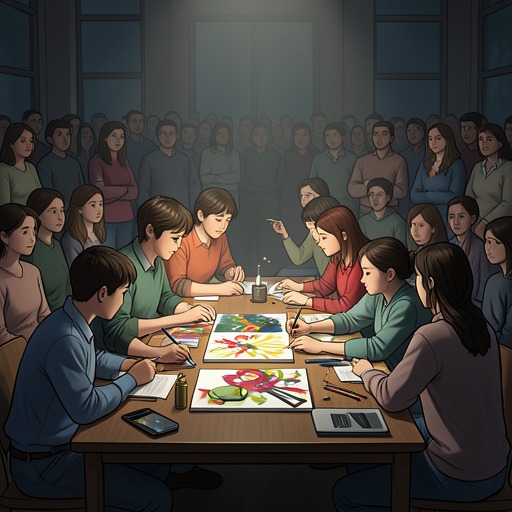
Tommy proposes the gallery theory of deferrals
Never Let Me GoTommy proposes the gallery theory of deferrals during a walk with Kathy, turning scattered memories of Hailsham into a possible explanation for the school’s secretive art collection. He imagines that Madame’s Gallery was not merely a place to preserve student work, but a way to assess whether couples seeking extra time together were truly in love. The theory offers a purpose for Hailsham’s emphasis on creativity and for Miss Emily’s claim that art revealed a student’s inner self; it also leads Tommy to fear that, having contributed nothing to the Gallery, he may have forfeited a special opportunity.
Setting and the deferral rumor
The conversation begins after Kathy and Tommy leave a shop. Kathy tries to restore the light, almost silly mood they had shared, but Tommy remains absorbed in thought and does not respond to her jokes. As they climb a steep path toward a cliff-top viewing area with benches facing the sea, he slows down and raises the rumor that couples who are genuinely in love can have their donations deferred. Chrissie and Rodney, he says, are especially convinced that such an arrangement exists and believe the former Hailsham students know more about it than they have said.
Tommy distinguishes the rumor from anything he remembers being told at Hailsham: he cannot recall anyone there discussing such a rule. He associates its recent circulation with the veterans and says that people including Ruth have been encouraging it. His tone is difficult for Kathy to read, but she recognizes that his thoughts are turning toward a different subject. He stops to poke at a crushed paper cup with his foot before explaining that he has been considering what the rumor, if true, might clarify about their past.
From the Gallery to a theory of judgment
Tommy’s first example is the Gallery. He recalls that the students never understood why Madame took away their best work. A dispute about tokens had once followed the removal of student possessions, and Roy J. went to speak with Miss Emily about it. Tommy remembers Miss Emily saying that having their work selected was a privilege and something the students should be proud of, but argues that she also let slip a more revealing explanation: pictures and poetry showed what a person was like inside, revealing the student’s soul.
That remark gives Tommy a possible link between the Gallery and deferrals. If two people asked to postpone donations because they were in love, someone would have to decide whether their claim was genuine. Tommy reasons that the decision could not be straightforward: a couple might profess love strategically, mistake sexual attraction for love, or confuse a crush with a lasting attachment. Whoever considered a request, whether Madame or another authority, would need evidence on which to base a judgment. In his reconstruction, the collected artwork could supply that evidence.
How the artwork might have been used
Tommy imagines Madame keeping a Gallery filled with work the students had made from childhood onward. A couple claiming to be in love could then be assessed through the art each had produced over many years. Since the work supposedly disclosed the makers’ inner selves, a decision-maker might compare the two bodies of work and judge whether they showed a meaningful correspondence, rather than a temporary or mistaken attraction. The theory makes the Gallery an instrument of evaluation, not simply an honor bestowed on talented students.
Kathy does not confirm that this explanation is correct. She acknowledges that it could account for Miss Emily’s words to Roy J. and for the guardians’ insistence that students learn to paint and make other kinds of art. Her response establishes the theory as plausible to her, not as verified knowledge about Madame’s actual purpose. Tommy’s account therefore remains an interpretation built from an old conversation, the students’ incomplete understanding of the Gallery, and a rumor circulating later among veterans.
Miss Lucy and Tommy’s lost chance
Tommy extends the theory to Miss Lucy’s earlier reassurance that his lack of artistic ability did not matter. He now thinks she said that because she felt sorry for him, even though she understood that Hailsham students had a special opportunity connected to the Gallery. If the collected work helped establish the authenticity of couples’ love, then a student whose art was never selected might have lost the means by which that opportunity could be judged. In Tommy’s account, Miss Lucy’s kindness would not make the underlying stakes disappear; her reassurance would instead have concealed them from him at the time.
The inference changes the emotional direction of the walk. As Tommy connects his theory to his own history, Kathy realizes where his reasoning is leading and turns toward him before she can speak. He laughs and concludes that, if his explanation is right, he may have blown his chance. Asked whether any of his work ever entered the Gallery when he was younger, he shakes his head. He recalls his own sense of being useless at art and Miss Lucy’s effort to help him, while continuing to believe that she meant well. The exchange ends not with proof of the deferral system, but with Tommy applying his speculative account to himself and imagining that a missed artistic opportunity may have closed a door before he knew it existed.
Significance of the theory
The conversation binds together three things the students had experienced separately: the removal of their artwork, the guardians’ pressure to create, and the later rumor that love might earn a reprieve from donations. Tommy’s explanation gives those memories a coherent institutional purpose, but the coherence itself is precarious. Nothing in the scene confirms that Madame used the Gallery to evaluate couples, and Tommy’s conditional reasoning leaves open the possibility that the students have mistaken the meaning of their past. Its force lies in showing how little they were told, and how a few remembered words can become the basis for an account of what their lives might have allowed.
For Tommy, the theory also transforms artistic exclusion into a personal consequence. At Hailsham, the Gallery had seemed mysterious and his inability to contribute had helped mark him as unsuccessful; now he imagines that the same failure may have cost him a chance to prove love and gain time. The change is not an established loss under a confirmed rule, but a feared one produced by his own reconstruction. His theory thus brings the promise of deferral and the history of Hailsham into painful proximity without resolving whether that promise was ever real.