told and not told
Never Let Me GoTold and not told names the gap between receiving information and understanding its full meaning. At Hailsham, the students hear about donation and the limits placed on their futures, yet those facts remain distant, incomplete, or absorbed without examination. Miss Lucy gives the pattern a name when she breaks through their evasions; Kathy’s retrospective account shows how it had been established, how it shaped the students’ talk, and why its effects persisted beyond that afternoon.
What the expression describes
Miss Lucy tells the students that they have been told, but do not really understand, and that some people are content to leave the matter there. Her distinction is not simply between truth and a lie: information has reached the students, but it has not become knowledge they can fully face or use to imagine their lives. They have heard enough to have a vague sense of what lies ahead, while still treating it as remote and avoiding serious discussion.
The truth she states is stark. The students will not pursue the ordinary futures they sometimes imagine, such as going to America, becoming film stars, or working in supermarkets. They will grow up and, before reaching middle age, begin donating their vital organs. Miss Lucy insists that they were created for this purpose and that their futures have already been decided. The expression therefore captures both the existence of disclosure and its failure to produce comprehension: the students possess pieces of the truth before they can grasp its consequences for their own lives.
How the knowledge was absorbed
Kathy later considers whether the Hailsham guardians carefully timed what they told the students, keeping each new piece of information just beyond the students’ capacity to understand it. Tommy proposes that the guardians may have done this deliberately throughout their years at Hailsham: the students would take in each fact at some level, without stopping to examine it. Kathy considers that explanation too much like a conspiracy theory, but accepts that it describes something recognizable. She remembers having a vague awareness of donations even when she was six or seven, and later talks from the guardians did not feel wholly new.
The way subjects were taught may have helped carry that information into the students’ minds. Around the age of thirteen, lessons about sex were sometimes joined to discussion of donation. In one lesson, Miss Emily used a life-size skeleton to explain sex, then warned the students to be careful about sexual relationships, in part because people outside Hailsham could have babies and attached different stakes to sex. The students’ attention was naturally drawn to the subject they found exciting and worrying; discussion of their future could recede into the background even as they heard it. Kathy suggests that this overlap helped the students absorb basic facts about what awaited them without confronting those facts directly.
Their inability to have babies and their future donations were thus present within lessons that also addressed more immediate concerns. Kathy does not claim that every lesson was a calculated act of concealment. She allows that connecting the subjects could be natural, while still recognizing how the arrangement let serious knowledge enter the students’ understanding indirectly. The result was neither complete ignorance nor clear, conscious preparation.
Miss Lucy’s interruption and its aftermath
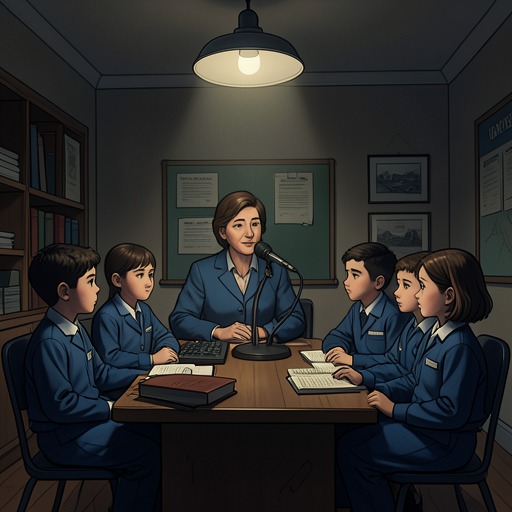
Miss Lucy’s declaration comes after she hears students talking about plans for lives they will not have. She says that the subject has been allowed to go on too long without proper explanation and tells them directly that their futures are fixed. Kathy remembers that Miss Lucy’s gaze moved across the students after she spoke, but doubts that she completed everything she may have intended to tell them. The students’ puzzled, uncomfortable faces, Kathy guesses, made the attempt difficult to continue. Years later, Ruth recalled a more extensive explanation, including the sequence of carers and donations; Kathy is not sure that Miss Lucy actually said those things that afternoon. The memory itself preserves a limit on what can be confidently known.
News of the outburst spread, but attention settled largely on Miss Lucy rather than on the substance of her warning. Some students thought she had briefly lost her composure; others thought the guardians had instructed her to speak. Even students who had been present sometimes understood her as reprimanding them for being noisy. When the question of their future did come up, the response was often that they already knew. That answer demonstrates the very distinction Miss Lucy had made: the students could recognize the information as familiar without taking in what it meant.
Kathy later recalls that, at thirteen, the students had begun making jokes about donation, as they did about sex. The jokes acknowledged the future while keeping it at a distance. After Miss Lucy’s outburst, they faded. Donation became something they still avoided discussing, but now with a more sombre seriousness than the earlier awkwardness. In Kathy’s account, the speech marks a change not because it gives the students every practical detail, but because it alters the tone in which they can avoid what they have heard.
Retrospective meaning
Kathy’s account is itself shaped by the expression: she reconstructs what the students knew from memory, distinguishes recollection from later interpretation, and does not claim certainty where it is lacking. Her disagreement with Ruth about the extent of Miss Lucy’s explanation, and her qualified assessment of Tommy’s theory about the guardians, keep the phrase from becoming a simple accusation of deliberate deception. It describes a condition produced by partial disclosure, the students’ limited understanding, and a culture in which serious subjects were difficult to discuss openly.
The pattern also continues to matter in the students’ adult lives. Years later, Tommy raises fears about what may happen after a fourth donation, including the possibility that donors might continue beyond what people call completion. Kathy dismisses this as unsupported talk, while acknowledging that neither she nor the doctors have certain answers. The uncertainty is not identical to the students’ childhood incomprehension, but it recalls the same division between what can be said, what is known, and what remains beyond reliable understanding.
Kathy’s work as a carer depends on attending closely to donors and responding to what they can bear to express. She says that caring well requires knowing when to comfort, listen, or leave someone alone; her long service brings her back into contact with Ruth and Tommy. Yet care does not erase the limits of what can be known or changed. The expression’s significance lies in that tension: information can be present without being fully understood, and intimacy can make room for difficult knowledge without making the future less certain.