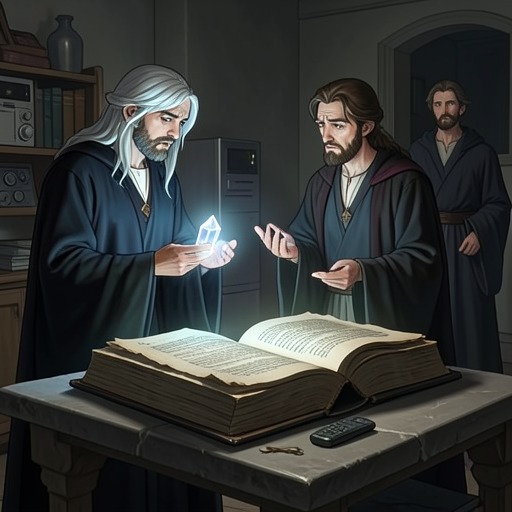
Acquisition of the Codex of the Hollowed Sun
New Life as a Max Level ArchmageThe Acquisition of the Codex of the Hollowed Sun is the first restoration reward recovered from the reopened Vanguard Guild Vault, and it transforms the vault from a symbol of lost heroic wealth into a practical answer to future threats. Vivisari Vexaria obtains a legendary tome that can absorb and preserve extraordinary quantities of mana, but the artifact’s usefulness is inseparable from its ominous implications: its hunger, its resemblance to an object associated with the Umbral Regent, and the System’s decision to provide it all suggest that the world may eventually face a danger requiring reserves beyond any ordinary mage’s capacity.
The Reopened Vault and the Quest Reward
The acquisition begins after Vivisari Vexaria descends into the cellar of the Vanguard Guildhall and examines its vault door. Vanguard had reverted to a tier-zero guild, a status that ordinarily should not have included a vault at all, and the door had refused to open when she tested it the previous day. This time it swings open, revealing a large, brightly lit chamber with silver walls and shelves, boxes, cabinets, stands, and other containers crowded with the treasures accumulated by the strongest adventuring party in history.
The restored chamber does not contain the complete inheritance Vivisari initially expects. It holds no artifacts, equipment, or consumables; instead, the visible stores consist of crafting materials, including midnight-black pelts, a massive golden scale, and jars of blue-and-green fluid. A second locked door stands opposite the entrance, implying that later stages of Vanguard’s restoration will grant deeper access and eventually expose more valuable objects. Even this first portion, however, is worth roughly the net worth of a small kingdom. The Party of Heroes had harvested materials such as dragon scales, phoenix ashes, and kraken teeth in quantities no other mortal group could match.
One object breaks the room’s pattern. It rests on a pedestal before the deeper door, clearly distinguished from the surrounding materials and immediately recognized by Vivisari Vexaria as the likely quest reward. The artifact is the Codex of the Hollowed Sun, identified as Legendary and marked with a level of 2000, alongside a displayed level of 0. Its position, rarity, and exceptionality make the acquisition a deliberate reward rather than merely another piece of salvaged stock.
Identification and Appearance
Vivisari Vexaria recognizes the Codex’s design from the tome the Umbral Regent wore on his belt. She remembers that it was not his primary spell tome and that she never saw him cast with it, a distinction that creates uncertainty without eliminating the connection. She uses Inspect as she approaches, then checks several abilities, including True Sight and Soul Sight, while remaining suspicious of the artifact. Nothing in those examinations reveals a curse or another immediate danger.
The physical object nevertheless carries a severe presence. It is shockingly heavy, as though carved from lead, with a smooth cover made of cold, polished black stone. A dull-silver circle is inlaid at its center, and thin, sharp lines radiate from it like sun rays. Jasper Trevane reacts to the book’s legendary status and ominous name with enough unease that he questions whether it is safe. Vivisari Vexaria answers that she senses nothing and considers it unlikely that a quest reward would be cursed, though she remains cautious because the tome is a relic repurposed from a Cataclysm.
The connection to the Umbral Regent is therefore presented as resemblance and provenance rather than confirmed identity. Vivisari Vexaria reasons that the System may have appropriated the design or materials, or produced an object modeled on the earlier relic. The Codex’s appearance invokes the first Cataclysm slain by the Party of Heroes: the Umbral Regent was once human, the weakest and most recently born of the Cataclysms, yet still the most powerful lich the world had ever seen. That history makes the tome’s visual similarity more consequential than a simple decorative echo.
The Codex’s Mana Function
The Codex’s defining ability becomes clear when Vivisari Vexaria handles it. It absorbs energy and functions as a mage’s accessory, an expected property for an object that emerged from the power associated with the Umbral Regent. More unsettlingly, Vivisari Vexaria feels the pages pulling at the energy core within her torso and at the power sources around the room. She describes the book as hungry and wanting to be fed, establishing that its operation is not passive storage but active consumption.
She opens her gates and pours mana into the first page. The Codex drinks deeply, drawing in oceans of mana until Vivisari Vexaria’s own pool is considerably reduced. As the page fills, a symbol brightens on it: Galdrust, the rune associated with the concept of a reservoir, storage, or container. The rune gives the Codex’s function a formal magical expression, while the draining of Vivisari Vexaria’s reserves demonstrates its cost in immediate, physical terms.
Each page can store an obscene amount of mana, although the quantity is still limited by what Vivisari Vexaria can supply. The flow eventually slows to a trickle and stops when the first page is full. She observes that the Codex contains at least fifty more pages, meaning that completely filling it would require even her to feed it constantly for weeks. The acquisition consequently provides immense capacity without erasing the constraints of time, supply, or the user’s own mana pool.
The stored mana may not be freely transferable. Vivisari Vexaria suspects that each page is effectively tied to the mage who filled it, or that transferring the energy would cause enormous losses while remaining technically possible. She cannot settle the question through observation alone and recognizes that further experimentation will be necessary. The Codex is thus both a usable instrument and an unresolved system of rules, with its long-term value depending on whether other mages can draw upon reserves she has created.
Strategic Value and Ominous Implications
After closing the Codex, Vivisari Vexaria explains to Rafael that it is a secondary mana pool, and a very large one. The clarification changes the artifact from a mysterious legendary relic into a strategic resource. Even a fraction of the power available to a level-2100 being would exceed what most Titled individuals could bring to bear. The mana already stored in the first page could erase a city, or more realistically a small village if someone such as Saffra could draw from the reservoir and channel it independently.
The Codex is consequently valuable even to Vivisari Vexaria herself, who had not expected the restoration reward to offer a functional benefit at her level. That usefulness troubles her rather than simply reassuring her. Rafael had earlier raised the possibility of an Eighth Cataclysm, and although no proof exists that such an event is imminent, the ability to accumulate mana over time and spend it when needed would be a major advantage against an opponent capable of genuinely challenging her.
The acquisition therefore produces a value shift from treasure recovered to threat perceived. The reopened vault initially promises access to the lost wealth of the Party of Heroes; the Codex fulfills that promise, but its hunger and enormous capacity make the reward feel like preparation rather than luxury. Vivisari Vexaria begins to regard the artifact as evidence that the System may be assisting them because some future danger imperils the entire world. The book’s practical power becomes inseparable from the question of why such power has been made available now.
Narrative Significance
The event combines discovery, reward, and foreshadowing. On the surface, Vivisari Vexaria completes the first stage of Vanguard’s restoration and obtains a legendary item from a vault that had been inaccessible even one day earlier. Beneath that successful progression lies a more troubling pattern: the visible vault is only a partial return, the Codex is an exception among the crafting materials, and a deeper locked chamber still withholds the most valuable treasures. Recovery is therefore structured as incremental revelation rather than complete restoration.
The Codex also links the present directly to the defeated Cataclysm era. Its black-stone body and silver sunburst recall the Umbral Regent, while its reservoir function introduces a new way to extend magical endurance without contradicting the established limits of personal supply. The artifact carries the past in its design, serves the present as a mana reserve, and points toward a possible future crisis. Its acquisition is decisive not because it merely strengthens Vivisari Vexaria, but because it makes preparedness itself part of the plot’s central mystery.