Adventurer's Guild
New Life as a Max Level ArchmageThe Adventurer's Guild is the central professional institution for adventurers in the world of Seven Cataclysms. It is at once a workplace, a ranking authority, a marketplace, and a public institution whose standards distinguish disciplined service from mere destructive power. Through registration, badges, quest records, advancement examinations, and guild administration, it turns extraordinary individuals into participants in an organized system whose reach extends from local branches to the entire adventuring profession.
Nature and Public Presence
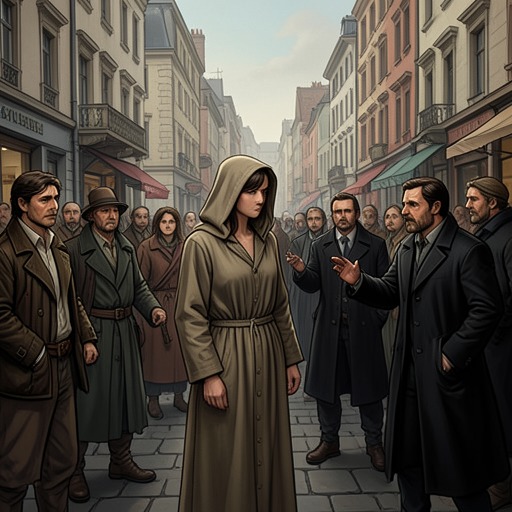
The Adventurer's Guild is one of the most visible meeting places for people drawn from across the world's peoples and professions. When Vivisari Vexaria enters a guild hall, she sees humans, elves, demons, and a dwarf among adventurers wearing platemail, flowing robes, and leather cuirasses. The scene makes the institution feel less like a closed military order than a shared civic framework in which very different bodies and abilities can be recognized under common rules.
The guild's public identity is expressed through the small metallic emblems pinned to its members' chests. The badges are rank identifiers, and their colors establish a hierarchy comparable to coinage: bronze, silver, gold, mithril, orichalcum, and starmetal. Starmetal adventurers are commonly called Titled because advancement at that level brings official titles. The visible badge therefore carries both practical information and social meaning, allowing strangers to read an adventurer's standing before hearing a single word.
The guild also operates within the public life of cities rather than apart from it. The celebration of Peace Day occurs in a society that has spent a century free from the Cataclysms, and the Adventurer's Guild stands as part of the institutional world that helps maintain that peace. Its relationship to danger remains permanent, however: adventurers hunt monsters, investigate threats, and continue preparing for dangers that may emerge from forgotten crypts, dimensional magic, or other unknown sources.
Rank System and Professional Standards
Advancement begins at bronze rank. Reaching level two hundred automatically qualifies an adventurer for silver, while gold rank and every rank above it require guildmaster approval. An applicant must have accumulated enough quest points, undergo a review of completed missions, and pass an examination. The process makes advancement dependent on a record of conduct as well as raw strength.
The guild's standards explicitly reject the idea that victory can be measured only by the number of monsters killed. A candidate may destroy every creature in a mission and still fail the institution's real test if the town is left in ruins. Upper-rank badges signify prestige because they also signify discretion: an adventurer must know how to act responsibly in a populated environment, not merely how to unleash overwhelming force. The ranking system thus converts power into an accountable professional identity.
Vivisari Vexaria's own registration shows how the system can impose a new public identity. After the Guildmaster agrees to register her, she receives a card and a gold-rank badge twenty minutes later. She uses the name Vivienne instead of Vivi, deliberately separating that registered persona from Vivisari Vexaria, even if the distinction appears minor. The guild's paperwork and badge consequently become tools of concealment as well as recognition, allowing her to enter its society without presenting herself under the name associated with her past.
Commerce, Quests, and Administrative Control
The guild is also involved in the appraisal and sale of adventuring resources, although its commercial procedures become stricter as value increases. When Vivisari Vexaria asks about having resources appraised, a guild official explains that the branch sometimes deals with orichalcum-ranked adventurers, but a purchase of that size requires direct approval from the Guildmaster. Ordinary in-guild exchanges are generally intended for newer adventurers, especially those at mithril rank and below.
The distinction reflects a regulated market rather than a simple shop counter. Orichalcum-grade products are valuable enough to require careful handling, and the guild official advises that an external merchant consortium or trading house may be more suitable. The cost of finding an appropriate buyer is insignificant beside the prices such objects can command. The Adventurer's Guild therefore serves as a gateway to commerce while acknowledging that its local branches are not designed to absorb every transaction.
Quests likewise pass through formal authorization. In one instance, the System recognizes Vivisari Vexaria's signature as valid, causing a quest on Rafael's desk to ignite in golden fire. The paper is consumed completely, leaving neither ash nor scorch marks. This unusual mechanism joins the guild's administrative routine to supernatural verification: a desk, a quest document, a signature, and the System become parts of one chain of authorization.
Leadership and Institutional Scale
The Adventurer's Guild extends beyond any single city branch. A figure described as the Chief Guildmaster is responsible for the entire Adventurer's Guild, not merely Meridian's local branch. The title represents an organization broad enough to require centralized leadership, while the contrast between the whole institution and an individual branch establishes a clear administrative hierarchy.
The chief's authority is not presented as a simple expression of ambition. He explains that he never wanted to lead the Adventurer's Guild permanently and accepted the role almost by accident, remaining because he had nothing better to do. Even when others address him as Guildmaster, he corrects them as Acting Guildmaster, and the exchange has become so habitual that he barely registers it. This reluctance places a personal hesitation inside an otherwise immense institution: the guild's continuity depends, at least temporarily, on someone who treats permanent leadership as an unwanted obligation rather than a coveted prize.
The headquarters reinforces the organization's scale. Its double doors open into a guildhall that is larger inside than outside, not because of Vivisari Vexaria's personal wards but because guild architecture follows the world's built-in rules. Upgrading a guild's tier expands its interior while preserving a reasonably sized exterior building and plot. This arrangement exists because Seven Cataclysms must accommodate hundreds of player guilds in the same district. Poor guilds may need instanced versions, while only the wealthiest receive permanent real estate, and inactivity can quickly lead to eviction.
The headquarters' short foyer opens into a common room, making the building both a functional administrative center and a social gathering place. Its spatial design embodies the guild's institutional contradiction: the outside remains constrained by ordinary urban property, while the inside expands according to organizational status and activity.
Strategic Importance and Narrative Significance
The guild's leadership is connected to information about major magical disturbances. The Chief Guildmaster has informants, although they have not yet determined why grand magi and archmagi are in an uproar. Reports of a massive dimensional spell at Prismarche fit the pattern of information reaching him, and his question about why Vivisari Vexaria did not warp to Meridian shows that the guild's intelligence network tracks movement and crisis conditions across regions.
The organization also exists alongside the material infrastructure of adventuring. The armored Convoy is larger than ordinary trains and built with armor thick enough to stop a cannonball. Its compartment contains eight slots lined with artificing designs, into which inert gray orbs are pulled by an invisible force and locked with loud impacts. These details place the guild's wider world within a system where transport, magical technology, supplies, and professional adventurers interact, even when the guild itself is not the machine performing the action.
Its members and associated adventurers confront threats that exceed ordinary quest work. Ghul-Feather, a gigantic two-headed crow recognized near a crypt after it tears the Convoy's engine car away, is identified as a possible surviving creation of the Umbral Regent. Elsewhere, the dangers of the world include the Dragon King, unknown horrors awakening from ancient crypts, and the possibility of another Shattered Oracle. The guild's practical ranking system therefore operates beneath a horizon of recurring catastrophe: no badge can eliminate the unknown, but the institution provides a structure for assigning responsibility when the unknown arrives.
That tension defines the Adventurer's Guild's significance. It makes dangerous power legible through badges, channels it through quests and examinations, and places commercial and supernatural resources under procedures that can be reviewed or approved. At the same time, its headquarters, intelligence network, and leadership reveal an organization whose importance exceeds local administration. In a world where even the heavens may seem to descend during an otherworldly battle, the guild remains the human-scale framework through which extraordinary people are registered, evaluated, directed, and remembered.