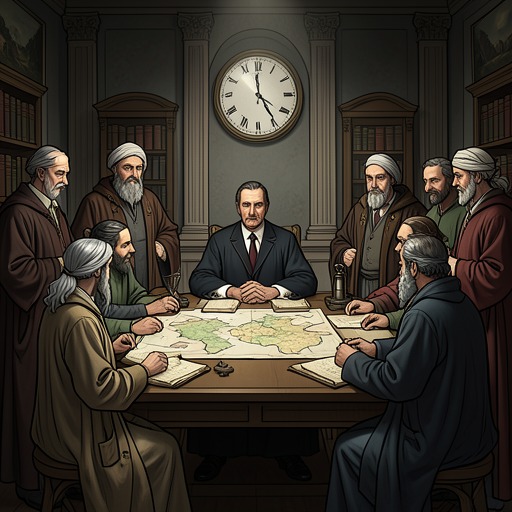
Adventurer's Guild Headquarters
New Life as a Max Level ArchmageAdventurer's Guild Headquarters is the central administrative landmark of the adventuring world and, in Meridian, a physical record of the century that followed the Party of Heroes' victory. Its reopening by Vivisari Vexaria is more than a visit to an old building: it reconnects a legendary guild with the systems, people, and unfinished obligations that survived its disappearance.
Location and Historical Setting
Adventurer's Guild Headquarters stands in Meridian's Adventurer's District, a cordoned-off quarter established because the city contains so many guilds and adventurers that their activity is safer when concentrated rather than allowed to spread unchecked. The district is consequently a place where professional power is ordinary: mithril and orichalcum badges appear frequently, and even a journey through its streets can expose visitors to the density of the adventuring institution.
Vanguard's guildhall is reached within minutes from the district, but the building has become something different from an ordinary working headquarters. It has been closed for a century and is now treated as a tourist destination. A thick rope keeps visitors away from the entrance, a commemorative plaque marks the site, and roughly a dozen people have gathered to admire the historical landmark. The public attention turns the headquarters into a monument before its original function has been restored, preserving the memory of the Party of Heroes and the vanished guild in a civic form.
That historical meaning is inseparable from the surrounding culture of Meridian and Prismarche. The Party of Heroes defeated the seventh and final Cataclysm a hundred years earlier, though all but the Sorceress perished in the battle. The anniversary is celebrated during Peace Day, when the population marks a century free from the Cataclysms that once ravaged the world. Adventurer's Guild Headquarters therefore belongs to a landscape shaped by victory, sacrifice, and the uneasy transformation of living history into public commemoration.
Architecture and Guild System
The entrance presents an apparent architectural paradox: the guildhall is larger inside than outside. This expansion is not an individual ward created by Vivisari Vexaria, but a translated feature of the guild system itself. In Seven Cataclysms, raising a guild's tier expanded its interior while leaving the exterior building and its plot of land reasonably compact, allowing hundreds of player guilds to occupy the same district. The poorest guilds had to rely on instanced versions, whereas the richest received permanent real estate; inactivity could quickly result in eviction.
The fact that these game-like rules have carried into the physical world gives the headquarters a dual identity. It is simultaneously a building and an institutional mechanism, a place whose dimensions respond to organizational status. Its interior architecture makes the invisible hierarchy of guild tiers materially legible, while its century of closure demonstrates that the translated system has not simply preserved the past as a museum display. It has preserved dormant capacity, waiting for the conditions that will authorize its use again.
A short foyer leads into a common room, establishing the headquarters as a functional communal space rather than merely a ceremonial hall. The guild board remains present, including a tan parchment quest pinned to cork. That quest becomes the first clear sign that the headquarters can resume active operations: its existence invites action, administration, and membership rather than passive remembrance.
Reopening and Restoration
Vivisari Vexaria approaches the headquarters in disguise with Rafael, concealing both of them from the surrounding crowd. Rafael raises an eyebrow at the door in silent question, and Vivisari casts an illusion so that observers cannot see the door being opened. She then takes the handle and pulls. The guildhall yields, ending a century of closure in a small physical gesture whose consequences are institutionally immense.
Rafael's reaction reveals the emotional weight of the moment. He draws a breath because he understands that the reopening is not simply the admission of two visitors; it is the return of a place that had defined his guild and then been inaccessible for generations. Vivisari feels her pulse quicken as well, although her response is shaped by a temporal dislocation: she has not personally experienced the hundred years that Rafael remembers, and the headquarters is both a familiar virtual location and an unsettlingly real one.
The restoration proceeds through the guild's quest system. Rafael points out that a quest is waiting on the board, and Vivisari reads it while he looks over her shoulder. After Mae confirms that she wishes to join, Rafael completes the necessary form. Vivisari signs as Vivisari for the first time, uncertain whether the anti-forgery enchantment will recognize her handwriting as belonging to the Sorceress. The system accepts the signature. The quest then ignites in golden fire, filling the room with heat and brilliant light before the paper disappears without leaving ash or scorch marks.
The supernatural administrative confirmation has an immediate practical result. Rafael verifies that Vanguard has become a tier-one guild, meaning that the craftsmen's quarters should be accessible and that at least part of the vault may be available again. Mae reacts with astonishment because the restoration includes the return of her laboratory. The headquarters thus changes from sealed memorial to functioning base: its reopening restores not only status, but rooms, resources, work, and the possibility of rebuilding a collective organization.
People, Absences, and Unfinished Work
The headquarters gathers the history of Vanguard's members even when those members are not present. Rafael explains that Ulden has returned to his dwarven enclave in the Western Kingdom, making him difficult to contact, though still more reachable than Eshara. Laelith is missing altogether. These absences prevent the guild's restoration from becoming a simple reunion. Reopening the headquarters exposes a network of incomplete relationships and unresolved searches as much as it restores a shared home.
The quest board and the guild charter therefore function as instruments of recovery. They preserve obligations that outlast individual lives, while the building's expanded interior preserves possibilities that have not yet been claimed. The guild's return depends on signatures, quests, tier recognition, accessible quarters, and the recovery of members or information. Institutional continuity is shown as something assembled through procedures rather than guaranteed by nostalgia.
The headquarters also connects private memory with public identity. For Rafael, entering the guildhall revives the past directly. For Vivisari, who remembers Vanguard through a virtual framework and has gaps in her current understanding of the translated world, the same room produces surrealism. The building makes that difference visible: it belongs to Rafael's lived century and to Vivisari's interrupted return at once.
Symbolic and Narrative Significance
Adventurer's Guild Headquarters is the clearest architectural expression of the book's recurring tension between game structure and lived reality. Rules that once served as gameplay necessities now govern material space, guild advancement, signatures, quests, and access to facilities. A parchment can become a quest, a signature can become proof of identity, and an apparently closed building can retain a responsive institutional interior. The headquarters turns abstract systems into rooms and consequences.
Its reopening also mirrors Vivisari Vexaria's return. Both the woman and the guild have been absent for a century, both are surrounded by public legend, and both are mistaken for something larger or more mythic than their former identities. Yet the return begins not with a public proclamation but with concealed movement through a tourist crowd, an illusion over a doorway, and a hand on a handle. The legendary past re-enters the present through practical action.
That contrast gives the headquarters its strongest significance. Outside, visitors treat it as a historical landmark connected to the Party of Heroes and the end of the Cataclysms. Inside, it is still capable of issuing quests, recognizing signatures, expanding its usable spaces, and returning Mae's laboratory. The building is therefore neither merely sacred memorial nor ordinary office. It is a threshold between commemoration and renewal, where the celebrated past becomes an unfinished institutional future.