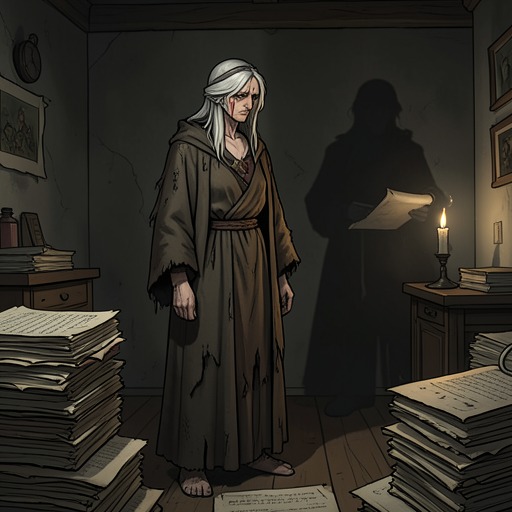
Archmage Lysander
New Life as a Max Level ArchmageArchmage Lysander is the headmaster of the Thaumaturgical Institute and the successor to Archmage Aeris. He is introduced indirectly through Saffra’s comparison of grimoires, but that comparison establishes his importance: his massive, white, gilded tome is the most impressive magical book she has seen, making Lysander a visible emblem of the Institute’s hierarchy and of the prestige attached to accumulated spellcraft.
Position at the Institute
Archmage Lysander occupies the Institute’s highest academic office in the period presented. When Vivisari Vexaria asks whether Archmage Aeris is still the headmaster, Saffra explains that Aeris stepped down shortly after the Turning and became a professor instead. Archmage Lysander then appears as the person who took Aeris’s place, placing him at the institutional center of magical education during the current era.
This succession also locates Lysander within a changed historical order. The Turning is identified as the day the Party of Heroes defeated the Seventh Cataclysm, so his headmastership belongs to the post-cataclysmic period rather than to the earlier age associated with Aeris’s leadership. The evidence does not describe his policies or administration, but it does make his office a point of comparison between the Institute’s former and present authorities.
The Grimoire as Public Identity
Lysander’s grimoire is not merely a private tool. Grimoires evolve with their owners, changing in design according to the individual and increasing in thickness as spells are added. In the mage world, they function as status symbols, advertising a mage’s breadth of magical knowledge at a glance in much the same way that an adventurer’s badge communicates standing, though with greater personalization and visual flair.
Lysander deliberately turns that symbolism into spectacle. He carries his massive grimoire strapped to his belt, an arrangement that makes its size impossible to overlook and is described as an obvious attempt to show off. The book is white and gilded, and Saffra admits that she is impressed whenever she sees it despite her dislike of him. Its appearance therefore performs two functions at once: it signals real dedication to building a large spell arsenal, and it projects the vanity associated with displaying that achievement.
Reputation and Contrast
Saffra’s judgment of Archmage Lysander is sharply divided. She is not a fan of him, and her wrinkled nose when his name is mentioned conveys immediate personal disapproval. Yet she cannot dismiss the accomplishment represented by his grimoire. Adding that many spells requires sustained effort, even if she suspects that Lysander may have learned low-tier spells merely to make the tome appear fuller. Her suspicion preserves the ambiguity of his reputation: the book proves extensive magical accumulation, but not necessarily that every part of that accumulation reflects disciplined or admirable study.
The comparison becomes more striking when Saffra sees Vivisari Vexaria’s own tome. Saffra explains that grimoires vary according to their owners’ class, level, and related qualities, then confesses that she has never seen anything like Vivi’s and that even the Headmaster’s grimoire comes nowhere close. Lysander’s book remains the standard of ordinary institutional grandeur, but Vivi’s tome exceeds that standard so dramatically that the comparison exposes the scale of Vivi’s unusual power and unsettles Saffra’s assumptions about what a grimoire can represent.
Narrative Function
Archmage Lysander serves as an offstage institutional presence rather than as an active participant in the scene. The narrative reaches him through memory, reputation, and an object associated with him: the white, gilded grimoire at his belt. This indirect introduction gives his authority a material form before he appears personally, while Saffra’s reluctant admiration prevents him from becoming a simple symbol of incompetence or vanity.
His replacement of Archmage Aeris also helps mark the story’s temporal and political transition. Aeris belongs to the remembered history of the Party of Heroes and the defeat of the Seventh Cataclysm; Lysander governs the Institute afterward. Within the immediate conversation, however, his most decisive role is comparative. The Headmaster’s tome provides the measure by which Saffra evaluates Vivi’s book, and its failure to approach Vivi’s scale turns a familiar institutional status symbol into evidence of a far greater anomaly.