Arrival in Prismarche
New Life as a Max Level ArchmageArrival in Prismarche is the decisive threshold crossing through which Vivi leaves the uncertainty of her return and confronts the world that has grown beyond the game she remembers. Her arrival is not merely a change of location: Prismarche supplies the first public evidence that history continued after the Party of Heroes’ victory, that the Cataclysms belong to living memory rather than game lore, and that Vivi herself has become a half-remembered figure in a civilization that can no longer fit her expectations.
The Gate to a Changed World
Vivi chooses Prismarche because visiting a smaller city first is logically preferable, and because the next train to Meridian will not depart until the following day. She places a Warp Anchor, gathers herself, and activates Gate to Nearest City. The ability is a skill rather than a spell, so even a non-magic class could use it; it consumes no mana and operates through intent. Its ten-second activation produces glowing white runes that appear on the ground and circle Vivi clockwise before the skill takes effect.
The transition immediately distinguishes this world from Seven Cataclysms. Instead of the familiar ease of a game-world warp, the fabric of space swallows Vivi, tumbles her through the passage, and expels her at the destination. She expects that the experience will require practice, because the world resembles the game she played without being identical to it. When she reemerges, she stumbles a step and finds Prismarche’s town square directly before her.
First Impressions of Prismarche
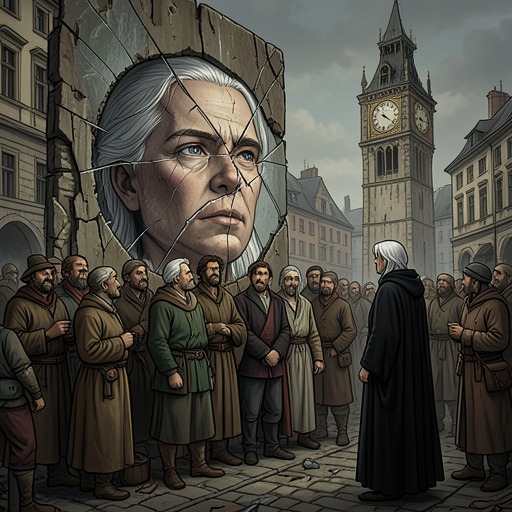
Prismarche receives Vivi with an excess of ordinary physical sensation. The bright morning sun shines through a cloudless blue sky, forcing her to squint and wait for her eyes to adjust despite her immense statistics; extraordinary power has not eliminated basic human responses. The square is paved in stone and dominated by a large town hall whose bell tower rises above the surrounding buildings. A huge clock face is visible across the plaza, and the eleven-o’clock bell rings as its hand moves into place.
The city is unmistakably human territory, with humans forming the overwhelming majority of its population. Yet it is also more developed than Vivi remembers. The city is larger than its game version, cleaner, and built with more glass windows and better roads. Most startlingly, a train station stands in the distance, its tracks extending southward toward the horizon. Seven Cataclysms had contained no trains, so the station becomes material proof that the world has not simply been translated from a game into reality. Time has passed, and the development is extensive enough to imply more than a few years or decades; rail travel has become ordinary even for a frontier city such as Prismarche.
The Party of Heroes in Public Memory
Vivi’s most destabilizing discovery comes when she turns from the city and sees an elevated display of five statues in the center of the square. The figures are the members of her regular party, the friends with whom she cleared most of the game. The bronze plaque identifies them not as players or companions, but as the Party of Heroes, turning personal memory into civic monument.
The city is preparing for a holiday, with colorful banners, decorative lanterns, workers on ladders, and stalls being assembled around the square. The festival is the centennial Peace Day celebration, commemorating the victory that freed the world from the Cataclysms. In the Prismarche Temple, a massive building of polished white stone with stained-glass windows depicting saints and heroes, Vivi encounters a second and more unsettling public consecration of that past: one of the prominent religious images represents her and her party. The open doors, wooden pews, long aisle, and grand altar place the Party of Heroes within an active religious landscape rather than a merely historical one.
A priest explains that the Party of Heroes triumphed over the seventh and final Cataclysm nearly a hundred years earlier, though the victory came at great cost and all but the Sorceress perished. This statement resolves the mystery of Prismarche’s altered architecture and technology while creating a sharper personal contradiction. Vivi is alive, present in the city, and able to recognize the people represented in stone and glass, but the society around her understands the heroes through a century of legend and loss.
Peace Day and the Shadow of the Cataclysms
The festival grows as the sun reaches the horizon and washes the city in orange light. After completing their daily duties, Prismarche’s citizens flood the streets and abandon restraint, celebrating the day that marks a hundred years of freedom from the Cataclysms that once ravaged the world. The younger generation has not witnessed those horrors firsthand, but the names of the disasters remain embedded in the culture: the Rampant Genesis of the Flesh-Weaver, the Crimson Blight brought by the Reaper of the Lost Harvest, and the Great Conflagrations called down by the Ashen Hierophant to scour entire cities.
Vivi remembers the game’s graphic presentation of the carnage left by those catastrophes and imagines how much more terrifying the events must have been for people whose world was actually destroyed by them. The public’s reverence for the Party of Heroes therefore has a concrete historical foundation. The statues and temple imagery are not empty decoration; they express a collective memory of survival. Arrival in Prismarche shifts Vivi’s position from player and returning outsider to a living remnant of the crisis that shaped the modern world.
A Return That Cannot Be Ordinary
The city’s century-long peace does not erase the possibility of another disaster. Much later, Master Aeris describes the continuing threats surrounding mortal civilization: the Dragon King could descend from the Sky-Pillar Range and destroy the mortal lands, an unknown horror could awaken from a millennium-old crypt, and another Shattered Oracle could emerge from an overambitious glimpse. His conclusion is that an Eighth Cataclysm is always possible, even if none is occurring at that instant. The statement gives the arrival retrospective weight: Vivi has entered a peaceful society whose peace is real but provisional, sustained beneath the expectation of catastrophe.
That tension culminates in the later perception of Vivi’s power. After she tears a Cataclysm apart with casual ease, observers would not simply assume that the legendary Sorceress had returned; they would assume that a god had appeared, because even Vivisari Vexaria’s known legend could not account for such force. The first step into Prismarche thus foreshadows the scale of the misunderstanding surrounding her return. The city’s statues preserve an old image of Vivi as a heroic survivor, while her present abilities threaten to place her beyond the category of hero altogether.