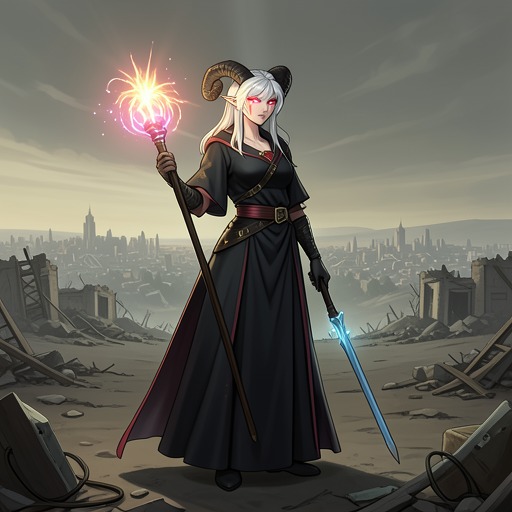
Ashen Hierophant
New Life as a Max Level ArchmageThe Ashen Hierophant is the Seventh and Final Cataclysm and the last of the Cataclysm Monarchs defeated by the Party of Heroes. A twelve-foot titan clad in black plate armor, he wielded fire on a scale that transformed him from a final-game opponent into a historical catastrophe: his flames destroyed more lives than disease, age, and famine combined, laid entire regions of the continent waste, and left scars still visible a century later. His decisive significance is that he exists simultaneously as a remembered monster, a playable challenge mastered by Vivi, and a benchmark against which the world measures powers that appear after his defeat.
Identity and Appearance
The Ashen Hierophant is represented in Prismarche as a towering figure in black armor, a form that the city’s inhabitants know with unusual intimacy even after a hundred years. Among the Cataclysm Monarchs displayed during the Peace Day celebrations, his public image is considered the most accurate. The reason is not merely artistic fidelity: Prismarche remained close enough to his former domain to retain a vivid memory of his presence, his fires, and the destruction they caused. His armor, height, and burning association make him a figure of both material enormity and historical memory.
His title places him at the summit of the Cataclysm sequence. The Ashen Hierophant is called the Seventh and Final Cataclysm and the Monarch among Monarchs, the power that stood at the end of the world’s known sequence of disasters. In the framework of Seven Cataclysms, he was not simply another powerful enemy. He represented the final raid and the ultimate limit of the game’s progression, later described as having reached level two thousand, the pinnacle of the Grand System and a condition that could not fundamentally be surpassed by ordinary advancement.
Domain and Historical Destruction
The Ashen Hierophant’s domain was in the Northern Kingdom, and the Burial Room of the Ashen Hierophant served as the arena for the final boss fight. When Vivi opened her eyes there after her return, she immediately recognized the yawning spires, the massive obsidian throne, and the lava bubbling nearby. The room therefore functions as more than a dungeon setting: it is the threshold through which a player’s remembered fiction becomes an inhabited world, and the Ashen Hierophant is the absent presence that makes the transformation terrifying.
His campaigns were defined by annihilating fire. The Great Conflagrations called down by the Ashen Hierophant scoured entire cities, while the wider destruction of his reign devastated expanses of the continent. The consequences were so extensive that the damage remained visible one hundred years after the Cataclysms had ended. The Peace Day crowds could cheer and jeer at representations of the old monsters because the newer generation had never experienced them directly, but the scale of the Ashen Hierophant’s destruction explains why the Party of Heroes continued to receive reverence long after the final battle.
The historical account of the victory emphasizes its cost. The Party of Heroes defeated the seventh and final Cataclysm a hundred years before the opening events, with all but the Sorceress perishing in the fight. The triumph therefore carries a double value: it marks the world’s liberation from the Cataclysms, but it also preserves the Ashen Hierophant as the enemy whose defeat demanded nearly the entire heroic generation. His defeat is remembered as peace’s foundation rather than as a clean or uncomplicated victory.
Vivi’s Encounter with His Legacy
For Vivi, the Ashen Hierophant is both familiar and newly dangerous. She had run the final boss fight at least a thousand times and had cleared the Burial Room on mythical difficulty while playing Seven Cataclysms. That achievement earned her the unique title Usurper of the Ashen Throne. Her expertise means that she knows his arena, mechanics, and attacks as a practiced player, yet waking inside the arena forces her to confront a crucial difference: the supposedly fictional environment has become physically vivid, with heat against her face and lava close enough to threaten her body.
The game’s death rules also shape her first response to the Ashen Hierophant’s world. Seven Cataclysms had no resurrection spells; when a player died, the player was reborn at the nearest temple, while unsecured items and gold dropped at the point of death. Vivi immediately considers whether that system applies to reality. The question is especially charged in the Burial Room, where the game’s final threat has ceased to be an abstract encounter and has become the geography of her arrival. Her confidence as a player is therefore accompanied by practical caution: she has minimal unsecured supplies, her best gear remains equipped, and death may be survivable, but only under rules she has not yet verified.
The staff Vivi carries is another material link to the Ashen Hierophant. She obtained it by raiding the Burial Room, and its origin is sufficiently complicated that she refuses to explain it during the early stages of Osmian’s trials. The staff can interact naturally with incorporeal matter, making its substance of particular interest to the archmage, but Vivi treats its provenance as a secret. The Ashen Hierophant’s dungeon thus continues to affect the plot through a relic that gives her unusual capabilities while also exposing how deeply her current power is rooted in the remains of the final Cataclysm.
The arena also supplies her with the practical resources of a defeated endgame boss. During her later hunting expedition, Vivi captures Frostmaw Titans and kills another with a super-charged fireball, producing an explosion of flesh and bone across the snow. Her willingness to harvest powerful monsters with minimal damage reflects the same player logic that once governed her final-raid challenge runs. The contrast is revealing: the Ashen Hierophant’s battle was once the ultimate spectacle, but in the transformed world Vivi can treat other legendary threats as sources of materials, while the remains of the Hierophant’s domain provide the equipment that makes such confidence possible.
Power, Ritual, and the Threat of Recurrence
The Ashen Hierophant’s power establishes the scale of the world’s former terror. Rafael explains that the Seventh and Final Cataclysm had reached level two thousand, the absolute peak of the Grand System. Vivi, however, has returned at a level three hundred higher than the historical Sorceress. The difference is not a small advantage: two hundred levels generally constitute an entire tier of power, so the present Vivi exceeds the legendary figure known to the world by a full classification and more. A normal-difficulty Ashen Hierophant would probably be something she could kill with her eyes closed, despite the fact that he once terrorized the world and no one could challenge him for millennia.
That disparity produces one of the story’s central ironies. The world remains terrified of the weak version of Vivisari remembered from history, while the returned Vivi may be vastly stronger than both that figure and the monster who once defined the world’s upper limit. She therefore hides the extent of her power. If the public witnessed what she could do, it would not interpret her as merely the old Sorceress returned. Her ability to tear a Greater Voidbeast apart with casual force would make people assume that a god had descended, because even the legendary Vivisari could not be credited with such disrespectful ease against a Cataclysm-scale threat.
The Ashen Hierophant also belongs to a larger history of magical catastrophe. Vivi understands that some Cataclysms may have originated in rituals, whether through the Umbral Regent’s ascension into lichhood, the Flesh-Weaver’s grotesque creations, or the Shattered Oracle’s glimpse into the unknowable and resulting madness. She cannot confirm the origins of every ancient monster, including the Colossus and the Maw, but the possibility places the Ashen Hierophant within a world where the boundary between deliberate magic and disaster is unstable. His conflagrations are therefore not only military destruction; they are part of a recurring pattern in which mastery of magic can become an engine of ruin.
The threat has not vanished merely because the Ashen Hierophant was defeated. Archmage Aeris warns that the Dragon King could descend from the Sky-Pillar Range and raze the mortal lands, that an ancient horror might awaken from a millennium-old crypt, and that another Shattered Oracle could emerge from one ambitious glimpse into forbidden knowledge. His conclusion is that there is always an Eighth Cataclysm on the horizon. The Ashen Hierophant is consequently both the final completed disaster of the old age and the measure that makes future disasters imaginable.
Legacy and Narrative Significance
A century after the final assault, the Ashen Hierophant has been converted into civic memory. His image appears among the figures of the Peace Day Festival, where crowds celebrate the hundred years since the Cataclysms ravaged the world. The festival’s atmosphere is exuberant rather than solemn: citizens drink, sing, and crowd the streets, while younger people regard the Cataclysm Monarchs as relics of a distant past. This cheerful treatment does not diminish the Hierophant’s historical importance. Instead, it demonstrates the distance between lived trauma and inherited legend.
His defeat also shaped the political and social order that Vivi reenters. The Caldimore line suffered grievous losses during the final assault on the Ashen Hierophant’s domain: Marquess Dorian Caldimore, his brother, his wife, three of his four sons, and most of the family died there. The surviving son, Damon Caldimore, later became a duke after decades of service during and after the Cataclysms, dragging the nearly extinct house back into prominence. The Hierophant’s battle therefore altered not only the landscape but also the lineage, rank, and political power of one of the story’s major houses.
Even the weapons circulating after the war preserve his connection to future conflict. Damon’s family legacy sword was forged over many decades from material taken from the Shattered Oracle’s workshop, then surrendered as payment to Morningstar. Its value was so immense that it drew the organization’s attention, and Damon’s larger purpose was to acquire more of the otherworldly substance so that he could stand against the world’s worst terrors despite his low level. His goal is explicitly defensive against the next catastrophe: to possess a weapon capable of ending an Eighth Cataclysm. In this way, the Ashen Hierophant’s defeat does not close the age of catastrophic fear; it supplies the historical proof that such fear is rational.
The character’s deepest narrative function lies in the contrast between spectacle and aftermath. In the game, the Ashen Hierophant was a repeatable final encounter, a challenge that Vivi could master through skill, preparation, and thousands of attempts. In the world of the novel, he is a dead monarch whose fires still define geography, religion, public celebration, family history, magical caution, and political ambition. He embodies the conversion of game mechanics into historical reality: a boss can be cleared, but a catastrophe cannot be reduced to the moment of victory. The Ashen Hierophant remains present through the scars he left behind and through the question his existence forces on the returned Vivi—whether the world has truly entered an age of peace, or merely reached the interval before another power rises.