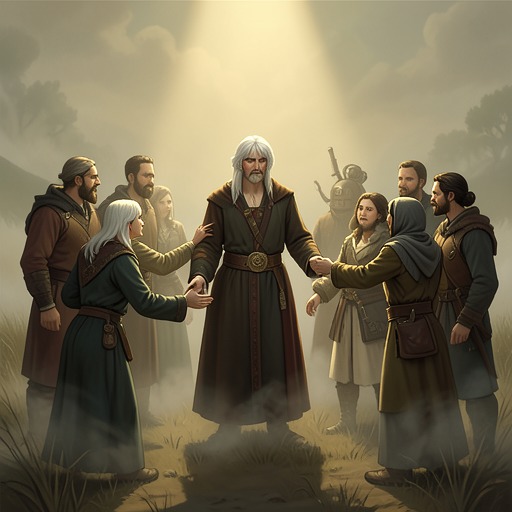
Bram
New Life as a Max Level ArchmageBram is a former member of Vanguard whose peaceful death is disclosed to Vivisari Vexaria after her long absence. He has no direct scene in the supplied material, yet his brief remembrance carries unusual weight: among the guild members whose fates must be reconstructed, Bram is one of the two confirmed dead, and his death contrasts sharply with the more violent losses associated with adventuring after Vanguard’s disbandment.
Identity and Place in Vanguard
Bram belonged to the guild circle known to Vivisari Vexaria before her disappearance. When Rafael summarizes the condition of her former guild members, he divides them into those whose whereabouts are known, those still alive but difficult to contact, one missing person, and two who have died. Bram is the first of the deceased identified, placing him within the dispersed human aftermath of Vanguard rather than among the active adventurers whose present circumstances can still be traced.
His existence is therefore conveyed through recollection and accounting rather than action. The enumeration initially sounds administrative, but the confirmation of death interrupts Vivisari Vexaria’s expectation that she might simply recover information about people from her former life. Bram becomes a concrete reminder that the years of separation have not merely suspended old relationships; they have permanently changed the community to which he belonged.
Death and Circumstances
Rafael explains that Bram died in his sleep, surrounded by family. He had already been elderly before Vivisari Vexaria disappeared, and Rafael presents his death as the most peaceful circumstance anyone could reasonably hope for. The account supplies no indication of violence, magical catastrophe, or an adventuring accident. Bram’s death is instead defined by age, sleep, and familial presence.
That peacefulness matters because the surrounding discussion is shaped by uncertainty and loss. Another former member, Rowena, died in an adventuring incident, and Rafael notes that she was not the only person to pursue adventuring after Vanguard’s disbandment. Against that dangerous trajectory, Bram’s death offers a gentler but still final ending. It allows Vivisari Vexaria some relief while making clear that even a natural death remains a shock when heard after years of absence.
Relation to Vivisari Vexaria’s Return
Vivisari Vexaria does not possess a close emotional bond with Bram in the same way she might have with someone whose life she had continued to share. Nevertheless, learning that he has died jolts her. Her reaction reveals the peculiar emotional condition created by her transmigration and disappearance: the people she once knew were once game characters to her, but they are now real people whose lives continued outside her awareness.
Bram’s death thus helps transform the past from a static memory into a history with irreversible consequences. Vivisari Vexaria had been eager to learn what had happened to her prior guild members; Rafael’s report forces her to receive that knowledge as grief rather than mere information. Bram’s family-surrounded death softens the blow, but it cannot undo the fact that she has returned too late to meet him again.
Narrative Significance
Bram functions as a quiet measure of elapsed time and of Vanguard’s fragmentation. The guild’s former members occupy different states—located, unreachable, missing, alive, or dead—and Bram’s position among the dead gives the list its first fully resolved human consequence. His peaceful passing also establishes a contrast within the book’s broader economy of danger: not every loss is produced by monsters, warfare, or reckless magic, yet every loss reshapes the survivors’ understanding of what has been lost.
His remembrance further complicates the distribution of grief. The narrative does not treat death as a uniform spectacle. Bram receives a brief but dignified account: he died naturally, with family around him, and his circumstances are described as desirable rather than horrifying. That treatment distinguishes his death from the violent, uncertain, or instrumentalized deaths elsewhere in the story, while still allowing his absence to register as a wound in Vivisari Vexaria’s return to a changed world.