Class Evolution
New Life as a Max Level ArchmageClass Evolution is the Grand System’s mechanism for transforming an established class into a more advanced one, and it is one of the clearest points where the world’s game-like progression system acquires interpretive force. The process rewards accumulated levels, but it can also recognize a character’s training, social position, and extraordinary apprenticeship. In Saffra’s case, it overturns her practical expectations and reveals that her relationship with Vivisari Vexaria has been acknowledged at a level far deeper than a conventional apprenticeship status.
Definition and Progression
The Grand System offers classes, stats, and skills through a progression structure in which level thresholds carry increasingly important rewards. The strongest recurring pattern appears at levels ten, fifty, and one hundred: these increments tend to provide larger bonuses, and the hundred-level marks often grant both a class evolution and a cornerstone skill. Class Evolution therefore functions as a culmination of advancement rather than as an arbitrary change of title. It marks a threshold at which ordinary growth becomes a qualitative transformation.
The process is not presented as governed by perfectly rigid rules. There are few hard-and-fast principles explaining exactly how the Grand System distributes classes, stats, and skills, but the level-based pattern remains undeniable. This mixture of regularity and uncertainty makes Class Evolution both predictable enough to pursue and mysterious enough to surprise. Characters can understand that a hundred-level summit matters without being able to determine in advance which evolved class the System will choose.
Saffra’s Unexpected Evolution
Saffra encounters the mechanism after defeating another monster and reaching a new level. The System first displays her level-up notification, followed by a second screen announcing Class Evolution. The moment carries unusually high stakes because she has spent the previous several years deliberately pursuing an Elementalist class. Her choice was practical: elemental magic offered dependable firepower and utility, was widely available, and made Elementalists valuable members of adventuring teams. Saffra had imagined a future in the wider world, making a difference through an adventuring group, rather than remaining in the Thaumaturgical Institute to study increasingly obscure spells.
That plan was shaped by social exclusion as much as by preference. More esoteric fields, including divination, illusions, and druidism, were often locked behind family inheritance, guild connections, noble titles, or the favor of an Institute mage. As an orphaned commoner with only moderately impressive talent, Saffra could not easily access those paths. Elemental magic was therefore simple, effective, and attainable; it was the obvious class for the life she thought she could build.
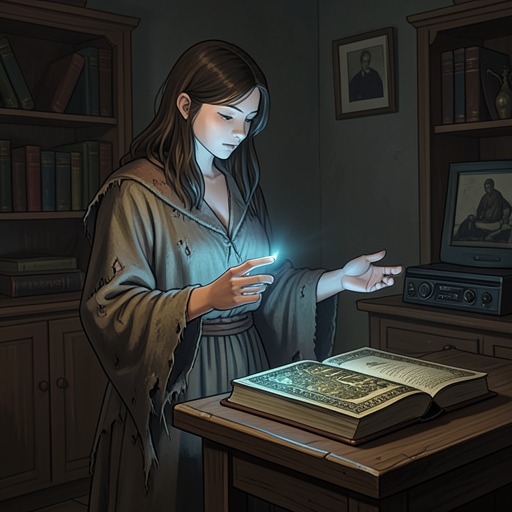
The System rejects that expectation. Instead of evolving her Initiate Mage class into Elementalist, it announces: “Congratulations! Your class [Initiate Mage] has transitioned into [Pupil of the Magus Prime].” The result catches Saffra so completely off guard that she can only respond with confusion. Her years of elemental study have not been erased, but they have not determined the System’s judgment either. The evolution identifies another fact as more decisive: her apprenticeship to Vivisari Vexaria.
Apprenticeship as Systemic Recognition
The evolved class belongs to the rare category of inheritance-type classes. Such classes are compared to the disciples of Sword Saints, whose students may receive a class identifying them as disciples of a figure whose importance is recognized by the Grand System. The significance lies less in a narrowly defined mechanical benefit than in the System’s acknowledgment that the master possesses exceptional standing. An apprenticeship to a person recognized at that level is itself treated as more valuable than almost any ordinary advantage.
This recognition also distinguishes a true inherited class from a temporary apprenticeship status. Statuses can be acquired and lost easily, and nobles sometimes purchase them for their children. A class is different: although classes are not necessarily permanent, the System’s classification carries a far stronger decree. For Saffra to become Pupil of the Magus Prime, the System must be treating Vivisari Vexaria not simply as someone who taught her, but as a master whose identity and power give the relationship exceptional systemic weight.
The revelation is especially striking because Saffra already understands Vivisari Vexaria’s strength. Vivisari has reached level nineteen hundred and is regarded as nearly peerless even among immortal beings, perhaps not far below the Dragon King. Class Evolution turns that personal knowledge into an institutionalized fact. The Grand System has effectively inscribed Vivisari’s stature into Saffra’s own class, making their connection part of Saffra’s formal identity.
Costs, Choices, and Moral Contrast
The broader story uses progression mechanics to expose competing ideas about responsibility. During the convoy disaster, Jasper refuses to spend his emergency healing potions on a man with a crushed spine because he may need those potions to defend the entire Convoy from monsters. His decision treats survival resources as instruments of collective calculation. Saffra chooses differently: when she finds that no sufficiently powerful healers are available, she uses a potion she carries to save injured people, despite not being hurt herself and despite knowing that Vivisari may condemn her for wasting it.
That choice gives Class Evolution an ethical background. Saffra’s advancement is not only the consequence of defeating monsters or crossing a numerical threshold; it follows a pattern in which her practical ambitions coexist with a willingness to spend scarce power on other people. The System’s judgment does not explicitly explain her morality, but the surrounding narrative contrasts her use of a valuable potion with Jasper’s refusal and makes clear that power is always tied to cost, risk, and responsibility.
The same tension appears in the behavior of powerful authorities. Damon Caldimore describes Isabella’s participation in a dangerous ritual as her duty to House Caldimore, insisting that she is not a sacrifice but a contributor to the success of her House. He frames potential death through inherited obligation. William, by contrast, defines dignity through action and rejects the idea that kneeling before Duke Caldimore would preserve his honor. These positions show how the world interprets identity through conduct, allegiance, and recognized role—precisely the territory Class Evolution formalizes through the Grand System.
Narrative Significance
Class Evolution transforms a leveling-system reward into a revelation about hidden social and metaphysical structures. Saffra believes she is choosing the most accessible route available to a talented commoner; the System reveals that her life has already been redirected by a relationship she did not fully understand. The result is both an advancement and a reclassification, replacing the future she planned with an identity defined by a powerful mentor.
That pattern reflects the book’s larger treatment of the Grand System. Its milestones appear mathematical, yet their consequences are personal and historical. A hundred-level summit can produce a class evolution, while a rare class can expose the importance of a master, a lineage, or a bond. In this way, progression is never purely private. The System distributes power, but it also interprets lives.
The concept further participates in the book’s recurring contrast between ordinary human categories and the scale of legendary figures. Prismarche’s Temple displays images of the Party of Heroes, whose victory over the seventh and final Cataclysm a century earlier made them objects of public reverence. Peace Day likewise turns survival from the Cataclysms into civic celebration. Against that background, Vivisari Vexaria’s return is so overwhelming that observers may mistake her for a god rather than the Sorceress. Class Evolution anticipates the same movement on a smaller, more intimate scale: it shows how a person can be elevated by association with a figure whose existence exceeds ordinary categories.
For Saffra, the final force of the evolution is therefore interpretive rather than merely numerical. She wanted an accessible elemental vocation and a place among adventurers; she receives a title declaring her pupil to a mage important enough for the System to recognize. Class Evolution makes the unexpected inheritance impossible to ignore. It records that Saffra’s path is no longer explained solely by talent, effort, or practical choice, but by the extraordinary bond that has come to define her place in the world.