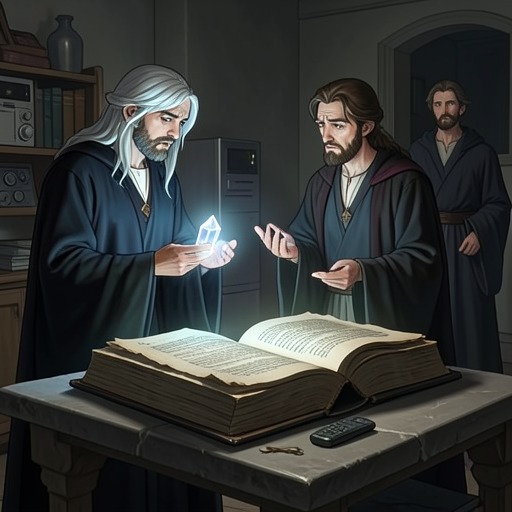
Codex Mana Experiment
New Life as a Max Level ArchmageThe Codex Mana Experiment is the decisive test of a black-sun codex whose practical novelty is a secondary mana pool that can also share mana between mages. What begins as Vivisari Vexaria’s attempt to understand an artifact becomes a dangerous lesson in borrowed power: Saffra can shape Vivisari’s stored mana as though it were her own, but the Grand System does not treat the resulting feat as hers. The experiment therefore separates spell formation from ownership, immediate control from true strength, and technical success from personal advancement.
Purpose and Setup
Vivisari Vexaria introduces the experiment after deciding that Saffra’s recovery can proceed naturally and that the two can continue their work the next day. She produces a book bearing a silver symbol of a black sun and explains that she needs to test how the codex works. Saffra instinctively attempts to inspect the item, but Vivisari Vexaria immediately blocks the attempt, causing the skill to fail. The exchange establishes that the codex is both valuable and private before its function is even revealed.
Vivisari Vexaria describes the codex as a secondary mana pool and a way to share mana between mages. The apparent simplicity of that explanation conceals its extraordinary implications. Saffra is accustomed to treating a mage’s mana as a personal reserve bounded by the caster’s own core and channels; the codex challenges that boundary by making another mage’s power available for shaping and casting. Its operation is not presented as a vague miracle but as a usable magical mechanism, one that can be tested through controlled contact.
Contact with the Reservoir
Saffra opens the codex and recognizes the glowing rune on its first page as Galdrust, meaning “Reservoir.” When she focuses on the symbol, she senses a tug in her gut: the book offers a choice between linking to it and accepting its mana or opening herself to provide mana of her own. She hesitantly accepts the first option. The physical book thus becomes an active interface between two magical capacities, and Saffra’s reluctance underscores that receiving power is an act of consent rather than an automatic discharge.
The connection overwhelms ordinary scale. Saffra experiences herself at the bottom of an ocean, surrounded by a continent-sized mass of unbridled mana capable of flattening mountains, withering forests, and boiling the sky. Yet the metaphor does not translate into loss of control. When Vivisari Vexaria instructs her to draw from the reservoir, the energy surges toward her without resistance, and Saffra shapes it as readily as mana from her own core. The codex’s danger lies precisely in this ease: the power is immense, but the act of handling it feels familiar.
The Scorchlance Escalation
Saffra fails to follow Vivisari Vexaria’s instruction to start small. She claims the entire lake of available energy and pours it into Scorchlance. Only when the spell circle is complete does she realize that she has created a Titled-rank spell and has no clear plan for releasing it. Her hurried search for a target ends with a Star-Ice Sentinel, an orichalcum-rank elemental sleeping in a shallow crater. Rather than waste the spell, she aims at the monster and invokes Scorchlance.
The first discharge proves that the borrowed reservoir can produce results far beyond Saffra’s ordinary casting capacity. She kills an orichalcum-rank monster in a single attack, but the accomplishment is immediately complicated by the absence of a level increase. Saffra recognizes that the Grand System does not acknowledge the kill as her feat because the mana belonged to Vivisari Vexaria, even though Saffra formed and incanted the spell. The experiment therefore exposes a precise limit: borrowed power can grant agency over an effect without transferring credit, experience, or ownership of the underlying strength.
Vivisari Vexaria then points Saffra toward a larger reservoir and a deeper crater, where a more powerful monster lies sleeping. Her invitation to try an even stronger Scorchlance turns the test into a challenge against a Titled-rank threat. Saffra’s astonishment marks the widening gap between what she thought magic permitted and what the codex makes possible. The experiment no longer concerns whether the artifact functions; it concerns how much destruction can be safely routed through a mortal caster.
Destruction of the Star-Core Bloom
For the second casting, Saffra draws from the seemingly endless reservoir with growing exhilaration. She experiences the power as an ocean that can be consumed without apparent depletion, pulling a city’s worth of mana into a tier-four spell. The scale of the act overwhelms the ordinary relationship between spell tier and effect: what is nominally a single tier-four Scorchlance behaves like at least a hundred thousand such spells layered together.
When Saffra invokes Scorchlance, a cataclysmic ray erupts, while a prismatic barrier protects her and Vivisari Vexaria from the fallout. The Star-Core Bloom disappears. So does the meteor associated with the target, and the crater is transformed into something resembling a volcanic mouth, with molten rock and slag replacing its icy walls and smoke rising in clouds the size of towns. The experiment has altered the geography of the hunting ground rather than merely defeating its intended monster.
The immediate aftermath preserves the event’s central ambiguity. Saffra recognizes that she cast the spell, yet also knows that the power was not truly hers. Vivisari Vexaria’s wry rebuke that Saffra should not have used the entire page confirms the practical cost of ignoring the experiment’s limits: the pair will not be collecting Star-Ice from the ruined site. Vivisari Vexaria nevertheless approves the result, judging it even better than expected.
Consequences and Significance
The Codex Mana Experiment establishes the codex as a power-sharing artifact with consequences for combat, progression, and responsibility. It can make Saffra functionally capable of attacks vastly beyond her normal reserve, but it cannot make the Grand System assign her the corresponding achievement. Power may pass through her hands without becoming part of her status. That distinction prevents the experiment from functioning as a simple shortcut to advancement while preserving its ability to change the battlefield on an extraordinary scale.
The event also develops the contrast between Saffra’s mortal limitations and Vivisari Vexaria’s immense magical capacity. Saffra is not merely shown a wondrous object; she is placed inside its operation and trusted to shape energy that could reshape the environment. Her mistake is not a failure of technique, since the spell works with devastating precision, but a failure of proportion: she treats an ocean of borrowed mana as though it were a manageable personal reserve. The resulting destruction makes the artifact’s rules memorable through consequence.
In the wider context of the book’s magic system, the experiment repeats a pattern in which extraordinary resources create both protection and vulnerability. Elsewhere, a Convoy’s power cores sustain defensive enchantments against Titled-rank monsters, while the loss or allocation of those cores becomes a crisis; similarly, healing resources are measured through dilution because lives are at stake and supply is limited. The codex offers a far greater reserve, but its abundance creates a new bottleneck: the caster must know how much power to draw and what can survive the resulting spell. The destroyed Star-Core Bloom is therefore not incidental spectacle. It is the concrete proof that magical capacity without restraint turns experimentation into landscape-changing force.