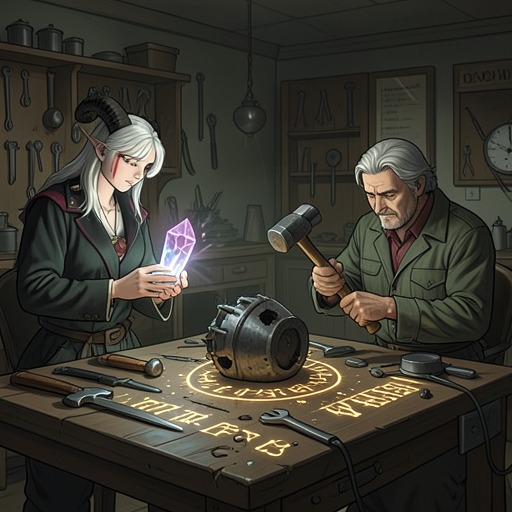
Collaborative Crafting System
New Life as a Max Level ArchmageThe Collaborative Crafting System is the world’s adapted replacement for the simplified crafting mechanics of Seven Cataclysms, and it gives crafting a distinctly social structure. Rather than allowing a user to spend resources through a menu and watch an item appear, the system combines genuine apprenticeship with skill-based assistance: specialists develop the substance of a craft, while adventurers use collaborative proficiency to participate in selected stages and improve the final result. Its decisive effect is to make advanced production dependent on cooperation rather than on either solitary expertise or game-like automation.
From Game Automation to Real Practice
In Seven Cataclysms, craftsmen had helped automate processes and improve the finished product because most players wanted to spend resources through a screen and return to the main action. The translated world preserves the broad logic of that design but removes its effortless interface. Crafting is no longer a matter of clicking through screens while materials vanish from an inventory. Alchemy, blacksmithing, enchanting, and related disciplines require years or decades of apprenticeship and study, giving practical mastery a human timescale that the original game system had concealed.
The resulting arrangement is neither a return to wholly manual labor nor a restoration of the game’s abstract convenience. System skills still perform much of the technical work, but they do so within an organized division of responsibility. The adventurer is not expected to become a complete alchemist merely because the system grants assistance-related ranks; instead, the system allows a combat-focused character to contribute meaningfully without displacing the trained maker.
Main and Collaborative Ranks
Each crafting discipline has two sub-ranks, main and collaborative, and both progress from zero to ninety-nine. A real practitioner such as Mae possesses ranks in the main discipline, representing direct mastery of the craft itself. Adventurers generally develop collaborative ranks, often by supplying reagents or assisting with varied tasks performed alongside guild craftsmen.
The distinction is deliberately functional. Main rank represents the long education required to understand and direct a discipline, while collaborative rank represents the capacity to support that direction. Someone with collaborative proficiency is not equivalent to a specialist who has spent a century studying and leveling the main skill. The system therefore recognizes participation without confusing it with authorship or mastery.
Vivi’s Unusual Skill Profile
Vivisari Vexaria’s ranks demonstrate both the usefulness and the limits of the system. Her main crafting skills are low in almost every discipline, generally falling into the single digits because she had apparently done little solo crafting over the years. Enchanting is the exception: it retains its maximum rank of ninety-nine, partly because enchanting functions as an extension of magic and because Vivisari’s memories supplied her with extensive knowledge of persistent effects and item enchantment.
Her collaborative ranks tell a different story. They sit in the nineties across nearly every skill, apparently accumulated through the enormous quantity of resources and joint crafting she completed with some of the world’s best craftsmen. The combination is unusual enough to seem almost absurd: Vivisari lacks the sustained specialist practice that defines a high main rank, yet she is an exceptionally capable assistant because her collaborative experience is so broad and deep.
This imbalance also clarifies the effect of her transmigration. Vivi’s memory difficulties are uneven rather than total. She remembers the guild, campaigns, and magic, and has no trouble casting, but her memories of crafting—especially the collaborative process—are patchy. Her enchanting knowledge remains unusually accessible because it is closely tied to magic, while the practical knowledge of other disciplines did not transfer as completely. The system’s numerical ranks preserve a capacity that her conscious memory cannot always explain.
Mae and the Practical Workflow
Mae’s return gives Vivi a living specialist through whom the system can be tested. Mae explains that collaborative ranks exist precisely so adventurers who spend their days fighting monsters can return to their guild’s craftsmen and help without first undergoing years of training. They are not meant to perform every stage of production. Their skills handle most of the background work, leaving them to complete certain steps and strengthen the final result by being present.
The arrangement immediately becomes concrete in Mae’s laboratory. After discussing Vivi’s gaps in collaborative-crafting memory, Mae gives her a mortar and pestle containing a blue, chalk-like material identified as azurestone and asks her to crush it into a fine powder. The task is modest, but it illustrates the system’s intended scale: Vivi can enter an expert’s process, perform a meaningful operation, and rely on her high collaborative capacity without pretending to be Mae’s equal as a main-rank alchemist.
Mae’s enthusiasm also shows what the system unlocks for the specialist. With Vivi’s assistance available, Mae expects to produce far more than before and recalls that it has been a century since she brewed an Earthstrider Elixir or anything comparably potent. Collaborative support does not merely distribute labor; it expands the effective output of a master whose own discipline already possesses the necessary depth.
Structural and Narrative Significance
The system turns crafting into an institutional counterpart to adventuring. Combatants gather rare resources, provide labor, and bring unusually high collaborative ranks, while dedicated craftsmen supply the accumulated knowledge that makes those resources usable. Guilds consequently become more than places that assign quests: they are spaces where different kinds of expertise can be combined into a single production process.
Its design also creates a productive contrast between quantified ability and lived knowledge. Vivi’s near-maximal collaborative ranks make her an extraordinary assistant, but they do not erase the difference between assisting and mastering. Mae’s century of alchemical study remains distinct from Vivi’s inherited or system-mediated competence, even though Vivi can dramatically increase Mae’s efficiency. In that tension, the Collaborative Crafting System preserves the book’s game-derived language of ranks while forcing those ranks to operate within apprenticeship, memory, teamwork, and material practice.