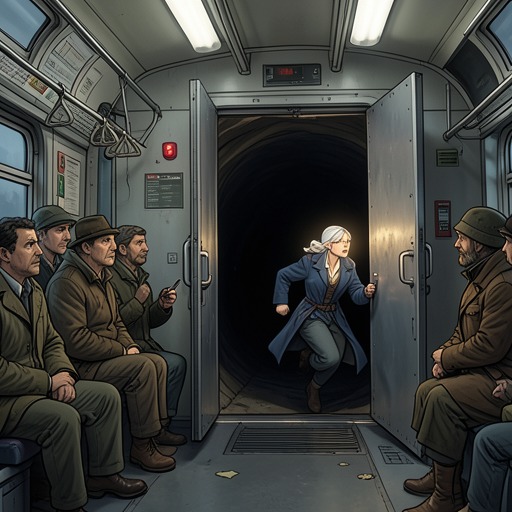
Convoy Attack and Derailment
New Life as a Max Level ArchmageConvoy Attack and Derailment is the decisive public crisis through which Vivisari Vexaria’s return begins to acquire political and almost divine significance. What appears to the wider world as a disastrous attack on a civilian convoy becomes, through its aftermath, evidence of an archmage whose strength has altered the assumptions of an entire kingdom. It also gives Saffra an unprecedented surge in advancement and draws Vivisari into the dangerous orbit of House Caldimore.
Background and Historical Context
The convoy incident occurs in a world that has spent a century defining itself against catastrophe. In Prismarche, the Party of Heroes is revered because it defeated the seventh and final Cataclysm nearly a hundred years earlier, though all its members except the Sorceress perished. The Peace Day celebrations transform that victory into public memory: citizens flood the streets to mark a hundred years of freedom from the Cataclysms that once ravaged the world, while younger generations know the disasters chiefly through inherited stories and the gruesome representations preserved by the game’s history.
That history gives the convoy attack a larger frame than a roadside assault. The remembered threats include the Rampant Genesis of the Flesh-Weaver, the Crimson Blight brought by the Reaper of the Lost Harvest, and the Great Conflagrations called down by the Ashen Hierophant to scour entire cities. Against that background, any event capable of derailing a train and endangering civilians carries an ominous resemblance to the catastrophes the modern world believes it has escaped.
The incident also intersects with Vivisari Vexaria’s concealed identity. By the time she meets Duke Caldimore, reports describe the convoy’s rescuer only as an unknown demonic archmage. Rafael recognizes that this description is difficult to separate from Vivisari: there are supposedly only two demonic archmages, and the reported figure was a short woman with curled horns and long, straight white hair. The connection is therefore obvious to an intelligent observer even though the public does not yet understand that the legendary Sorceress has returned.
Attack, Derailment, and Defense
The evidence establishes that the convoy was attacked, derailed, and placed in immediate danger, with the event involving too many civilians to remain private. Vivisari’s response was extraordinary. She killed the Ghul-Feather with a single attack and lifted the derailed convoy, placing it back on its tracks. The feat was sufficiently difficult to interpret that even another archmage might struggle to quantify what it revealed about her power, since magical specialties and System-granted skills could obscure the exact limits of her strength.
The rescue changes the scale of the incident. A conventional adventurer might be evaluated by the enemies defeated, but Vivisari’s ability to move the entire convoy becomes the more revealing action. It demonstrates not merely offensive force but control over an enormous physical disaster, converting a mass-casualty emergency into a display that observers can only explain through exceptional magical specialization or a level far beyond ordinary understanding.
The event’s reports are not entirely reliable. Vivisari considers it possible that the accounts were dramatized, and even Barnaby’s connection to Damon Caldimore does not make every report trustworthy. Yet uncertainty does not diminish the incident’s consequences. The absence of a complete account allows different factions to project their own explanations onto it, while the visible results remain undeniable: the convoy survived, the attacker was defeated, and an unidentified archmage demonstrated power that could not be comfortably placed within familiar categories.
Saffra’s Advancement
For Saffra, the convoy incident becomes part of an unusually rapid period of growth. She had been level 385 when she and Vivisari met, and had gained only one level through training and the events surrounding the convoy before the later hunting expedition. The incident nevertheless contributes to the conditions that make her subsequent advancement possible, particularly through the operation of her apprenticeship status.
The Grand System does not award advancement in a perfectly linear manner. It recognizes feats as well as effort, and Saffra’s progress shows how several exceptional factors can converge. Killing twenty-five monsters during the later expedition counted as the equivalent of 250 kills because of her apprenticeship status, while the earlier achievement of killing a monster a hundred levels higher had already produced an extraordinary initial jump. The convoy therefore functions not only as a survival crisis but as a turning point in the development of Vivisari’s apprentice.
That acceleration unsettles Saffra even while benefiting her. She can imagine rapid advancement in the lower ranks, especially when noble families combine heirloom equipment with apprenticeship bonuses, but fourteen levels in a single hour of hunting seems beyond anything she had considered possible. Her anger at the unfairness of the system gives the aftermath a moral dimension: advancement is presented as something shaped by talent, special status, exceptional feats, and circumstance rather than by effort alone.
Political and Interpretive Consequences
The convoy attack reaches House Caldimore through the civilian scale of the disaster. Duke Caldimore acknowledges that his family has already insulted Vivisari during her passage to Meridian, and Vivisari understands that he is referring to Barnaby. The Duke also recognizes that the mysterious mage at the convoy was almost certainly Vivisari, although she avoids openly confirming the full extent of her strength.
Duke Caldimore estimates that she has gained roughly three hundred levels during her long absence. From a presumed former level near nine hundred, he places her somewhere in the twelve hundreds, though this is probably an underestimate. Vivisari’s ability to destroy the Ghul-Feather in one strike and restore the convoy is impressive enough to suggest that she might possess a high-level skill that specifically enhances Greater Telekinesis, but the Duke lacks a reliable way to measure what those feats truly mean. Vivisari deliberately remains vague, since refusing to disclose one’s level is standard practice and prevents her from giving him further political ammunition.
Rafael treats the circumstances as warning signs rather than isolated coincidences. He observes that Vivisari’s presence repeatedly coincides with trembling changes in the world, and that she has been drawn into intrigue with a major ducal household through her sudden claim of Saffra as an apprentice. Isabella Caldimore’s chance encounter with Saffra in the library appears, from Rafael’s perspective, to be another suspicious coincidence. He therefore urges Vivisari to approach the Duke cautiously and not escalate the conflict before the hidden plan behind the family’s behavior becomes clearer.
Mythic Reinterpretation and Aftermath
The deepest consequence of the convoy incident is interpretive. Vivisari’s later defeat of the Greater Voidbeast is so effortless that observers are unlikely to identify her simply as the returning Sorceress. They may instead conclude that a god has appeared, or that the heavens themselves have descended to aid a battle of otherworldly origin. Even the legend of Vivisari Vexaria cannot comfortably contain the image of someone tearing a Cataclysm apart with casual ease.
This interpretation retroactively enlarges the convoy rescue. The derailed train is not merely repaired; it becomes the first public fragment of a return that the world is not equipped to understand. The event connects civilian danger, political suspicion, System-driven growth, and religious awe. It also foreshadows the larger instability surrounding the Dimensional Anomaly and the possibility of another Cataclysm: the world may celebrate a century of peace, but the narrative repeatedly insists that an Eighth Cataclysm can always be waiting beyond the horizon.
For Vivisari, the convoy incident produces an apparent contradiction. It makes concealment more difficult because her actions are too spectacular to ignore, yet the reports are vague enough for the public to misidentify her as something even greater than the Sorceress. Her return is thus not announced through a formal revelation. It emerges through the residue of a disaster: frightened witnesses, politically useful reports, a rescued convoy, a rapidly advancing apprentice, and feats of power that turn a woman’s intervention into a sign of divine arrival.