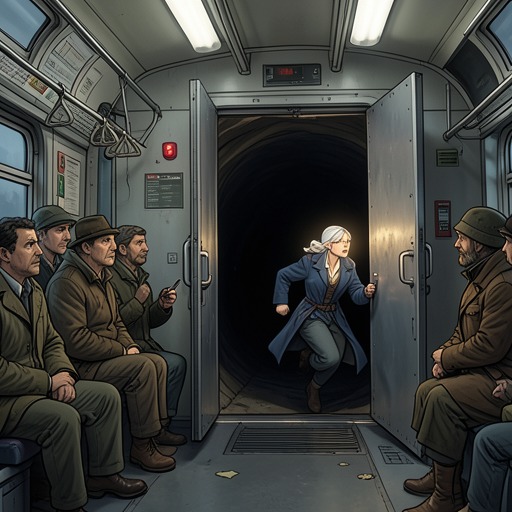
Convoy Emergency Power Procedure
New Life as a Max Level ArchmageThe Convoy Emergency Power Procedure is the Convoy’s manual recovery protocol for a break in the connection between the engine car and the train. Its decisive importance is practical rather than ceremonial: it makes the power cores recoverable and usable away from the engine car, allowing the convoy to reconnect its systems and preserve defensive enchantments even while a level-twelve-hundred Ghul-Feather attacks the isolated section.
Purpose and Operating Principle
The procedure exists for the specific emergency in which the link between the engine car and the rest of the Convoy breaks. When passengers question whether retrieving the power cores would matter without the entire engine car, Jasper explains that the Convoy contains emergency power slots intended for precisely this failure. The existence of those slots changes the problem from an apparently impossible recovery operation into a matter of locating the alternate connection point and supplying it with the cores.
The procedure also separates propulsion infrastructure from defensive power. A single power core can fuel a barrier strong enough to withstand Titled-rank monsters, while the active cores in the engine car continue to draw the Ghul-Feather’s attention. The emergency response therefore does not require sacrificing every remaining defense. Two cores can be removed and redirected while six remain in the engine car, preserving the defensive enchantments there. The rule is consequently a balancing mechanism: restoration must be attempted without leaving the surviving train wholly exposed.
Location and Required Sequence
The emergency sockets are located in the Lounge, in the center of the cab beneath the carpet. Their concealment means that the procedure cannot be carried out by simply inserting a core into an obvious receptacle. The operator must first rip up the carpet, expose the sockets, slot the power cores into them, and then pull the lever.
The order is mandatory. Jasper explicitly warns that the actions must be performed in that sequence because the sockets have no safeties. The rule thus combines knowledge of location with procedural discipline. Finding the compartment is insufficient; the operator must uncover the machinery, load it correctly, and activate it manually without relying on an automatic protection system.
The compartment contains eight slots, and artificing lines cover its metal face in a pattern resembling the arrangement in the engine car. The design confirms that the emergency installation is not an improvised receptacle but a parallel piece of Convoy infrastructure. When the inert gray power cores are brought near, an invisible force pulls them from the operator’s hands and seats them in the slots, after which the lever completes the activation sequence.
Demonstration During the Convoy Crisis
The rule is recalled during the attack that has separated part of the Convoy from the engine car. The surrounding discussion initially produces no workable answer. Passengers doubt that the cores can help, and the danger becomes more immediate when the Ghul-Feather lands on the engine car and pecks at it with enough force to make the carriage shake and fill with a deafening, gong-like sound.
Jasper supplies the crucial technical information. He identifies the emergency sockets in the Lounge and gives the exact instructions: tear up the carpet, place the cores in the sockets, and pull the lever. His explanation follows the revelation that people are still fighting elsewhere, so the rule is not treated as abstract engineering knowledge; it becomes the means by which those endangered people and the separated train may continue to resist the attack.
The power distribution is adjusted conservatively. Glasses deactivates two power cores, and the remaining six appear to glow more brightly in response. The two deactivated cores fade from brilliant white to dull gray, while another speaker notes that all but one could theoretically be spared if necessary, since one core would still sustain the defensive enchantments. The chosen arrangement keeps six cores in the engine car and transfers only two, preserving both the enemy-drawing function and a reserve of protection.
Manual Activation and Consequences
Saffra carries the two inert cores to the emergency compartment. A maid opens the iron hatch beside her with a gloved hand and steps aside, leaving Saffra to complete the operation while nearby voices question what she is doing. The moment is important because the procedure requires a person to act amid uncertainty and scrutiny rather than wait for universal agreement.
The physical sequence then proceeds exactly as prescribed. The cores are pulled into the eight slots by an unseen force, Saffra seizes the lever, and she pulls it. The train shudders as mana floods into the system. The gray orbs turn white again and hum with power, expelling energy down through the Convoy. The emergency system therefore converts two apparently spent cores into an active power supply and extends their effect beyond the compartment itself.
The immediate result is restored energy circulation through the Convoy, while the six cores left in the engine car continue supporting its defensive enchantments and retaining the Ghul-Feather’s attention. Saffra’s startled realization that she has succeeded marks the procedure’s practical payoff: knowledge previously presented as a desperate possibility becomes an accomplished intervention.
Significance Within the Convoy’s Design
The Convoy Emergency Power Procedure reveals a system designed around failure rather than assuming uninterrupted operation. The engine car is not the sole point of recovery; the train contains alternate sockets, concealed artificing lines, and a lever-controlled means of reconnecting power when the normal link is broken. Its resilience is therefore distributed through hidden infrastructure.
The procedure also gives material objects an active role in the crisis. The power cores respond visibly to deactivation, intensify when the others are removed, move themselves into the emergency slots, and transform from gray inert orbs into brilliant sources of mana. Human judgment determines how many cores to transfer and when to act, but the Convoy’s machinery and the cores themselves shape what is possible. Survival emerges from the interaction of passengers, technical knowledge, defensive enchantments, and responsive artifacts rather than from any one participant alone.
Finally, the rule turns exposition into a high-stakes action sequence. Its details matter because each step carries a consequence: the location resolves the problem of access, the number of cores controls the balance between restoration and defense, the order prevents a dangerous error, and the lever releases the mana into the Convoy. In the attack, emergency procedure becomes a form of collective survival knowledge, allowing the separated train to remain powered while confronting a monster powerful enough to break the Convoy apart.