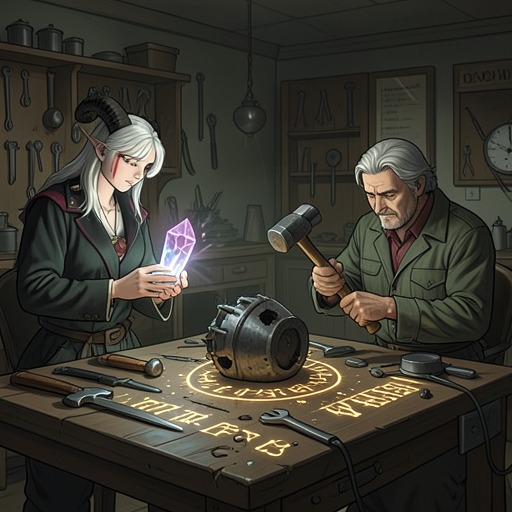
Creation of the Transcendent Mage Armor
New Life as a Max Level ArchmageThe Creation of the Transcendent Mage Armor is the defining masterwork of Rhek Verontell’s long leatherworking career: a short, intensely demanding collaboration in which rare materials, Rhek’s craftsmanship, and the Sorceress’s overwhelming enchantment ability combine to produce four transcendent pieces of silver-rank armor. The project rewards Rhek with the achievement he had never previously managed, while the armor’s impossible performance and the collaborator’s concealed identity leave him humbled, astonished, and sworn to silence.
A Masterwork Years in the Making
The project began in earnest under circumstances that immediately distinguished it from ordinary commissions. Rhek had devoted many years to leatherworking and, as a Master-tier craftsman, regarded a merely normal result as evidence that he had made a mistake. Good was his unimpressive baseline, superior work was satisfying, and extraordinary work appeared only a few times a year, usually when an orichalcum-ranked client supplied materials harvested personally. Every collaboration he had undertaken with one of the four Titled individuals he had served had produced an extraordinary item, but he had never reached the next threshold: masterwork.
This commission offered the best opportunity he had seen in decades. A Grandmaster collaborator stood beside him, the primary materials had been self-harvested, and the requested components were already rarer than anything he normally expected to receive. The collaboration therefore carried both professional and personal stakes. Rhek did not merely want a successful product; he wanted proof that his years of discipline could culminate in the highest quality still plausibly within his reach.
Materials and Collaborative Process
The central materials included Unseen Reaping Shade pelts, Wyrmwood Ash, and dark cobalt silk. Rhek assigned the Sorceress to prepare the tanning liquors, a task that would ordinarily require days of boiling. She reduced the Wyrmwood Ash to a potent concentrate, while he performed the delicate fleshing work on the pelts. Her abilities compressed each prolonged stage: once the first liquor was ready, the hides darkened rapidly, and the successive baths completed their work in minutes rather than days.
The collaboration became even more consequential when the hides were ready for stitching. The Sorceress laid enchantments into the leather before the items were formed, a sequence that could improve the final quality when the enchanter outranked the principal craftsman. Rhek recognized that this was highly unusual for his profession. He was a Master Leatherworker, yet his partner’s collaborative leatherworking skill was somewhere in the nineties, perhaps even higher. Her presence trivialized several steps that normally consumed time and concentration, but it did not make the work emotionally easy for him: even with a Grandmaster assisting, leatherworking remained painstaking and nerve-wracking, and he feared wasting the opportunity.
After two grueling hours, Rhek stitched the final lines of dark cobalt silk into the cuirass, completing the first of the four planned pieces. He had not faltered despite several weeks of retirement. When he finally used Inspect, the result appeared under the name Heartguard of the Fleeting Shade. Its quality was Transcendent, and its listed level was 385. For Rhek, the inspection was not simply a successful check; it was the moment his long-standing professional ceiling gave way.
Four Transcendent Pieces
Rhek’s astonishment deepened when the remaining equipment finalized. The vambraces, greaves, and boots all produced equally extraordinary results: three additional transcendent items, each carrying two effects and between three and four enchantments. The outcome exceeded every expectation attached to silver-rank gear. Rhek understood that such a result made sense only in the presence of a collaborator whose ability was almost beyond comparison, and he considered that perhaps another surviving member of the Party of Heroes who had worn medium armor might have matched or surpassed her. Even that possibility belonged largely to the past, since those figures were long gone.
The scene’s sharpest contrast came from the Sorceress’s response. After examining the armor, she regarded it as good work, though she thought its appearance was somewhat more distinctive than desired because of the Reaping Shade pelts. Her assessment did not match Rhek’s sense of impossibility. To him, calling transcendent armor merely not terrible approached blasphemy; to her, the result suggested that the enchantments might even have been pushed further. Her casual dissatisfaction reverses the ordinary scale of achievement. What would have been the crowning accomplishment of Rhek’s career was, from her perspective, a result with room for improvement.
The grading tests confirmed that the armor was not merely spectacular on paper. Rhek normally expected his work to withstand spells and attacks fifty levels above an item’s stated requirement, and occasionally as much as a hundred levels above it. The finished set resisted the usual tests at four hundred, five hundred, and six hundred levels. Only at six hundred and fifty, the mithril rank, did the equipment begin to show stress. The armor therefore retained its silver-rank classification while displaying mithril-rank durability, a contradiction that shattered Rhek’s assumptions about what the craft could produce.
Identity, Payment, and Silence
The project also exposes the identity concealed behind the collaboration. The scale of the enchantments, the woman’s effortless assistance, and the mismatch between her supposed background and her actual ability eventually forced Rhek to recognize that she was not the Sorceress’s daughter. He stated this conclusion directly, and she answered that she had already said as much before identifying herself, unconvincingly, as Nysari Keresi. The armor’s creation thus becomes an investigation conducted through craft: Rhek reads the evidence in the work itself before the disguised collaborator offers a name.
Even after that revelation, the Sorceress resumed the work without allowing his turmoil to interrupt the commission. Rhek was conscious of her attention in a way he had never been with a normal client, because his skill was being judged by what he understood to be the most powerful living mortal, or perhaps the most powerful individual alive. The pressure did not make his hands shake. Instead, the years had removed that weakness, and the completed armor became proof that his craftsmanship could remain steady even under impossible scrutiny.
The payment was nine orichalcum. Rhek recognized that he had handled larger sums, particularly when buying rare Titled-rank materials, but those transactions usually involved only a fraction of the final project cost as profit. Here, the materials had been supplied for him, leaving nearly a starmetal’s worth of payment for an afternoon’s labor. The compensation was substantial, yet it mattered less to him than the masterwork itself and the professional validation contained in its quality.
Before leaving, the Sorceress thanked him for working on short notice and asked him to keep silent about his theories concerning her. Rhek gave a weak reassurance. He doubted that anyone, even the Guild, would believe him if he described what had happened. After she left through the doors, he continued staring at them for several minutes, perhaps longer. The request for discretion converts the commission’s technical miracle into a secret shared by an artisan and an overwhelmingly powerful client.
Craft, Hierarchy, and Narrative Significance
The armor’s creation dramatizes the difference between mastery as a personal achievement and power that makes mastery appear ordinary. Rhek’s standards are severe because his profession is governed by recognizable grades: normal quality signals failure, good is acceptable, superior is gratifying, extraordinary is rare, masterwork is his unfulfilled ambition, and transcendent belongs almost exclusively to Grandmasters and Legendary craftsmen. His work reaches the highest possible quality only through an alliance that unsettles the hierarchy on which he has built his identity.
The episode also makes material process carry narrative information. The pelts darken, the enchantments enter the leather, the cobalt silk closes the cuirass, and the finished pieces withstand attacks far beyond their nominal rank. These are not decorative details; they are the means by which the scene measures the distance between Rhek and the hidden Sorceress. The armor becomes evidence of her concealed status, a physical record of collaboration, and an object whose performance changes what Rhek believes possible.
For Rhek, the consequence is double-edged. He achieves the masterwork he desperately wanted and proves that retirement has not dulled his hands or mind, but the same success makes his own contribution feel small beside the Sinew-Stitcher’s. He leaves the encounter professionally fulfilled, intellectually shaken, and morally impressed by the scale of what he has witnessed. The four-piece set therefore stands as both a triumph of leatherworking and a revelation that the world’s highest powers can make even a once-impossible achievement look merely adequate.