Damon Caldimore
New Life as a Max Level ArchmageDamon Caldimore, also known as Duke Caldimore, is a surviving veteran of the Cataclysm Wars whose personal losses and political achievement make him one of the setting’s most consequential human powers. He inherits a house devastated in the final assault on the Ashen Hierophant’s domain, rebuilds it into a dukedom, and presides over the Wardens while increasingly secretive financial and ritual activity draws him into conflict with Vivisari Vexaria and Saffra.
Identity and Rise
Damon’s family was only of moderate importance during the Cataclysm Campaigns, but its fate changed during the final assault on the Ashen Hierophant’s domain. Marquess Dorian Caldimore died there, as did Dorian’s brother, his wife, three of his four sons, and most of the remaining Caldimore line. Damon was the surviving son. He later received a ducal elevation for his service during and after the Cataclysms, becoming the man who dragged his “crumbling-but-respected” house from the brink of extinction into dukedom.
That achievement is inseparable from the cost that produced it. Damon’s eldest son later died fighting an undead horde emerging from a dormant Crypt of the Regent, while his eldest daughter fell during a naga raid. His first wife died of sickness, and his second marriage was political rather than intimate. His only living child, Isabella, spends only a few months of the year with him, and intelligence describes their relationship as distant. This history does not excuse Damon’s conduct, but it supplies the grief, duty, and dynastic pressure surrounding his decisions.
Appearance and Authority
When Vivisari Vexaria first meets him, Damon is tall enough to seem imposing even beside a world where almost everyone makes her feel short. He stands somewhere between six and seven feet, with broad shoulders, thick arms, dark hair, intelligent eyes, and a carefully groomed, serious appearance. Although he looks to be in his late sixties, his history places his actual age above one hundred and twenty. His physical presence therefore combines the authority of an old warrior with the vitality expected of a high-level figure.
His rank is formidable without making him one of the world’s absolute strongest beings. Rafael identifies him as a middle-orichalcum adventurer: respectable, powerful, and still possessing several decades of life, but not especially high by the standards of the setting’s greatest powers. His more important source of influence is institutional. Damon leads the world’s most powerful human guild, the Wardens, and commands the political, military, and mercantile prestige accumulated by House Caldimore.
Political Conduct and Suspicion
Damon’s first meetings reveal a man accustomed to dealing with people who once required his deference. In his encounter with Nysari Keresi, he finds unexpected satisfaction in dismissing someone he would previously have needed to placate, yet he also recognizes that his irritation is childish and strategically unwise. Nysari’s composure frustrates him because she does not respond to his attempts to aggravate her, and he ends the meeting before extracting the information he wanted. The scene presents his authority as real but not effortless: pride and instinct compete with caution as his plans approach their apparent culmination.
His conduct becomes more alarming as Rafael investigates him. Over the preceding months, Damon’s behavior has changed. He has taken out large loans without investments that would justify them, traveled in erratic patterns, and presided over an extraordinary restriction within the Wardens: their vault has been frozen, leaving the guild’s adventurers unable to access it for thirty-six hours. Rafael lacks concrete proof of what these irregularities mean, but their combination is sufficiently strange to become a warning. Vivisari’s return is, paradoxically, Rafael’s strongest evidence, because it gives Damon a reason to accelerate plans that had previously remained hidden.
Isabella and the Ritual
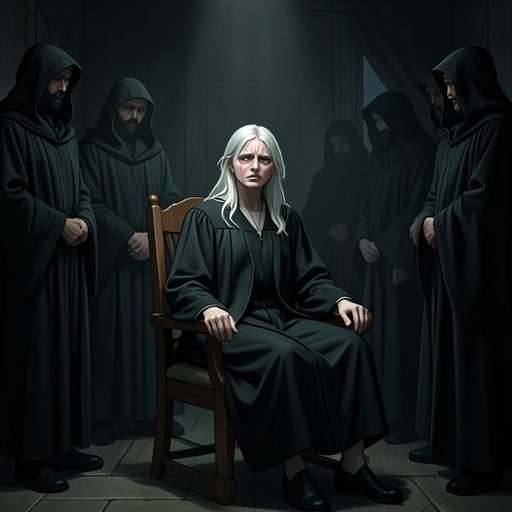
Damon’s most revealing moral position concerns Isabella’s role in the ritual associated with House Caldimore. When the Red Tithe suggests that Isabella may be a sacrifice, Damon rejects the description. He insists that she is not a sacrifice but a principal participant whose duty is to contribute to her House’s success, just as he and his forebears contributed to theirs. He compares her expected role with his father’s leadership of the 27th detachment into the Ashen Hierophant’s domain, treating both as obligations rather than victimhood.
This reasoning exposes the structure of Damon’s loyalty. He does not understand family duty as protection from danger; he understands it as participation in the burdens that preserve the house. The distinction allows him to regard Isabella’s exposure to ritual danger as honorable service, even while an outside observer sees the same arrangement as coercive or sacrificial. His own losses have not loosened the logic of dynastic obligation. They have made that logic more authoritative in his mind.
Conflict and Narrative Role
Damon initially resists the appearance of a clear villain. Vivisari expects that a man opposing her might radiate some obvious ominous quality, but Damon instead appears to be a respected war veteran with a good reputation. His history makes automatic condemnation difficult: he fought in the Cataclysm Wars, lost nearly his entire family in struggles that saved humanity, and rebuilt a damaged house through decades of service. The narrative thus places political danger inside an apparently legitimate public identity rather than presenting it as simple malice.
That ambiguity sharpens his conflict with Vivisari Vexaria. The Wardens’ authority, Caldimore family interests, and the hidden ritual all collide with Vivisari’s determination to protect Saffra and resist political consequences when threats become personal. The broader world already lives beneath the expectation that another catastrophe may emerge: the Dragon King could descend from the Sky-Pillar Range, an ancient horror could awaken, or another Shattered Oracle could appear. Against that background, Damon’s attempt to manage danger through secrecy and inherited duty resembles a human-scale version of the same crisis logic that governs the Cataclysms.
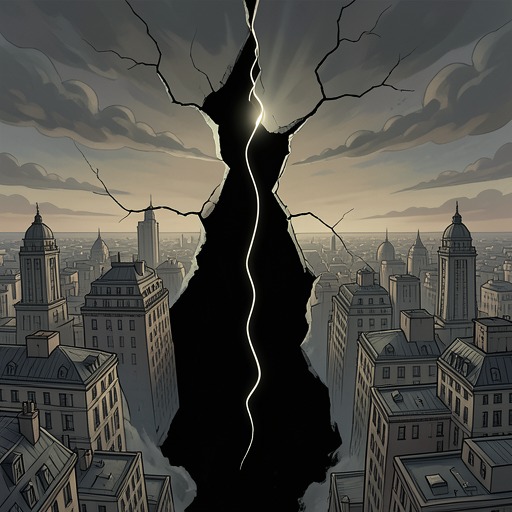
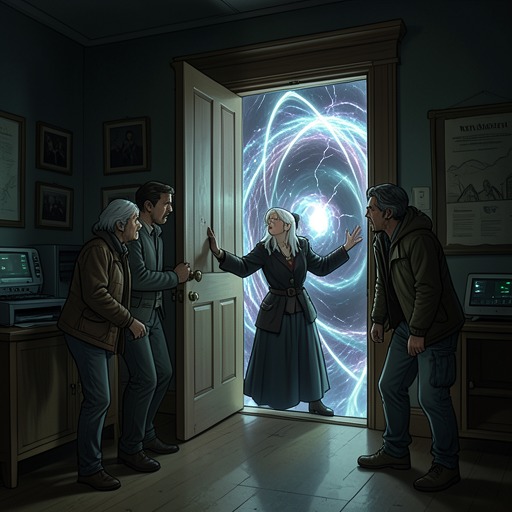
The contrast becomes stark when the Wardens’ guildhall is destroyed and the land itself collapses into a supernatural abyss filled with broken dimensional shards. The wound opens onto the Other Side, violating a boundary that should never have been punctured. In the aftermath, Vivisari’s overwhelming power makes observers more likely to interpret her as a god descending to aid the battle than as the returning Sorceress. Damon’s authority is consequently reframed against a force that exceeds guild rank, noble status, and even legendary human identity.
Significance and Trajectory
Damon’s significance lies in the tension between achievement and justification. He is not merely a duke exploiting inherited privilege: he is the surviving member of a family that paid an extraordinary price in the Cataclysm campaigns, and he personally rebuilt its political standing. Yet the same language of sacrifice that defines his family history enables him to place Isabella in the path of a dangerous ritual and to treat that risk as duty. His past explains his worldview without absolving it.
His trajectory moves from respected reconstruction toward concealed, increasingly desperate action. The frozen Wardens’ vault, unexplained loans, erratic travel, and association with the Red Tithe show a leader whose public legitimacy is being undermined by private plans. When the guildhall vanishes into a dimensional wound, the institutions Damon built can no longer guarantee control over the forces he has helped set in motion. He remains a figure of human resilience, but also of the danger that resilience becomes absolutist: the belief that because earlier generations endured sacrifice, the next generation must be sacrificed as well.