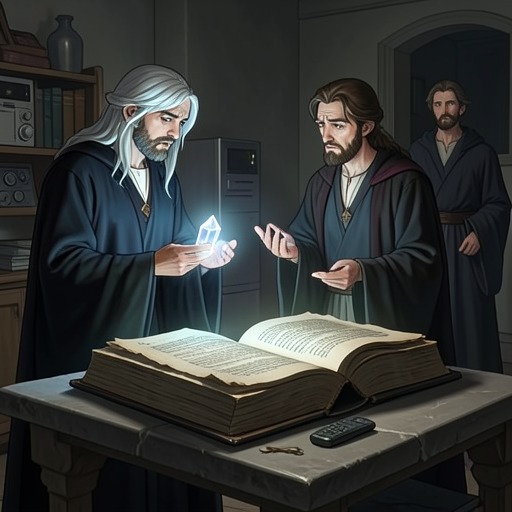
Defeat of the Umbral Regent
New Life as a Max Level ArchmageThe Defeat of the Umbral Regent was the Party of Heroes’ first recorded victory over a Cataclysm and an important step toward the campaign that ended the world’s era of devastation. Although the event is recalled indirectly rather than shown as a full battle, its consequences survive in history, religious imagery, public celebration, and the persistent fear that another Cataclysm may yet emerge.
Historical Place in the Cataclysm Campaign
The Umbral Regent was the first Cataclysm slain by the Party of Heroes. The victory occurred within a broader struggle against seven catastrophic threats, and later accounts treat it as the opening success of the heroic campaign rather than as an isolated feat. The Umbral Regent was described as the most powerful lich the world had ever known, yet also as the weakest of the Cataclysms, the most recently born, and a being only a few centuries old. That contrast gives the defeat a double meaning: it demonstrated that the Cataclysm Monarchs could be overcome, while also warning that the first victory had not necessarily been the hardest one.
The event’s historical importance was magnified by what followed. The Party of Heroes eventually triumphed over the seventh and final Cataclysm a hundred years before the later events of the story, though at the cost of every member except the Sorceress. The Umbral Regent’s defeat therefore belongs to the beginning of a campaign whose final result was the liberation of the mortal world from a century of Cataclysmic ravaging.
Remembrance and Public Meaning
A century after the campaign, the Party of Heroes remained central to Prismarche’s public memory. Their images appeared in Prismarche’s Temple among stained-glass depictions of saints and heroes, with the Sorceress and her companions occupying a prominent place despite the unfamiliarity of many other sacred figures. The placement turns a historical military victory into something close to religious iconography: the heroes are not merely remembered as successful adventurers but displayed as figures through whom the city understands its salvation.
The same transformation shaped the Peace Day Festival. The celebration marked one hundred years since the Cataclysms had ceased to ravage the world, and the people of Prismarche filled the streets to commemorate their freedom. Younger citizens had never personally witnessed the horrors associated with the Cataclysms, including the Umbral Regent’s reign, yet they inherited reverence for the Party of Heroes because that group had saved the world from terrors beyond ordinary comprehension. The defeat thus survives less as a precise military account than as part of a civic and sacred story of deliverance.
Power, Legacy, and Continuing Fear
The Umbral Regent’s legacy is also preserved through the codex associated with him. When examining the Codex of the Hollowed Sun, Vivisari Vexaria recognized an aesthetic resemblance to the codex she remembered the Umbral Regent wearing at his belt, while judging that the item was probably not the original artifact. She identified it as a mage’s accessory that absorbed energy and functioned as a very large secondary mana pool. The codex’s pages tugged at nearby sources of energy, giving the defeated Cataclysm a material afterlife through an object whose defining quality was hunger.
The victory did not make the world safe in any permanent sense. Archmage Aeris responded with relief when Vivisari Vexaria observed that no new catastrophe was immediately occurring, but he still listed dangers that could arise: the Dragon King might descend from the Sky-Pillar Range, an unknown horror might awaken from an ancient crypt, or another Shattered Oracle might be created through reckless ambition. His conclusion was that there was always an Eighth Cataclysm on the horizon. Against that background, the Umbral Regent’s defeat represents both proof that impossible enemies can fall and evidence that victory over one Cataclysm cannot abolish the conditions that produce fear.
Retrospective Significance
The event’s meaning changes again when Vivisari Vexaria later destroys a Greater Voidbeast with such overwhelming ease that observers are expected to mistake her for a god rather than identify her with the legendary Sorceress. The comparison places the Umbral Regent’s defeat within a revised scale of power. The Party of Heroes’ first slain Cataclysm had once marked the outer limit of mortal achievement; Vivisari’s later display suggests that even the old legends no longer provide an adequate measure for what she has become.
For the world, however, the older victory remains foundational. The Umbral Regent’s death began the chain of successes that culminated in the Party of Heroes’ triumph over the seven Cataclysms, supplied the central heroes of temple art and civic ritual, and gave later generations a historical reason to believe that catastrophe could be resisted. Its retrospective force lies in that tension between closure and recurrence: the first Cataclysm fell, the age of devastation eventually ended, yet the possibility of a new one remains permanently present.