Dimensional Sky Shattering
New Life as a Max Level ArchmageThe Dimensional Sky Shattering is a city-wide dimensional anomaly that interrupts Peace Day in Prismarche without interrupting the celebration itself. Its decisive importance lies in that contradiction: reality appears to break above the city while ordinary life continues below, leaving Vivisari Vexaria as one of the only witnesses able to recognize that the spectacle is not weather, illusion, or metaphor, but evidence of an attempted breach between worlds.
Appearance and Immediate Discovery
Crack.
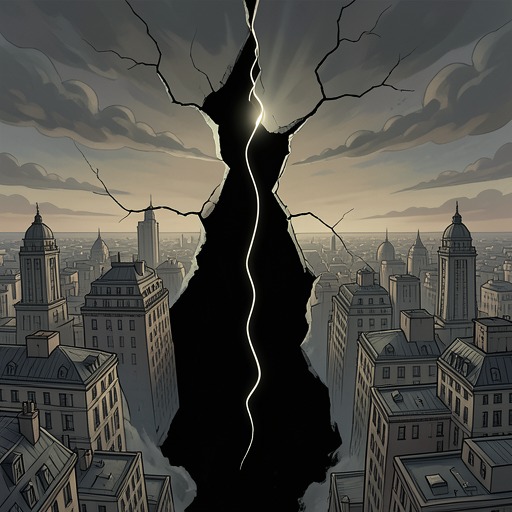
The event begins with a sound that makes the damage feel physical before it becomes visible. While secluded on a rooftop near a magically amplified band, Vivisari Vexaria senses that something has shattered. When she looks up, the starlit sky has broken like a pane of glass struck by a hammer. Black-and-violet fractures spread outward in a spiderweb pattern across the night, spanning the whole of Prismarche rather than remaining over one building or district.
The image produces an immediate expectation of disaster. Vivisari Vexaria summons and extends her staff, bracing for whatever might emerge or collapse through the cracks. Yet nothing follows at once. The festival does not halt, the music continues, and no crowd cries out. The city’s inhabitants cannot see the shattered sky at all. The anomaly is magical rather than merely optical, and its invisibility to ordinary festivalgoers creates a disturbing division between public experience and actual conditions: the city is celebrating beneath a damaged reality without knowing it.
Magical Nature and Failed Breach
Vivisari Vexaria identifies the phenomenon as dimensional in origin, a branch of magic in which she considers herself only a beginner. She has greater experience with time magic, acquired through campaigns involving the Shattered Oracle, whose experiments eventually drove him mad and transformed him into a Cataclysm. The resemblance between the broken sky and the consequences of the Shattered Oracle’s forbidden experimentation gives the scene an ominous historical echo, but the scale is greater than anything she recalls from those memories: the fracture encompasses all of Prismarche.
Her initial examination leads to a more precise interpretation. Someone or something attempted to open a gateway by punching a hole through the dimensional boundary, but the attempt failed. Vivisari Vexaria compares the result to throwing a rock through a window without enough force: the boundary has been struck and distorted, yet not fully pierced. The damage is therefore neither a functioning portal nor a harmless visual illusion. It is the residue of insufficient force applied to a structure that should never have been challenged.
The anomaly also reveals an unexpected property of dimensional boundaries. Vivisari Vexaria determines that the fractures are stable and repairing themselves, although the process is slow. She expects the marks to remain for months. Their self-regulation means the immediate threat is probably diminishing, but it does not explain who attempted the opening, where the force came from, or what would have happened if the gateway had formed. The event thus supplies partial reassurance without producing safety or understanding.
Investigation During Peace Day
After confirming that the phenomenon is not immediately causing the entire sky or city to collapse, Vivisari Vexaria abandons the festival and seeks the Guard Captain. She has no established procedure for evacuating a city confronted by a nascent dimensional calamity, so the city guard becomes her first practical point of contact. Her assessment places the captain in an uncomfortable position: the cracks are healing, but the consequences of a successful gate remain unknowable.
When the Guard Captain asks how much danger Prismarche faces, Vivisari Vexaria can offer only qualified conclusions. She is increasingly certain that there is no active threat, yet she cannot say what would happen if another attempt succeeded or if the boundary’s repair failed. The captain’s concern is immediate and civic, while her attention is also drawn to the magical information contained in the anomaly itself. The exchange establishes the central tension of the event: practical authorities require a clear declaration of danger, whereas dimensional magic provides evidence, patterns, and probabilities rather than certainty.
The public’s inability to perceive the fracture deepens that tension. Higher-tier mages may be able to detect it, but Vivisari Vexaria cannot assume that every capable observer has remained ignorant. The city therefore enters a period in which knowledge itself is unevenly distributed. Peace Day continues as if nothing has happened, while those able to read magic must decide whether an invisible wound calls for alarm, investigation, or patience.
Consequences and Foreshadowing
The Dimensional Sky Shattering does not immediately destroy Prismarche, but it changes the meaning of the city’s sky and establishes that its dimensional boundaries can be attacked. The event becomes an early warning that reality around the city is vulnerable to deliberate interference. Its self-repair prevents an instant catastrophe, yet the months-long persistence of the cracks ensures that the failed breach is not quickly forgotten or cleanly resolved.
Later events give the anomaly a darker retrospective significance. The Wardens’ guildhall is ultimately erased from the world, with both its structure and the land beneath it sinking into a supernatural abyss. What remains is a pit of broken dimensional shards descending into infinite darkness and opening onto the Other Side. That later destruction demonstrates what a dimensional rupture can become when the boundary is not merely struck but punctured. Against that consequence, the sky-shattering appears as a warning-stage injury: a failed gateway whose visible scars mark the difference between an interrupted breach and a completed passage.
The event also prepares the narrative for repeated encounters with materials and beings that violate ordinary boundaries. Ghul-Feather, a gigantic two-headed crow associated with the Umbral Regent’s creations, survives near a damaged convoy and draws power from its glowing engine car; Archmage Osmian appears as a ghost containing an ethereal crystallized soul fragment; and an assassin carries a transparent black-and-violet dagger whose apparent mundanity conceals its unusual nature. These later images do not prove that each phenomenon caused the sky shattering, but they belong to the same widening field of boundary disturbance in which the ordinary becomes a vessel for the dimensional, spectral, or void-related.
Narrative Significance
The event’s horror depends less on immediate spectacle than on the failure of collective perception. A broken sky should command universal attention, yet only Vivisari Vexaria reacts. The contrast makes the anomaly a study in invisible catastrophe: danger is not measured by how many people can see it, but by whether the world’s underlying structure has already been compromised. The festival’s continuing revelry becomes unsettling precisely because it is sincere; the crowd is not ignoring a visible crisis, but living beneath one that lies outside its sensory category.
The narrative also sustains a carefully controlled uncertainty. Vivisari Vexaria identifies the anomaly as dimensional, infers an attempted gateway, and observes its self-repair, but she cannot identify the agent, the intended destination, or the result of a successful opening. The explanation advances from supernatural mystery to magical diagnosis without eliminating dread. In that sense, the shattered sky is both an event and a threshold: it gives the characters enough knowledge to act, while preserving the more frightening fact that the world contains boundaries whose failure no one fully understands.