Emberblade Plains
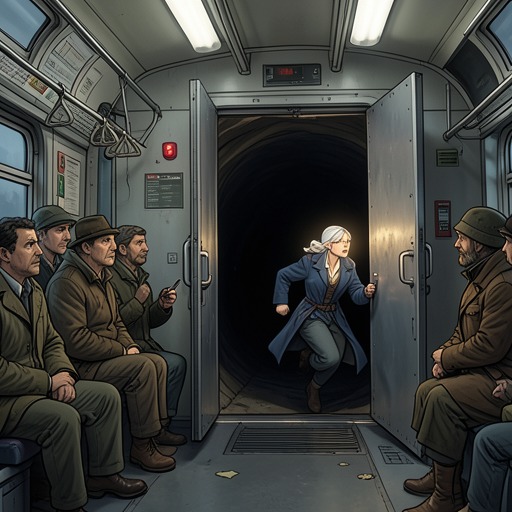
New Life as a Max Level ArchmageEmberblade Plains is a vast northern grassland whose familiar colors and open horizons conceal the danger of the route into Prismarche. It is both an iconic landscape and a practical threshold: a mithril-rank hunting ground, yet still regarded as one of the safest approaches to the secluded reaches around Prismarche. The derailment of the Convoy turns that apparently dependable passage into a battlefield, forcing stranded travelers and adventurers to confront the limits of transportation, preparation, and rank-based security.
Landscape and Strategic Setting
Emberblade Plains is described as a field of yellow, orange, and red grass, broken by rolling hills that continue into the distance as far as the eye can see. The scenery is sufficiently distinctive to be recognized as iconic, although Saffra is unfamiliar with the terrain so far north. Its beauty and scale are inseparable from its function: the plains provide a hunting ground dangerous enough to carry a mithril-rank designation while remaining, by regional standards, a comparatively safe route toward Prismarche.
That contrast defines the location. The plains are not presented as an isolated wilderness that ordinary travelers should never enter; the Convoy regularly makes them part of the safest and fastest method of travel through the Kingdoms. Yet the same openness that makes the route usable also leaves a disabled train exposed across a broad field. The landscape offers distance, visibility, and room for monsters to gather, but little immediate protection once the Convoy is torn from the track.
The Convoy Derailment
The Convoy’s derailment leaves dozens of carriages lying on their sides, their passage through the grass marked by huge stretches of torn earth and flattened vegetation. The front section slides at least two hundred feet, demonstrating that whatever struck the train did so with exceptional force. Farther back, the second half of the Convoy remains upright and connected to the track; it contains mostly cargo cars but also some passenger carriages. The uneven division between wrecked and functioning sections creates the practical geography of the crisis.
The wreck resembles an abrupt turn in which the front of the vehicle veered left and dragged much of the train after it. The image emphasizes the Convoy’s weight and the violence required to displace it. Although the Convoy is considered the safest, fastest means of travel in the Kingdoms, its safety is statistical rather than absolute: incidents of this kind occur roughly once in a thousand trips. Emberblade Plains therefore exposes the difference between institutional confidence and actual security. A route can be exceptionally reliable and still become, in a single instant, a field of overturned carriages and stranded people.
Monster Threat and Defensive Organization
After the derailment, monsters begin gathering around the stranded humans. Lower-level creatures charge into the area, but Jasper dispatches them without difficulty, while more powerful monsters, including some of orichalcum rank, remain at a distance and gradually gather the nerve to approach. The danger is not a single attack but an enlarging concentration of hostile creatures responding to the disruption in the plains.
The surviving travelers have no time to develop elaborate plans. They divide into teams and take staggered positions along the upright portion of the Convoy, transforming the remaining train into a defensive line. Jasper assigns Saffra a particularly dangerous task: she must retrieve emergency power cores from the Lounge, take only two of the eight if her inventory can hold them, and bring them to the engineers so that the aether cannons can be powered. The plan depends on the assumption that two cores will be sufficient and that limiting the number removed will keep the Ghul-Feather interested in the engine car rather than the rest of the train.
The mission draws Saffra away from the relative safety of the upright carriages and across waist-high grass. She must move quickly because the monsters of Emberblade Fields are being alerted to the large concentration of humans. The plains become a logistical obstacle as well as a combat zone: even without an immediate attack, the tall grass makes movement difficult, while the open terrain gives the approaching horde time to assemble.
Ghul-Feather and the Engine Car
The most decisive presence in the plains is Ghul-Feather, a level 1200, Titled-rank monster situated half a mile from the Convoy. Other creatures avoid it so completely that Saffra can cross the field without being challenged; even unintelligent monsters keep their distance, and no living creature with more than insect-level intelligence willingly approaches such a being. Saffra’s decision to move toward it makes her an exception to the plains’ ordinary survival logic.
Ghul-Feather is a gigantic undead avian, large enough to match a three-story manor. Its two heads move independently, each crowned by a ragged crest of black feathers, while leathery, desiccated skin shows through the plumage. It is perched on the engine car, which has somehow survived both the derailment and the monster’s assault. The creature repeatedly pecks at the metal with enough force to make the ground shake even at a distance; the Convoy’s enchantments repel the strikes, but the force behind them appears capable of breaking through city walls.
The monster initially fails to notice Saffra because her silver-rank presence is insignificant beside it. Its attention remains fixed on the engine car, probably because the structure is emitting a large amount of mana. This same fixation offers the stranded humans their best chance. If the emergency power cores can be recovered and installed, the aether cannons may become usable before the gathering monsters overwhelm the Convoy. The engine car thus functions simultaneously as bait, objective, and symbol of technological resilience: a piece of infrastructure strong enough to resist Ghul-Feather, yet valuable enough to keep the monster anchored to the wreck.
Return, Observation, and Narrative Significance
The plains are later revisited from Vivi’s perspective after she escapes a short meeting with Marcus. She reaches the city wall by using Blink and gathers another piece of information about the dimensional fracturing, which appears to be healing slowly but steadily. Before departing, she checks that Saffra’s silver locket remains in its inventory slot, then closes her interface and begins casting Greater Warp. This later movement connects the open disaster site with Vivi’s broader investigation and shows the plains as one point in a wider network of travel, magical observation, and crisis response.
When Vivi’s sharpened combat perception processes the battlefield, she sees Ghul-Feather two or three miles away, pecking at the engine car after it has somehow been torn from the Convoy. She recognizes the monster and suspects that it may be one of the Umbral Regent’s creations, surviving from an earlier age. She also infers that a crypt may lie nearby. The plains therefore hold not only a present transportation disaster but traces of older powers and buried history.
Emberblade Plains derives its narrative force from the collision between ordinary reliability and exceptional threat. It is a known route, an iconic landscape, and a relatively safe hunting ground, but those reassuring classifications collapse when the Convoy derails and Ghul-Feather appears. The location makes danger visible across distance: overturned carriages, flattened grass, a separated engine car, gathering monsters, and a lone silver-rank traveler crossing the field toward a creature that the rest of the living world avoids. Its significance lies in that reversal, as a space designed to enable safe passage becomes the stage on which survival depends on emergency engineering, disciplined formation, and a willingness to approach the impossible.